Page: 1
/ 14
Total 110 questions
API Source Inspector Electrical Equipment API-SIEE Exam Questions
Question 1
According to API 541, for the bearing temperature rise test, motor bearing stable temperature is defined:
Answer : C
The correct answer isC. In API 541, during thebearing temperature rise test, a motor bearing is considered to have reachedstable temperaturewhen thetemperature rise does not increase by more than 1C over a period of one hour. This definition is important because the acceptance of the test depends on showing that the bearing temperature has effectively leveled off under the test conditions rather than still trending upward. If temperature continues to rise beyond that limit, the test has not yet reached thermal stability and the result cannot be treated as final.
This criterion is used in factory testing of large motors to confirm acceptable bearing thermal performance, lubrication condition, mechanical fit, and overall operating behavior at the test load and speed. In source inspection, the inspector verifies not only the final measured bearing temperatures, but also that thetest duration, stabilization criterion, instrumentation, and recorded resultscomply with the governing standard and approved procedures. A 30-minute interval is not the API 541 stability definition, and a 2C rise in one hour is too permissive. Therefore, the correct API 541 requirement isa rise of not more than 1C in one hour, which makesoption Cthe verified answer.
Question 2
Which of the following is a typical topic for the pre-inspection meeting prior to the start of fabrication?
Answer : B
Question 3
NEMA rated motor controllers require a minimum range of conductor sizes for a specific size controller. Which of the following conductor sizes is appropriate for a Size 2 controller?
Answer : D
The correct answer isD. For aNEMA Size 2 motor controller, the appropriate conductor range is10 AWG to 4 AWG for 60C rated cableand10 AWG to 6 AWG for 75C rated cable. This matches the common NEMA controller terminal wire range used for Size 2 starters and controllers in industrial motor control applications. In practical source inspection and shop verification, this matters because the inspector must confirm that the controller terminals are suitable for the intended field wiring and that the manufacturer's assembly, labels, and terminal data are consistent with the governing standard and purchase specification.
The API Guide for Source Inspection and Quality Surveillance of Electrical Equipment includesMotor Control Centersamong the major covered equipment categories for source inspection. The guide also makes clear that its focus is onsource inspection and quality surveillance activities, meaning verification of compliance with drawings, specifications, nameplates, and applicable referenced standards during manufacture and inspection. Since MCC buckets and NEMA motor controllers rely on proper terminal and conductor compatibility,option Dis the correct NEMA-aligned answer.
Question 4
A circuit breaker is defined as:
Answer : C
The correct answer isC. Acircuit breakeris a switching and protective device used tomake, carry, and interrupt currentin an electrical circuit. In normal service, it can be used to energize and de-energize a circuit, and under abnormal conditions it is designed to open automatically to interrupt fault or overload current. In source inspection and quality surveillance of switchgear and related electrical equipment, the inspector verifies that the circuit breaker type, ratings, interrupting capacity, trip features, mechanical condition, and test documentation conform to the approved specification and equipment data.
OptionAdescribes afuse, which is a one-time overcurrent device that opens when its element melts. OptionBis too vague and better describes surge-protective or voltage-limiting devices rather than a circuit breaker. OptionDrefers more closely to the construction of switchgear or motor control assemblies, not the breaker itself.
Although the formal standard definition of a circuit breaker includes its fault-interrupting function, the best available answer among the listed options isC, because it most closely identifies the breaker as the device used to switch a circuit on and off.
Question 5
Which enclosure type is defined in the guide as a construction where free exchange of air is prevented between the inside and outside of the motor?
Answer : B
Question 6
What is the purpose of an equipment risk assessment in the source inspection process?
Answer : B
The correct answer isB. In the API source inspection process, anequipment risk assessmentis used to determinehow much source inspection and surveillance effort is neededfor a particular item during themanufacture and fabrication phaseat the supplier or vendor facility. The assessment helps establish the inspection strategy by identifying the degree of surveillance, the need for hold or witness points, the frequency of shop visits, and whether increased oversight such as resident inspection may be justified. In other words, the risk assessment is a planning tool that aligns inspection effort with the potential impact of failure, nonconformance, schedule delay, or critical service requirements.
OptionAis too narrow because the assessment is not limited to failure of the vendor's quality system. OptionCrelates more to supplier qualification or procurement selection, not source inspection planning. OptionDis unrelated to the technical purpose of inspection risk assessment.
From an API perspective, the practical value of the equipment risk assessment is that it ensures inspection resources are applied where they are most needed so that critical equipment receives the proper level of surveillance and verification before release.
Question 7
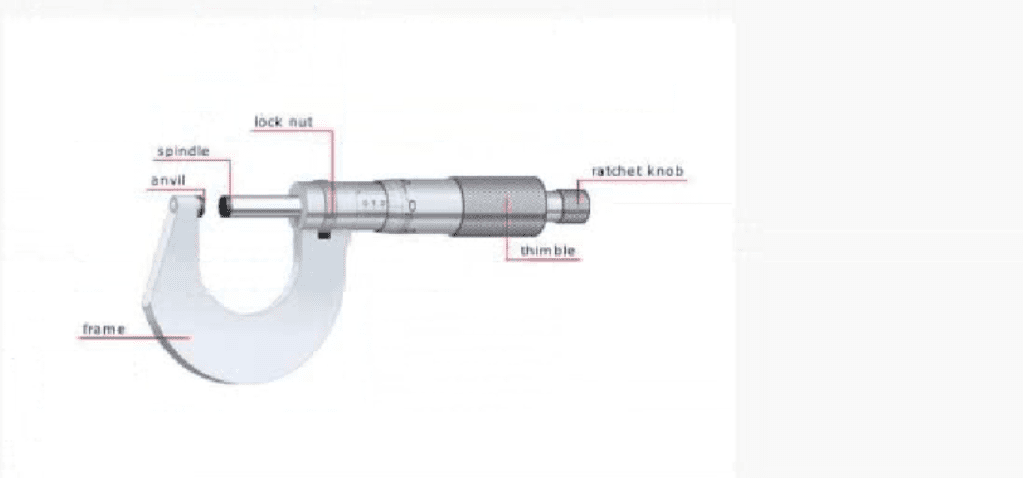
This device is a(n):
Answer : A
The correct answer isAbecause the illustrated device is anoutside micrometer. Its labeled parts clearly identify it:frame, anvil, spindle, lock nut, thimble, and ratchet knob. These are the standard components of a micrometer used for highly accurate dimensional measurement of outside diameters, thicknesses, and small gaps. In source inspection and quality surveillance, this type of instrument is commonly used when verifying critical dimensions of machined parts, shaft diameters, plate thicknesses, and other precision features that must comply with drawings and manufacturing tolerances.
The other options do not match the image. Adigital caliperhas sliding jaws and an electronic display. Avernier caliperalso uses sliding jaws with a vernier scale, not a rotating thimble and spindle arrangement. Anengineer's scaleis a straight rule used for scaled drawing measurements, not for precision mechanical inspection. In API-aligned source inspection practice, understanding inspection tools is essential because inspectors must use the correct measuring instrument for the required tolerance and ensure that the device is properly controlled and calibrated. Therefore, the pictured instrument is correctly identified as amicrometer, makingoption Athe verified answer.
 All Official Question Types