Page: 1
/ 14
Total 165 questions
ARDMS Abdomen Sonography Examination AB-Abdomen Exam Questions
Question 1
Which adjustment would most likely improve visualization of a small superficial tubular structure such as a peripheral artery?
Answer : C
Reducing slice (section) width improves spatial resolution, particularly elevational resolution, which enhances visualization of small, superficial structures. Lower slice width reduces off-axis beam artifacts and blurring. Wavelength depends on transducer frequency, not adjustable directly during scanning.
According to Zwiebel's Introduction to Vascular Ultrasound:
''Reduction in slice thickness improves imaging of small superficial structures by minimizing volume averaging and improving elevational resolution.''
Zwiebel WJ, Pellerito JS. Introduction to Vascular Ultrasound. 6th ed. Elsevier, 2019.
AIUM Practice Parameter for Vascular Ultrasound, 2021.
---
Question 2
Which condition is characterized by abnormal dilatation of veins of the pampiniform plexus and most commonly affects the left testicle?
Answer : B
A varicocele is an abnormal dilatation of the pampiniform plexus veins, usually seen on the left side due to the perpendicular insertion of the left testicular vein into the left renal vein, making it more susceptible to elevated venous pressure. Sonographically, varicoceles appear as multiple serpiginous anechoic tubular structures that show venous flow on color Doppler, often accentuated with Valsalva maneuver.
Hydrocele (A) is a fluid collection surrounding the testis.
Hematocele (C) is blood within the tunica vaginalis.
Spermatocele (D) is a cystic lesion arising from the epididymis.
Reference Extracts:
Dogra VS, Bhatt S. 'Sonographic evaluation of testicular varicoceles.' Journal of Ultrasound in Medicine. 2004;23(6): 829-838.
Rumack CM, Wilson SR, Charboneau JW, Levine D. Diagnostic Ultrasound. 5th ed. Elsevier, 2017.
---
Question 3
Which of the following is a possible early complication of a renal transplant?
Answer : B
Acute tubular necrosis (ATN) is the most common cause of early graft dysfunction following renal transplantation. It results from ischemia-reperfusion injury during the transplantation process. Ultrasound findings may be nonspecific but Doppler may show elevated resistive indices.
Ureterocele (A) is a congenital anomaly.
Transplant artery stenosis (C) is a late complication.
Transitional cell carcinoma (D) is rare and not typically an early complication.
Reference Extracts:
Middleton WD, Kurtz AB, Hertzberg BS. Ultrasound: The Requisites. 3rd ed. Elsevier, 2015.
Rumack CM, Wilson SR, Charboneau JW, Levine D. Diagnostic Ultrasound. 5th ed. Elsevier, 2017.
---
Question 4
Which finding is an indication for renal biopsy to assess for renal failure?
Answer : A
Significant proteinuria, especially if persistent or in the nephrotic range, may indicate glomerular disease and is a common indication for renal biopsy. Leukocytosis and hypercalcemia are not specific for renal biopsy. Hematuria may warrant biopsy if accompanied by proteinuria.
According to KDIGO Clinical Practice Guidelines:
''Persistent proteinuria is one of the strongest indications for renal biopsy to evaluate underlying glomerular pathology.''
Kidney Disease: Improving Global Outcomes (KDIGO) Clinical Practice Guideline for Glomerulonephritis, 2021.
American Society of Nephrology (ASN) Nephrology Board Review, 2021.
Question 5
Which diagnosis is most consistent with this image from a patient with acute scrotal pain?
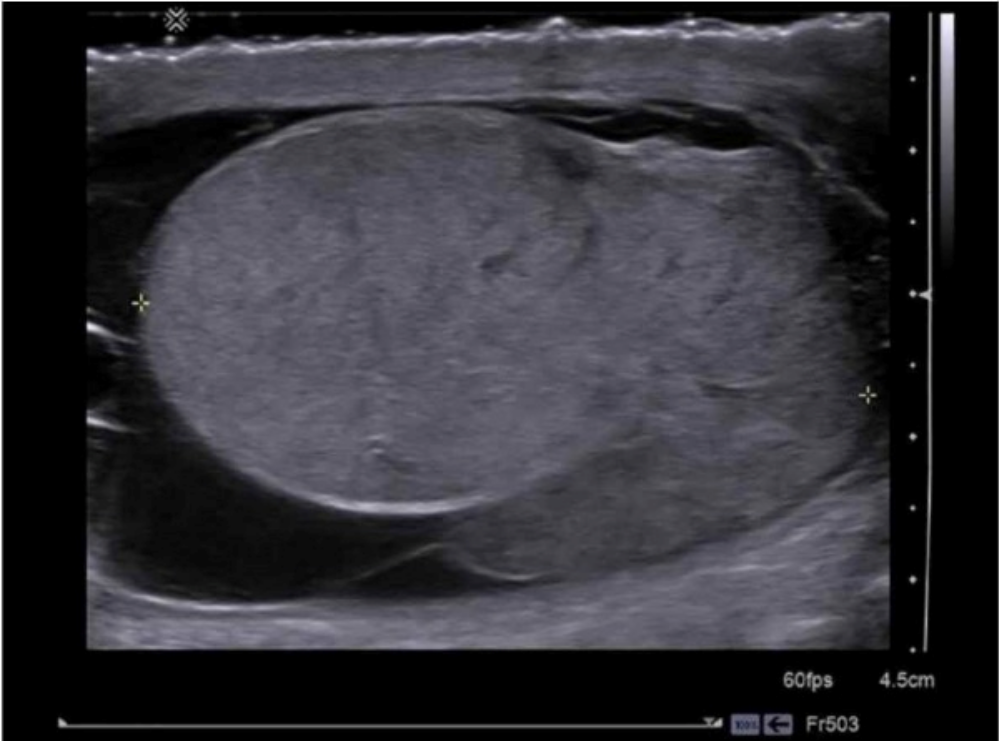
Answer : C
The grayscale ultrasound image demonstrates a uniformly enlarged, hypoechoic (dark), and heterogeneous testis without signs of surrounding scrotal wall thickening or a discrete fluid collection. This pattern is highly suggestive of testicular torsion in the setting of acute scrotal pain.
Sonographic features of testicular torsion on grayscale imaging:
Enlarged testis
Diffusely hypoechoic parenchyma
Loss of normal homogeneity
Absence of internal vascular flow on Doppler imaging (not shown here but critical in confirming diagnosis)
Testicular torsion occurs due to twisting of the spermatic cord, leading to vascular compromise and eventual infarction if not promptly corrected. It is a surgical emergency and typically presents in adolescent males with sudden-onset, severe unilateral testicular pain.
Comparison of answer choices:
A . Scrotal abscess appears as a complex fluid collection with irregular margins and posterior enhancement.
B . Testicular rupture would show discontinuity of the tunica albuginea, heterogeneous texture, and often a hematocele.
C . Testicular torsion --- Correct. The enlarged, hypoechoic, heterogeneous testis is characteristic, particularly in the acute phase.
D . Epididymitis typically shows an enlarged, hypervascular epididymis and may extend to the testis (epididymo-orchitis), but vascularity is usually increased rather than absent.
Dogra VS, Gottlieb RH, Oka M, Rubens DJ. Sonography of the scrotum. Radiology. 2003;227(1):18--36.
Rumack CM, Wilson SR, Charboneau JW, Levine D. Diagnostic Ultrasound, 5th ed. Elsevier; 2017.
AIUM Practice Parameter for the Performance of a Scrotal Ultrasound Examination (2021).
Question 6
Which action should a sonographer take if the abdominal aorta measures 5.5 centimeters in the anteroposterior diameter?
Answer : A
An abdominal aortic aneurysm (AAA) measuring 5.5 cm represents a significantly increased risk of rupture and often requires surgical evaluation. The sonographer must report this critical finding immediately to the interpreting physician. The sonographer should never disclose a diagnosis directly to the patient.
According to AIUM and SRU Guidelines:
''An aortic diameter of 5.5 cm or greater should be promptly reported to the interpreting physician due to the high risk of rupture.''
AIUM Practice Parameter for Abdominal Aortic Ultrasound, 2020.
Society of Radiologists in Ultrasound (SRU) Consensus Statement, 2003.
Question 7
Which condition is most likely to develop after splenic trauma?
Answer : B
Splenosis refers to autotransplantation of splenic tissue following splenic trauma or splenectomy. After rupture, splenic fragments may implant throughout the peritoneal cavity and vascularize, forming multiple nodules of functional splenic tissue. Splenosis is typically asymptomatic and discovered incidentally on imaging.
Splenule (A) is a congenital accessory spleen, not related to trauma.
Hamartoma (C) is a benign primary splenic lesion.
Target lesion (D) generally refers to sonographic appearance seen in metastases or infections, not post-trauma.
Reference Extracts:
Mortel KJ, et al. 'Multimodality imaging of splenic lesions and the spleen.' Radiographics. 2004;24(4):1137-1163.
Rumack CM, Wilson SR, Charboneau JW, Levine D. Diagnostic Ultrasound. 5th ed. Elsevier, 2017.
---
 All Official Question Types