Page: 1
/ 14
Total 56 questions
Atlassian Managing Jira Projects for Cloud ACP-620 Exam Questions
Question 1
You need to configure automatic issue assignment in a company-managed project.
Assignment depends on a value selected by users during issue creation.
Users should be able to select only one value.
Identify two elements that can be configured together to meet this need. (Choose two.)
Answer : A, D
Radio Buttons custom field: Ensures users select only one value during issue creation, which can then drive assignment logic.
Automation rule: Can be configured to automatically assign issues based on the selected value in the custom field, enabling dynamic and rule-based assignments.
Question 2
You are the project administrator of two Scrum projects, MOBI and TIS.
Team members find it difficult to switch between both projects to work on separate sprints.
They need the ability to work on issues from both projects in a single sprint.
Identify two ways that you can satisfy this requirement. (Choose two.)
Answer : C, E
Create a new Scrum board that includes both MOBI and TIS issues: This allows the teams to plan and manage sprints using a single board that pulls issues from both projects.
Change the TIS project board filter to include issues from MOBI project: Modifying the board filter to include issues from both projects enables the board to support a shared sprint across MOBI and TIS.
Question 3
A shared dashboard contains the Issue Statistics gadget.
Amanda complains that the gadget displays 23 issues when she views it while other team members report that they see 45 issues.
Select two reasons that explain why the numbers differ. (Choose two.)
Answer : B
Some of the issues are hidden by issue security levels: Amanda may not have permission to view issues restricted by security levels, causing her to see fewer results.
She does not meet the currentUser() criteria in the saved filter: If the saved filter uses currentUser() in its JQL and Amanda doesn't match its logic, the results shown to her will differ from those seen by others.
Question 4
Teams using Project A and B currently use their own respective Scrum boards.
They must now work together on the same products and issues and in the same sprints.
You created a new Scrum board based on this filter:
project in (A,B) ORDER BY Rank ASC
You must also check two settings to make sure the teams can access and use the new board.
Identify the two settings. (Choose two.)
Answer : E, F
Sharing on the board filter: The board filter must be shared with all users who need access to the board; otherwise, they won't be able to view or use it.
Project permissions: Users must have the necessary permissions (such as Browse Projects and Manage Sprints) on both Project A and Project B to view issues and manage sprints on the new shared board.
Question 5
An automation rule used to run successfully in your project but now it returns some errors. You inspect the rule as shown.
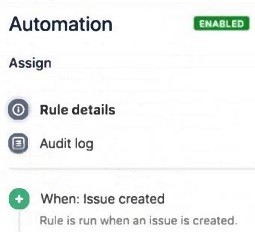
Identify a possible cause of the errors.
Answer : B
The rule is triggered when an issue is created, and likely includes an action to assign the issue. If the rule previously worked but now fails with errors, and the rule is still enabled, a common cause is that the user executing the rule (Atalie) lost the Assign Issues permission, preventing the assignment action from succeeding.
Question 6
A team-managed project has a custom role in addition to the built-in roles.
New user Quinn needs to perform the following actions in the project:
transition issues
add comments
remove watchers
add attachments
manage sprints
Which role will definitely grant him the permissions he needs?
Answer : C
In team-managed projects, only the Administrator role has full access to all permissions, including advanced actions like managing sprints and removing watchers. While the Member and Custom roles may cover some actions, only the Administrator role definitely grants all the listed capabilities.
Question 7
DEV is a company-managed Kanban project with many statuses.
Users should never see issues in Cancelled or Rejected status when viewing their project board.
You want to remove the issues from the board but still have them counted in project reports.
Identify the approach that satisfies this requirement.
Answer : B
Adding a board sub-filter to exclude the Cancelled and Rejected statuses removes those issues from the board view while still including them in project-level reports. This approach hides them from the board without deleting or modifying workflow data.
 All Official Question Types