Page: 1
/ 14
Total 120 questions
CIPS Innovation in Procurement and Supply L6M8 Exam Questions
Question 1
TGY Ltd is a manufacturing organisation which produces five major components for use in the transport sector. Each component is produced by a different Project Team. Below are details of the five projects.
Project 1: The team are looking at where the material originates and how much of this natural resource is left in the ground.
Project 2: The team are focused on what happens when the product is no longer required by the customer and whether the product can be repurposed to save it going to landfill.
Project 3: The team are keen to ensure the customer is happy with the product and that it meets safety standards. The focus of the Life Cycle Analysis is on what happens inside the factory.
Project 4: The team are looking at the longevity of the item once purchased by the customer.
Project 5: The team are exploring the additional overhead costs associated with the production of the item and the way in which the item is produced.
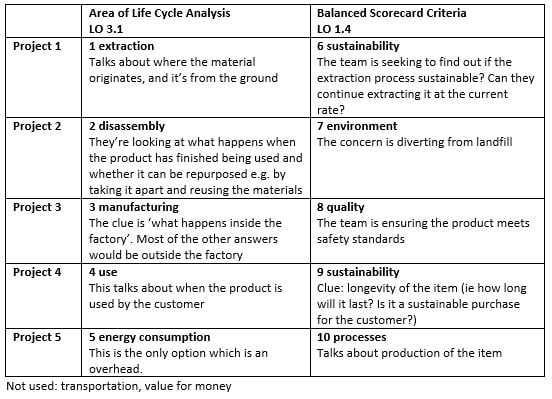
Complete the table below by listing the area of life cycle analysis being looked at, and the area of the Balanced Scorecard this relates to (some options may be used twice); energy consumption, use, disassembly, extraction, manufacturing, transportation, sustainability x2, quality, environment, value for money, processes.

Which of the following will you put into box 7?
Answer : C
The correct answers are as follows:
Question 2
ISO 20400 sets out principles of sustainable procurement. Which of the following are key principles outlined by the standard? Select all that apply
Answer : A, B, C
1 2 and 3 are principles of sustainable procurement mentioned in ISO 20400. Others include; accountability, transparency, ethical behaviour, full and fair opportunities, respect, focus on need, and integration. P. 216
Domain: 3.1
Question 3
Samir runs a small furniture manufacturing organisation and has recently decided to implement a Just-in-Time methodology. He has weighed up the pros and cons of this and has concluded it is the right thing for his business. Samir acknowledges that certain aspects of procurement will therefore need to change. Which of the following would Samir need to be aware of?
Answer : B
2 is the correct answer- in JIT you only order the supplies that you need, when you need them. Therefore ensuring the right quantities are ordered is fundamental. Options 3 and 4 are incorrect as JIT requires no storage of supplies and stuff is only delivered when you need it (therefore there are no fixed delivery dates). Option 1 is also incorrect as you can always change supplier when you have a JIT process. See p.139
Domain: 2.2
Question 4
In what situations would a procurement professional use an e-auction? Select all that apply
Answer : B, C
The correct answers are 2 and 3. The study guide states e-auctions 'might be used in situations such as renewing an existing contract, frequent tenders or where there is an opportunity to negotiate specific spot purchases' p. 52. You wouldn't use an auction to negotiate a price with a supplier- this would be a direct conversation between the two parties, nor would you use it to tender a research project. A research project would use a conformance spec so isn't suitable for an auction, which focuses on price. Similarly you wouldn't use an auction for Early Supplier Engagement.
Domain: 1.3
Question 5
Screws and Hammers Ltd is a wholesale retailer of small items used in the construction trade, and is popular with small and medium sized maintenance and construction businesses. Sarah, the head of Marketing, has decided that a good way to increase sales is to put a list of the stock they carry on their website, along with the price of each item. What is this known as? Select TWO
Answer : B, D
This is a sell-side catalogue which is a form of e-catalogue (as it's on the website). Buy-side catalogues are used by buying organisations and detail approved suppliers they can purchase stuff from. See p. 49
Domain: 1.3
Question 6
Pop Drink Ltd is a multi-national organisation which manufacturers beverages, selling these in over 40 different countries and creating an average annual revenue of over 50m. The new Strategic Business Development Manager is keen to engage in technology transfer between the 'developed countries' where much of the revenue is generated, and 'developing countries' where ingredients are farmed and extracted. Which of the following is a benefit to Pop Dink Ltd of doing this?
Answer : D
The correct answer is 4. Of those options listed, this is the only benefit to Pop Drink Ltd. Options 1 and 3 are benefits to technology transfer, but these benefits are received by the developing nation rather than the company. Option 2 may be a benefit of technology transfer, but isn't guaranteed- it depends on what tech is transferred and why. See p.38 for more information on technology transfer
Domain: 1.2
Question 7
Wesley is putting together a Business Case to implement 'green' procurement practices at his organisation. He is listing external drivers for sustainability- which of the following could he include within the list?
Answer : B, D, E
2, 4 and 5 are external drivers- the other two would be internal drivers. See p. 221 for more on putting together a business case.
Domain: 3.2
 All Official Question Types