Page: 1
/ 14
Total 476 questions
Cisco Understanding Cisco Cybersecurity Operations Fundamentals 200-201 CCNACBR Exam Questions
Question 1
What is a difference between tampered and untampered disk images?
Answer : D
The difference between tampered and untampered disk images is:
Tampered Images: These are disk images that have beenaltered or modifiedin some way after their initial creation. The stored hash and the computed hash willnot matchif the image has been tampered with.
Untampered Images: These are disk images that havenot been alteredsince their creation. They are consideredauthenticand reliable for forensic investigations. The stored hash and the computed hash willmatch, confirming that the image has remained unchanged.
Therefore, the correct answer is: D. Untampered images are used for forensic investigations.
Question 2
Refer to the exhibit.

Which type of attack is being executed?
Question 3
What are the two differences between vulnerability and exploit? (Choose two.)
Answer : A, C
Question 4
Which security monitoring data type is associated with application server logs?
Answer : A
Question 5
Which management concept best describes developing, operating, maintaining, upgrading, and disposing of all resources?
Answer : C
Question 6
Refer to the exhibit.
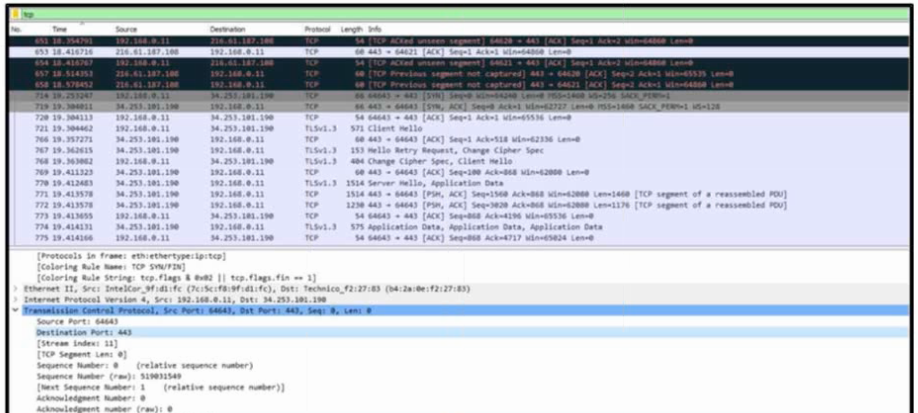
Refer to the exhibit. A communication issue exists between hosts 192.168.0.11 and 34.253.101.190. What is a description of the initial TCP connection?
Answer : D
Question 7
A security analyst notices a sudden surge of incoming traffic and detects unknown packets from unknown senders After further investigation, the analyst learns that customers claim that they cannot access company servers According to NIST SP800-61, in which phase of the incident response process is the analyst?
Answer : B
The analyst is in the detection and analysis phase of the incident response process according to NIST SP800-61. In this phase, events are detected and analyzed to determine whether they constitute incidents that require a response. It involves monitoring security events or data collection, correlation, and analysis of log entries and network flow data, among others. The goal is to identify incidents quickly so that appropriate actions can be taken.Reference:= NIST SP800-61, Computer Security Incident Handling Guide, Section 3.2: Detection and Analysis
 All Official Question Types