Page: 1
/ 14
Total 481 questions
Cisco Automating Networks Using Cisco Platforms 200-901 CCNAAUTO Exam Questions
Question 1
Refer to the exhibit.
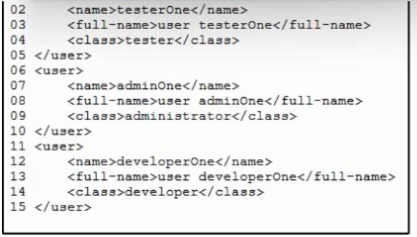
Refer to the exhibit. Which YANG model is used to generate the XML in the exhibit?
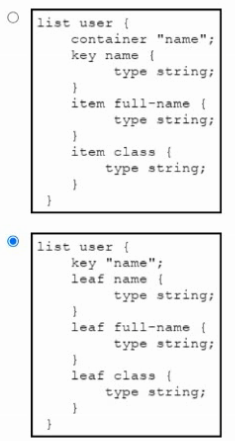
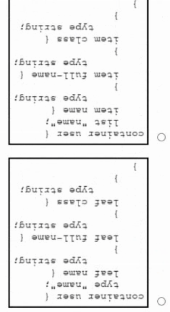
Answer : B
Question 2
Refer to the exhibit.
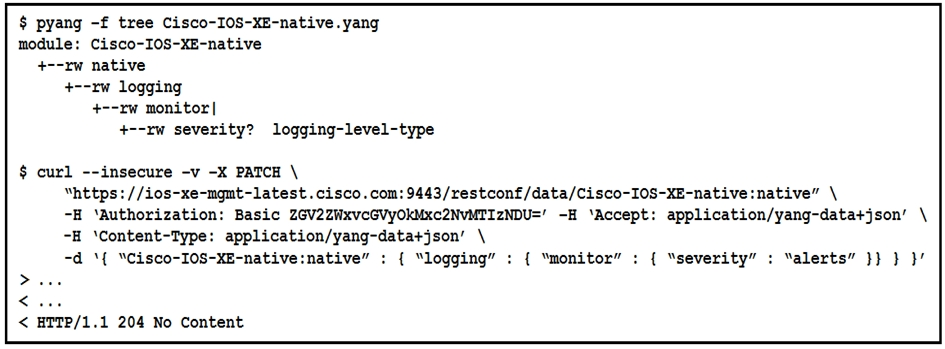
The definition of the YANG module and a RESTCONF query sent to a Cisco IOc XE device is shown. Which statement is correct if the RESTCONF interface responds with a 204 status code?
Answer : D
Question 3
Refer to the exhibit.
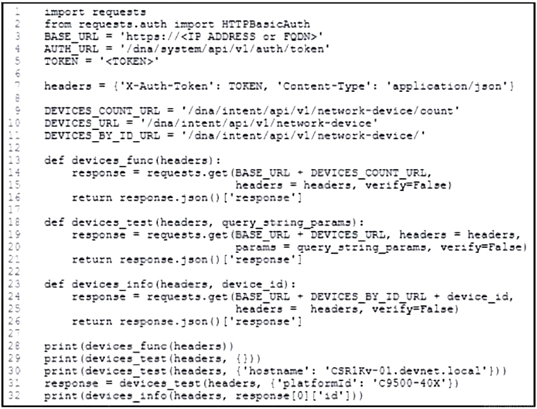
An engineer prepares a script to automate workflow by using Cisco DNA Center APIs to display:
total count of devices
list of the network devices
information of one device with a hostname filter
What is displayed in the final step after the Python script is executed?
Answer : B
The Python script shown in the exhibit is designed to interact with Cisco DNA Center APIs. Here's a step-by-step breakdown of what the script does:
It imports necessary libraries and sets the BASE_URL, AUTH_URL, and TOKEN for authentication.
It defines the headers to include the authentication token and content type.
It constructs URLs for fetching the device count, all devices, and devices by ID.
The devices_func function makes a GET request to fetch the total count of devices.
The devices_test function fetches a list of network devices based on query parameters.
The devices_info function retrieves detailed information about a specific device using its ID.
The script then prints the total count of devices, all devices, and filtered device information based on the hostname and platform ID.
In the final step, after executing the script, it fetches devices with the hostname 'CSR1Kv-01.devnet.local' and then filters the list by platform ID 'C9500-40X'. This results in displaying the filtered information about the device that matches both the hostname and platform ID criteria.
Cisco DevNet Associate Certification Guide
Cisco DNA Center API Documentation
Question 4
A company wants to accelerate the adoption of technologies that will simplify its operations. Staff have different skill levels and are looking for a single site to find easy-to-consume beginner, intermediate, and advanced multidomain use cases. Which site should be used?
Answer : B
The DevNet Automation Exchange is designed to provide users with easy-to-consume use cases for network automation across various skill levels. It includes resources for beginner, intermediate, and advanced users to help them accelerate the adoption of automation technologies.
DevNet Automation Exchange: This site provides curated content and solutions for network automation. It includes code samples, learning labs, and use cases that cater to different skill levels.
User-Friendly Resources: The platform is designed to help users find relevant information quickly and easily, regardless of their experience level.
Option B is the correct answer because it specifically addresses the need for a single site that offers a variety of resources for different skill levels in network automation.
Cisco DevNet Automation Exchange: Automation Exchange
Question 5
Refer to the exhibit.
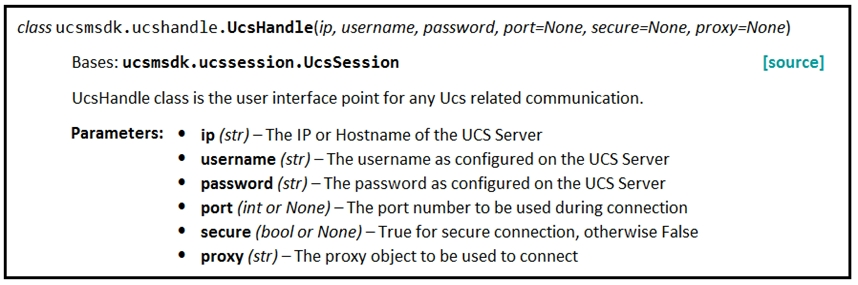
Given the API documentation for the UCS SDK python class, UcsHandle, which code snippet creates a handle instance?
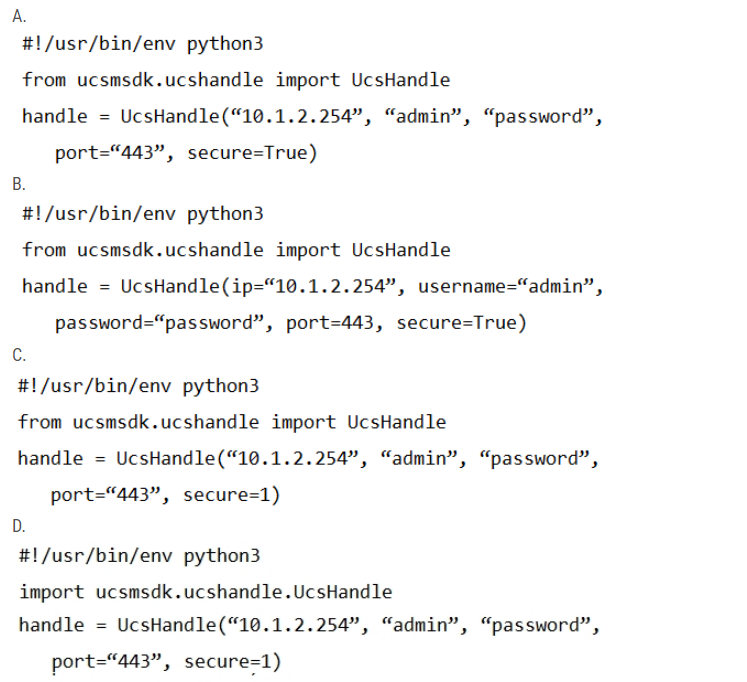
Answer : A
Option A correctly creates a handle instance using the UcsHandle class from the UCS SDK in Python. The correct instantiation requires providing the IP address, username, password, port number, and secure connection parameters as per the documented API.
The correct code snippet is:
from ucsmsdk.ucshandle import UcsHandle
handle = UcsHandle('10.1.2.254', 'admin', 'password', port='443', secure=True)
This snippet matches the API documentation requirements:
ip: The IP or hostname of the UCS Server.
username: The username as configured on the UCS Server.
password: The password as configured on the UCS Server.
port: The port number to be used during the connection.
secure: True for a secure connection.
UCS Python SDK Documentation (provides details on how to use UcsHandle)
Cisco DevNet Associate Exam Topics: Infrastructure and Automation (understanding how to use APIs and SDKs for automation)
========================
Question 6
Which advantage does the agile process offer compared to waterfall software development?
Answer : D
The agile process allows for incremental delivery of features, meaning new functionalities can be added or existing ones updated in small, manageable increments. This is in contrast to the waterfall model, where all phases are completed before the product is delivered. Agile enables continuous improvement and adaptation to changing requirements throughout the development process.
Question 7
Which platform is run directly using a hypervisor?
Answer : A
A platform that runs directly using a hypervisor is referred to as a virtual machine (VM). A hypervisor, also known as a virtual machine monitor (VMM), is software that creates and runs VMs. It allows multiple VMs to share the hardware resources of a physical host, providing isolation and resource management for each VM.
Cisco DevNet Associate Certification Guide: Chapter on Virtualization and Hypervisors.
Cisco Documentation on Virtualization and Hypervisor Technologies.
 All Official Question Types