Page: 1
/ 14
Total 640 questions
Cisco Implementing Cisco Enterprise Advanced Routing and Services 300-410 ENARSI Exam Questions
Question 1
Refer to the exhibit.
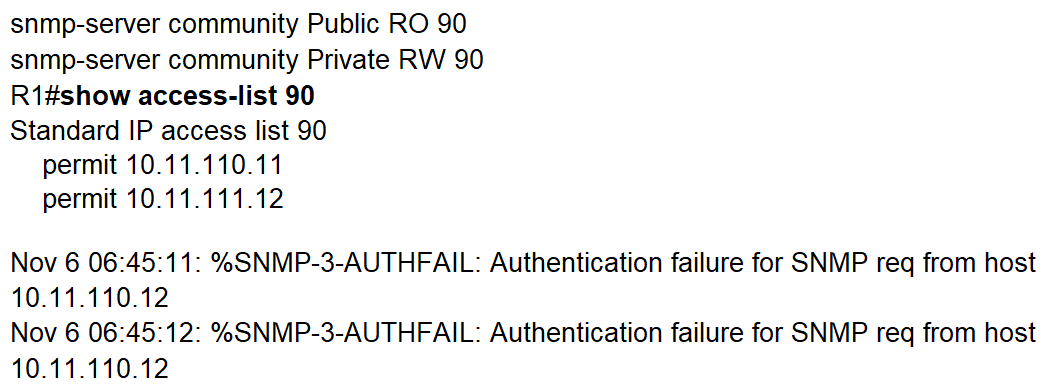
A network administrator notices these console messages from host 10.11.110.12 originating from interface E1/0. The administrator considers this an unauthorized attempt to access SNMP on R1. Which action prevents the attempts to reach R1 E1/0?
Answer : C
Question 2
Refer to the exhibit.
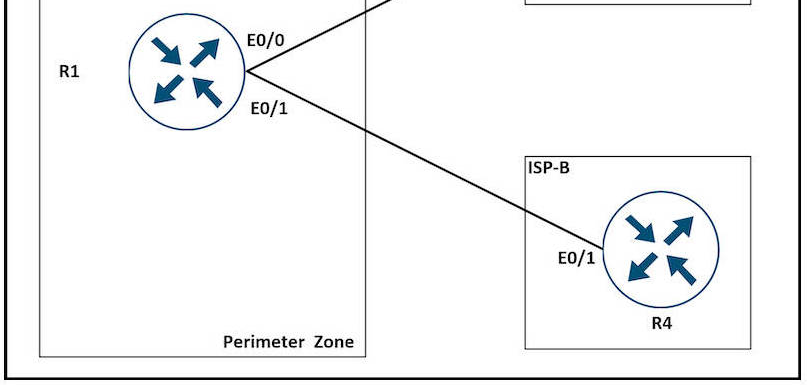
A network is under a cyberattack. A network engineer connected to R1 by SSH and enabled the terminal monitor via SSH session to find the source and destination of the attack. The session was flooded with messages, which made it impossible for the engineer to troubleshoot the issue. Which command resolves this issue on R1?
Answer : C
To turn off terminal monitor, use ''terminal no monitor'' in the enable mode
Question 3
A network engineer must configure a DMVPN network so that a spoke establishes a direct path to another spoke if the two must send traffic to each other. A spoke must send traffic directly to the hub if required Which configuration meets this requirement?
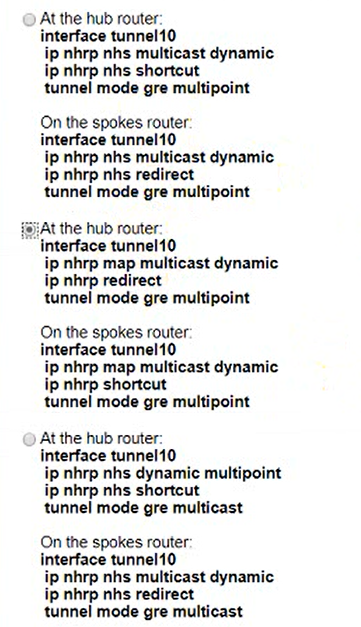
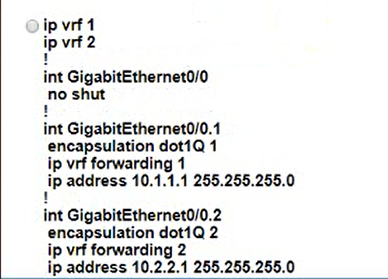
Answer : B
Question 4
Refer to the exhibit.
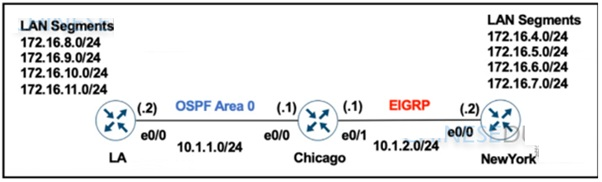
The network administrator configured the Chicago router to mutually redistribute the LA and NewYork routes with OSPF routes to be summarized as a single route in EIGRP using the longest summary mask:
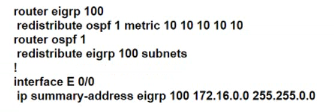
After the configuration, the New York router receives all the specific LA routes but the summary route. Which set of configurations resolves the issue on the Chicago router?
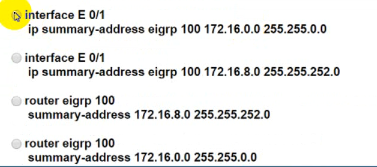
Answer : B
Question 5
In a DMVPN network, the Spoke1 user observed that the voice traffic is coming to Spoke2 users via the hub router. Which command is required on both spoke routers to communicate directly to one another?
Answer : B
Question 6
The network administrator configured CoPP so that all HTTP and HTTPS traffic from the administrator device located at 172.16 1.99 toward the router CPU is limited to 500 kbps. Any traffic that exceeds this limit must be dropped.
access-list 100 permit ip host 172.16.1.99 any
!
class-map CM-ADMIN
match access-group 100
!
policy-map PM-COPP
class CM-ADMIN
police 500000 conform-action transmit
!
interface E0/0
service-policy input PM-COPP
CoPP failed to capture the desired traffic and the CPU load is getting higher.
Which two configurations resolve the issue? (Choose two.)
Answer : A
Question 7
The network administrator configured R1 to authenticate Telnet connections based on Cisco ISE using TACACS+. ISE has been configured with an IP address of 192.168.1.5 and with a network device pointing toward R1(192.168.1.1) with a shared secret password of Cisco123.
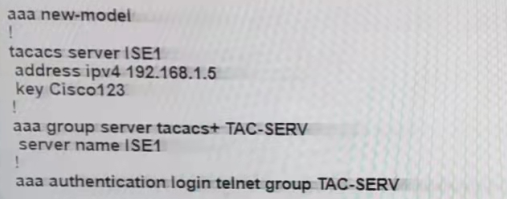
The administrator cannot authenticate to R1 based on ISE. Which configuration fixes the issue?
Answer : C
The last command ''aaa authentication login telnet group TAC-SERV'' created the method list name
telnet so we need to assign it to line vty.
Configure-ISE-2-0-IOS-TACACS-Authentic.html
 All Official Question Types