Page: 1
/ 14
Total 286 questions
Cisco Designing Cisco Enterprise Wireless Networks 300-425 ENWLSD Exam Questions
Question 1
Which statement about creating a mobility group is true, excluding mobility anchors?
Answer : A
Creating a mobility group requires that all Wireless LAN Controllers (WLCs) share the same mobility group name. This allows them to recognize each other as peers and participate in client mobility events. The WLCs must be defined as peers in each other's static mobility members list to facilitate inter-controller communication and roaming.
Question 2
Refer to the exhibit.
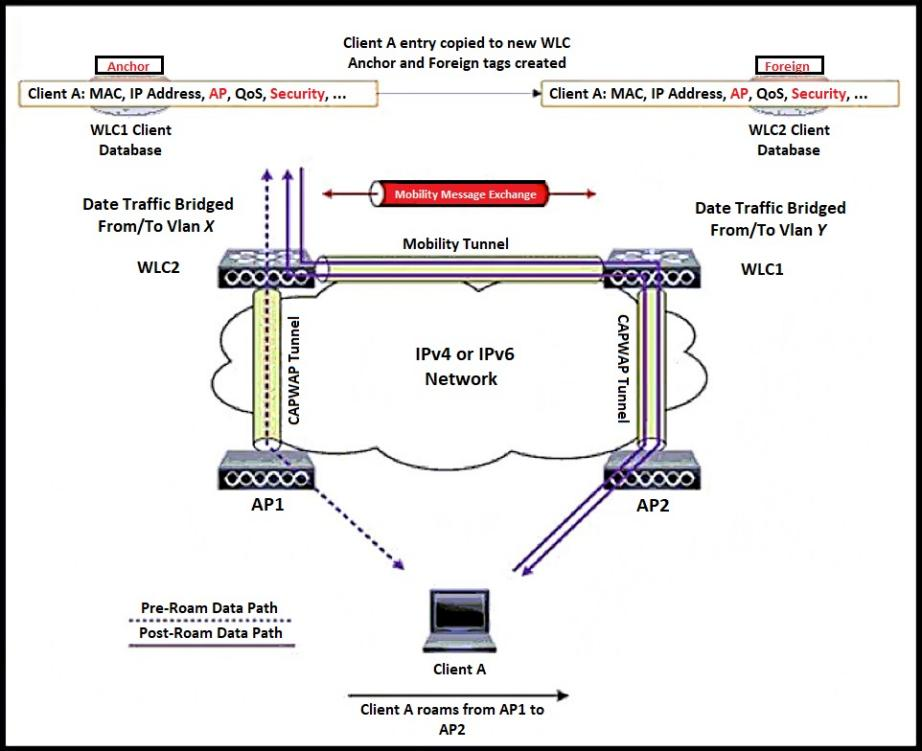
Client A is roaming from AP1 on WLC1 to AP2 on WLC2. The client roams between two APs registered to two different controllers. The WLAN on the two controllers is on a different subnet. Which scenario explains the client's roaming behavior?
Answer : B
When Client A roams from AP1 on WLC1 to AP2 on WLC2 across different subnets, this is considered a Layer 3 roam. Unlike Layer 2 roaming where the client's database entry moves with them, in Layer 3 roaming, the client's database entry is copied to the new controller (WLC2). This ensures continuity of service as Client A transitions between access points managed by different wireless LAN controllers.Reference:= (CCNP Enterprise Wireless Design ENWLSD 300-425 and Implementation ENWLSI 300-430 Official Cert Guide Premium Edition and Practice)
Question 3
Which solution benefits from signal attenuation and provides channel reuse for high-density WI-FI deployment in an amphitheater?
Answer : D
Question 4
A customer is migrating from a legacy Cisco AireOS WLC to a new Cisco 9800 10S XE WLC with Cisco 9100 APs The new APs must associate to the Catalyst 9800 WLC. and wireless clients must seamlessly roam between the old and new WLCs even during SSO The new Catalyst 9800 WLC deployment is configured to use SSO. Which command must be added to meet the requirements?
Answer : B
Question 5
When designing for voice over WLAN, what is the recommended cell overlap percentage between adjacent APs?
Answer : B
Question 6
An engineer must ensure that the wireless network can accomplish fast secure roaming by way of caching keys on the access points. Which key caching mechanism is enabled by default on a Cisco AireOS WLC?
Answer : B


Question 7
A hospital has a Cisco Catalyst 9800 Series Wireless Controller in a SSO solution deployed to the primary data center The hospital plans to increase redundancy in the wireless environment Management decides to deploy an extra Catalyst 9800 WLC offsite to another data center on a different subnet. A WAN link connects the data centers with a firewall at both ends. Which two design approaches must the engineer take to ensure that the APs can fail over? (Choose two)
Answer : A, D
 All Official Question Types