Page: 1
/ 14
Total 277 questions
Cisco Implementing Cisco Enterprise Wireless Networks 300-430 ENWLSI Exam Questions
Question 1
A customer is experiencing performance issues with its wireless network and asks a wireless engineer to provide information about all sources of interference and their impacts to the wireless network over the past few days. Where can the requested information be accessed?
Answer : A
Question 2
A wireless controller has a RADIUS server configured globally. Another RADIUS server is mapped for WLAN A in this controller. Which RADIUS server does the controller use for authenticating clients from WLAN A?
Answer : C
Question 3
What must be configured on the Global Configuration page of the WLC for an AP to use 802.1x to authenticate to the wired infrastructure?
Answer : B
On the Global Configuration page of a Wireless LAN Controller (WLC), for an Access Point (AP) to use IEEE 802.1X for authenticating to the wired infrastructure, it is necessary to configure a RADIUS shared secret. This secret will be used by the AP as part of its credentials when communicating with a RADIUS server during the authentication process.Reference: (CCNP Enterprise Wireless Design ENWLSD 300-425 and Implementation ENWLSI 300-430 Official Cert Guide)
Question 4
A network engineer recently deployed Cisco Catalyst Center (formerly DNA Center) to a customer site. The customer is being flooded with alarms for wireless clients that fail AAA authentication. What is the path to disable the alarm in the Cisco Catalyst Center user interface?
Answer : C
Question 5
Refer to the exhibit.
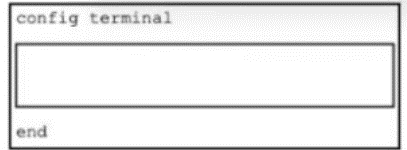
Refer to the exhibit A network engineer must deploy a configuration to a Cisco Catalyst 9800 WLC to prevent a FlexConnect AP from allowing wireless clients to connect when its Ethernet connection is down Which code snippet must be added to the box in the code to complete the configuration?
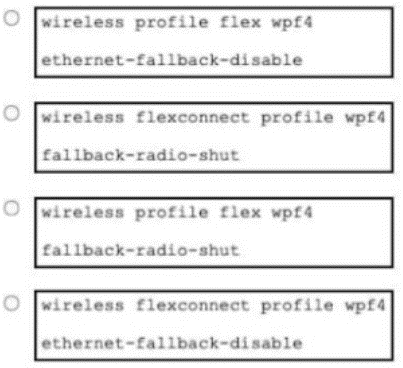
Answer : C
Question 6
A retail company wants to migrate from their existing CMX location services to Cisco Spaces infrastructure for detect and locate functionality. Ports 80 and 443 are opened to establish the connection between the wireless network and Cisco Spaces. However, the CMX is in a DMZ and is not publicly accessible. Which two actions must the administrator take to achieve location hierarchy in Cisco Spaces from CMX? (Choose two.)
Answer : A, E
Question 7
Which role does an engineer configure for administrative access to the wireless infrastructure, using Cisco ISE, to allow configuration of the WLC syslog configuration?
Answer : A
The MANAGEMENT role should be configured for administrative access to the wireless infrastructure using Cisco ISE. This role allows the configuration of WLC syslog settings, among other management tasks, ensuring proper logging and monitoring of the wireless network.Reference:= ( CCNP Enterprise Wireless Design ENWLSD 300-425 and Implementation ENWLSI 300-430 Official Cert Guide )
1of30
 All Official Question Types