Page: 1
/ 14
Total 38 questions
Cisco Designing and Implementing Secure Cloud Connectivity 300-440 ENCC Exam Questions
Question 1
Refer to the exhibits.
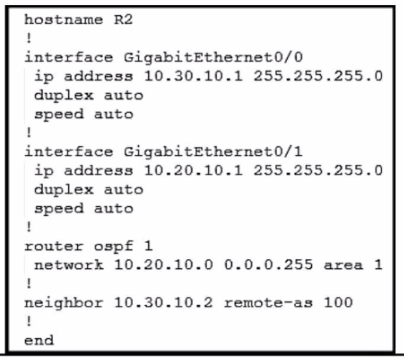
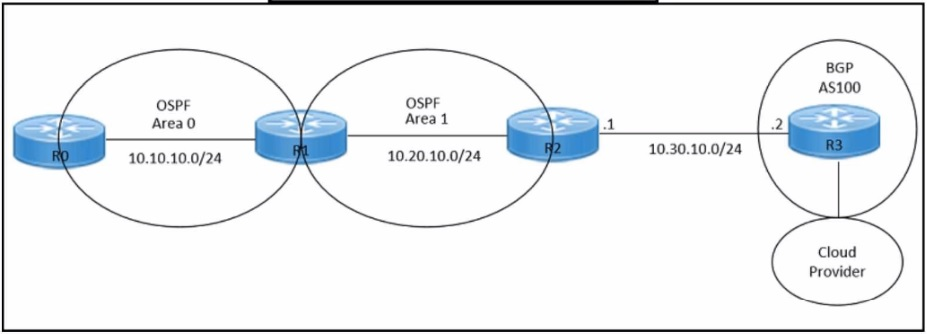
Refer to the exhibits. An engineer must redistribute OSPF internal routes into BGP to connect an on-premises network to a cloud provider. Which two commands should the engineer run on router R2? (Choose two.)
Answer : A, D
To redistribute OSPF internal routes into BGP for connecting an on-premises network to a cloud provider, the engineer should run the commands ''router bgp 100'' and ''redistribute ospf 1'' on router R2. The command ''router bgp 100'' is used to create a BGP routing process with AS number 100. The command ''redistribute ospf 1'' is used to redistribute OSPF routes from process ID 1 into BGP.Reference: = I need to access the specific content of Designing and Implementing Cloud Connectivity (ENCC) v1.0 from Cisco's official resources to provide exact references. However, I don't have direct access to external databases or resources, including the Cisco ENCC course materials. I recommend referring to the ENCC course materials for the most accurate and detailed information. Please note that this answer is based on general networking principles and may not reflect the specific content of the ENCC course. Always refer to the official course materials for the most accurate information.
Question 2
Refer to the exhibits.
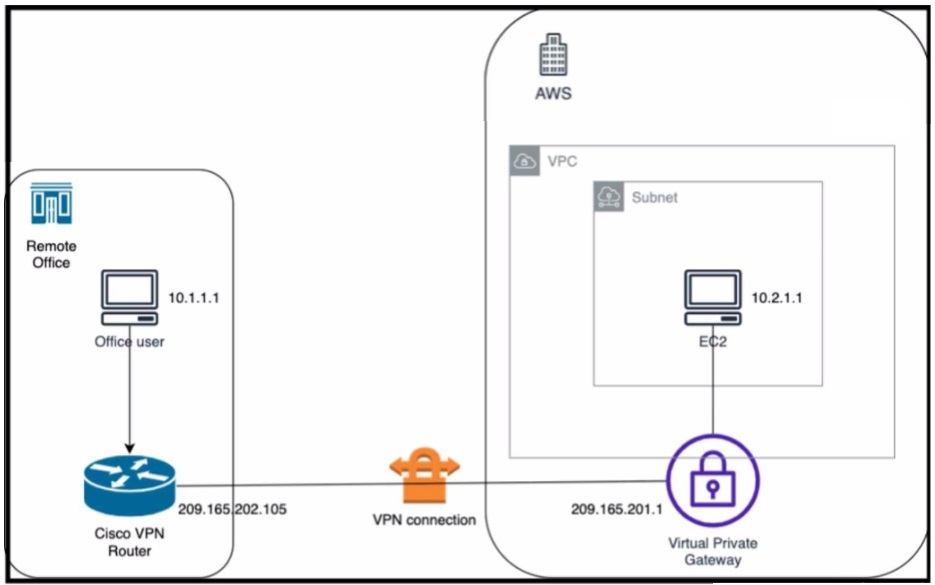
Refer to the exhibit. An engineer successfully brings up the site-to-site VPN tunnel between the remote office and the AWS virtual private gateway, and the site-to-site routing works correctly. However, the end-to-end ping between the office user PC and the AWS EC2 instance is not working. Which two actions diagnose the loss of connectivity? (Choose two.)
Answer : B, C
The end-to-end ping between the office user PC and the AWS EC2 instance is not working because either the security group rules for the host VPC are blocking the ICMP traffic or the IPsec SA counters are showing errors or drops. To diagnose the loss of connectivity, the engineer should check both the security group rules and the IPsec SA counters. The network security group rules on the host VNET are not relevant because they apply to Azure, not AWS. The IPsec SA configuration on the Cisco VPN router and the AWS private virtual gateway are not likely to be the cause of the problem because the site-to-site VPN tunnel is already up and the site-to-site routing works correctly.Reference:=
AWS Documentation, User Guide for AWS VPN, Section: Security Groups for Your VPC
Question 3
Refer to the exhibits.
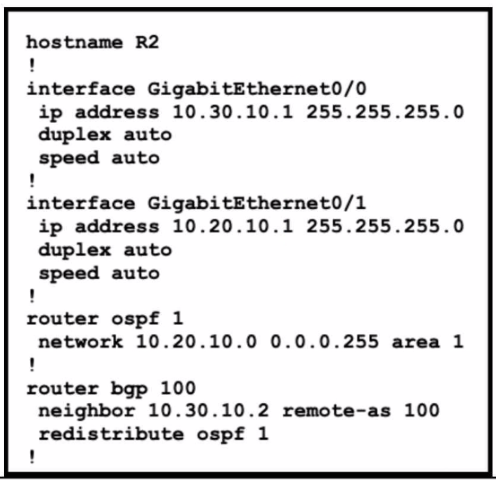
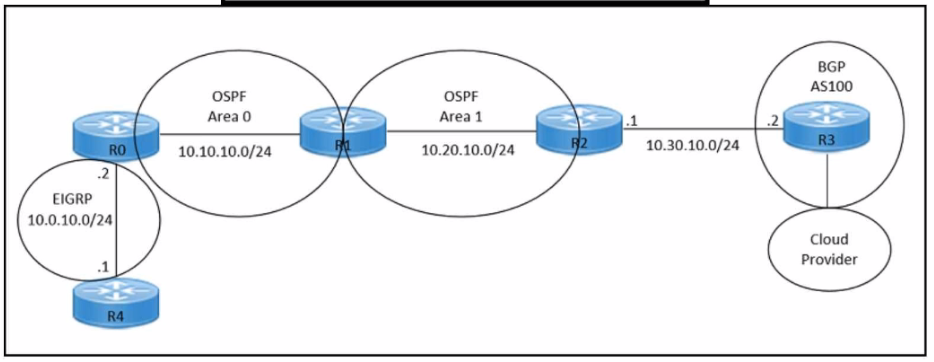
Refer to the exhibits. An engineer must redistribute only the 10.0.10.0/24 network into BGP to connect an on-premises network to a public cloud provider. These routes are currently redistributed:
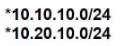
Which command is missing on router R2?
Answer : C
The commandredistribute ospf 1 match externalis missing on router R2. This command is needed to redistribute only the external OSPF routes into BGP. The external OSPF routes are those that are learned from another routing protocol or redistributed into OSPF. In this case, the 10.0.10.0/24 network is an external OSPF route, as it is redistributed from EIGRP into OSPF on router R1. The other commands are either already present or not relevant for this scenario.Reference:=
Question 4
An engineer is implementing a highly secure multitier application in AWS that includes S3. RDS, and some additional private links. What is critical to keep the traffic safe?
Answer : B
A highly secure multitier application in AWS that includes S3, RDS, and some additional private links requires specific routing and bucket policies to keep the traffic safe. The reasons are as follows:
Question 5
Refer to the exhibit.

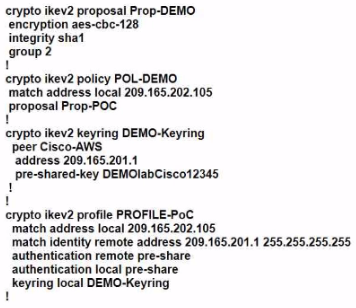
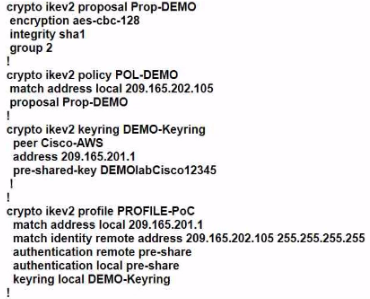
Which Cisco lKEv2 configuration brings up the IPsec tunnel between the remote office router and the AWS virtual private gateway?
A)
B)
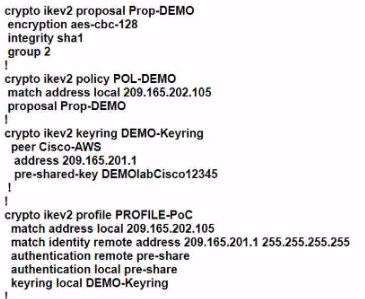
C)
Question 6
Refer to the exhibit.
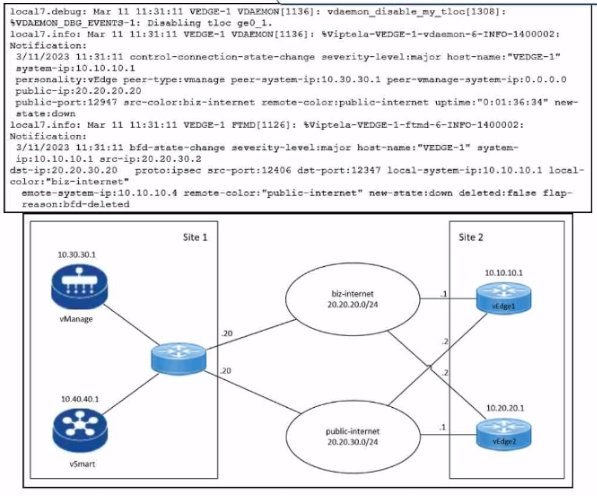
Refer to the exhibits. An engineer troubleshoots a Cisco SD-WAN connectivity issue between an on-premises data center WAN Edge and a public cloud provider WAN Edge. The engineer discovers that BFD is Dapping on vEdge1. What is the problem?
Answer : B
BFD (Bidirectional Forwarding Detection) is a protocol that detects failures in the overlay tunnel between Cisco SD-WAN devices. BFD packets are sent and received periodically by each device to check the liveliness and quality of the connection. If a device does not receive a BFD packet from its peer within a specified timeout interval, it considers the peer to be unreachable and reports a BFD down event. This event triggers a control connection state change and a possible route change in the SD-WAN fabric.
In this scenario, the engineer discovers that BFD is flapping on vEdge1, which means that the BFD session between vEdge1 and the remote Edge device is going up and down repeatedly. This indicates a connectivity issue between the two devices, such as network congestion, packet loss, or misconfiguration. The most likely cause of the problem is that the remote Edge device failed to respond BFD keepalives within the timeout interval, which resulted in a BFD timeout event on vEdge1. This event caused vEdge1 to mark the remote Edge device as down and notify the control plane. The control plane then tried to establish a new BFD session with the remote Edge device, which may have succeeded or failed depending on the network condition. This cycle of BFD session creation and deletion caused the BFD flapping on vEdge1.
Question 7
A company has multiple branch offices across different geographic locations and a centralized data center. The company plans to migrate Its critical business applications to the public cloud infrastructure that is hosted in Microsoft Azure. The company requires high availability, redundancy, and low latency for its business applications. Which connectivity model meets these requirements?
Answer : A
The connectivity model that meets the requirements of high availability, redundancy, and low latency for the company's business applications isExpressRoute with private peering using SDCI.
By using ExpressRoute with private peering and SDCI, the company can achieve the following benefits:
 All Official Question Types