Page: 1
/ 14
Total 221 questions
Cisco Troubleshooting Cisco Data Center Infrastructure 300-615 DCIT Exam Questions
Question 1
Refer to the exhibit.

A new Cisco Nexus 5548 Switch connects to a network. SAN switching is configured on the switch. The switch fc2/10 NP uplink is shown in the exhibit. Which action ensures that fc2/10 is in an up state?
Answer : C
Enable NPIV on the upstream switch that connects the port is the required SAN-side correction. In Cisco storage fabrics, symptoms such as isolated ports, missing targets, failed zone merges, vFC down state, or inaccessible LUNs are rarely solved by changing a random endpoint setting. The engineer must validate the FC control-plane dependency associated with NPIV, Cisco Nexus: VSAN assignment, trunk allowance, FSPF parameters, fcdomain uniqueness, NPIV support, NPV uplink behavior, DCBX/LLDP negotiation, and active zoning. The selected answer is the one that restores that dependency. Other choices may be valid operational commands in a different failure, but they do not address the precise point where fabric membership or access control is broken. Cisco guidance is to verify the active database and the operational database separately because a configured object is not necessarily active in the fabric. Post-remediation checks should include interface state, VSAN status, FLOGI/PLOGI, zoneset membership, and target visibility from the initiator.
Question 2
A host connected to port Eth0/1 on the Cisco Nexus Series Switch received this error
*Mar 6 12 57 42 882 %PM-4-ERR DISABLE psecure-violation error detected on Eth0/1, putting Eth0/1 in err-disable state-Mar 6 12 57 42 882 %PORT_SECURITY-2-PSECURE_VIOLATION Security violation occurred, caused by MAC address a526 cc69 3503 on port EthernetO'1.
The server administrator concluded that the issue was caused by plugging the host in the wrong switch port and fixed the problem Which action must be taken to recover the port from the error?
Answer : C
Shut and no shut the interface Eth0/I is correct because the failure is an operations-plane condition involving Cisco Nexus. In Cisco data center products, management functions depend on more than IP connectivity. AAA servers must return the correct attributes, RBAC must map users to the correct security domain or role, certificates must be trusted and valid for the access method, and firmware or registration workflows must satisfy documented prerequisites such as NTP and required ports. The selected answer corrects that dependency. The distractors are not root-cause fixes because they either target a different subsystem or change a setting that would not influence the observed login, registration, warning, or fault. After the change, validation should include a successful login or registration test, review of the audit/fault record, and confirmation that the expected administrative scope is enforced. That approach matches Cisco operational troubleshooting for DCIT environments.
Question 3
Refer to the exhibit.
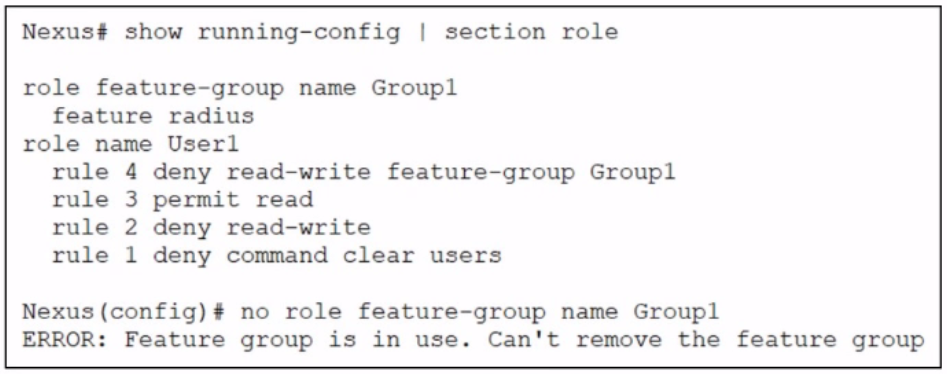
Refer to the exhibit.
An engineer must delete the feature-group role on the Cisco Nexus 9000 Series Switch but the CLI rejects the command Which command set resolves the issue?
Answer : B
The correct remediation is role name User1 no rule 4. In Cisco data center troubleshooting, the first priority is to isolate whether the failure is caused by the underlay, overlay control plane, first-hop gateway behavior, or a consistency parameter. This item is centered on Cisco Nexus, Nexus 9000, Cisco Nexus 9000, so the selected action targets the condition that prevents normal forwarding rather than masking the symptom. Cisco Nexus and ACI guidance treats vPC, VXLAN EVPN, OTV, OSPF, BGP, HSRP, and LACP issues as state-dependent technologies: a neighbor, peer, VLAN, VNI, multicast group, timer, MTU, or policy mismatch can leave the protocol partially operational while traffic is still dropped. The rejected alternatives either change unrelated attributes, introduce a new inconsistency, or affect only a secondary behavior. The operational check after applying the fix should be to confirm adjacency or peer state, validate the relevant route/MAC/endpoint table, and test traffic in the affected VLAN or VRF. This aligns with Cisco DCIT network troubleshooting methodology for isolating control-plane state before changing data-plane policy.
Question 4
Refer to the exhibit.
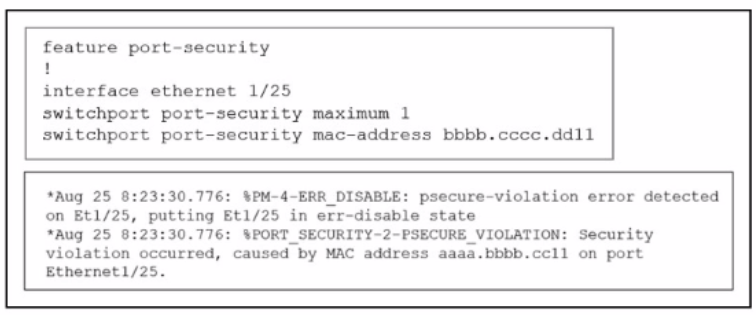
Refer to the exhibit. An engineer connected a Cisco UCS-C Series server to port Ethernet 1/25 on the Cisco Nexus Series Switch. After the cable is connected, the server does not have connectivity to the network and the port light indicator shows as disabled. Which command set resolves the issue?
Answer : D
The correct action is interface ethernet 1/25 switchport port-security maximum 1 switchport port-security mac-address bbbb.cccc.dd11. Cisco UCS troubleshooting depends on the relationship between policy, inventory discovery, firmware state, and server identity. The question involves UCS, Cisco Nexus, so the selected option fixes the UCS component or policy that directly controls the failure. In UCS Manager, service profiles, vNIC/vHBA templates, boot policies, firmware packages, server pools, adapters, fabric interconnects, and I/O modules are applied through a managed model; a server can fail even when basic IP reachability exists if the relevant policy is incomplete or the hardware inventory has not been acknowledged correctly. The distractors typically change an unrelated object, force a disruptive recovery without fixing the policy, or apply to a different UCS mode. Cisco guidance is to verify faults, FSM stage, inventory status, association status, and the specific boot or connectivity policy before taking action. After the remediation, validate that the fault clears, the FSM completes, and the server or fabric component returns to the expected operable state.
Question 5
Refer to the exhibit.
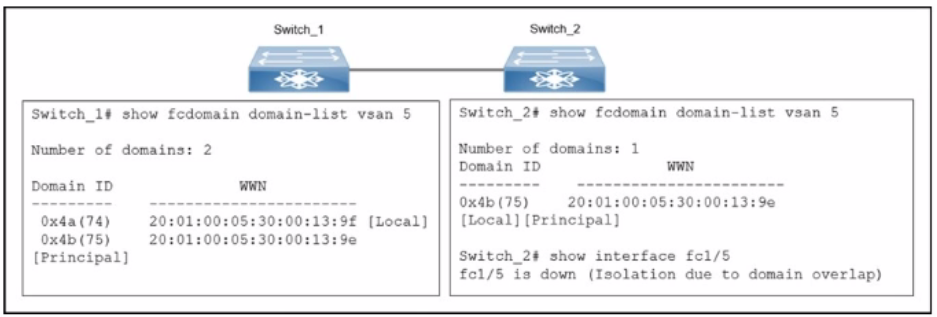
Refer to the exhibit. An engineer connected Switch_2 to Switch_1, but noticed that the Switch_2 Fibre Channel port that is destined to Switch_1 is down and isolated. Which two commands resolve this issue? (Choose two.)
Answer : A, D
[ ] fcdomain restart disruptive vsan 5; [ ] fcdomain domain 23 static vsan 5 is the correct fix under Cisco SAN troubleshooting practice. The issue described involves VSAN, FSPF, where the operating state depends on the correct combination of port type, VSAN, fabric service, and access-control database. MDS and Nexus SAN features do not infer missing policy: if the active zoneset, fabric-binding database, fcdomain, NPIV setting, or FCoE/LLDP negotiation is wrong, the link may come up physically but the initiator will not reach the target. The selected answer corrects the missing or mismatched element. The remaining choices either act at the wrong layer, change a non-causal parameter, or provide only a temporary reset. After applying the fix, a proper Cisco validation path is to review show interface, show flogi database, show fcns database, show zoneset active, and any isolation or merge-failure logs. That confirms the storage network is operationally consistent.
Question 6
Refer to the exhibit.
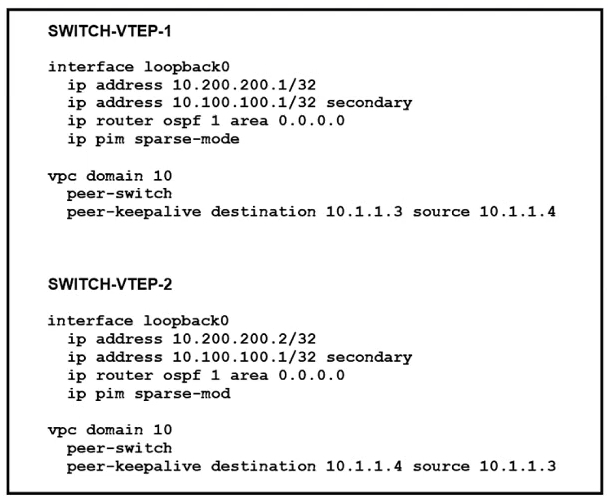
Refer to the exhibit. One of the vPC VTEPs fails to route VXLAN traffic to vPC connected hosts. When the issue was being diagnosed, it was discovered that the packets that were expected to be forwarded to the MAC address on the SWITCH-VTEP-1 are instead forwarded to the MAC address on SWITCH-VTEP-2 and then dropped. Which action resolves the issue?
Answer : C
The selected resolution is Configure peer-gateway under the VPC domain on both peers because the failure is in the Fibre Channel/FCoE control path around vPC, VXLAN. Cisco MDS and Nexus platforms separate configuration from operational state: a VSAN, zone, vFC binding, device alias, or port-security entry can exist in configuration but still fail if it is not active, correctly merged, or allowed on the link. The correct option addresses the fabric condition that prevents communication. The incorrect options are technically adjacent but would not repair the specific dependency; for example, changing unrelated databases or resetting ports without correcting policy leaves the same failure to recur. Cisco SAN troubleshooting therefore starts with port role and VSAN checks, then confirms fabric services such as fcdomain, FSPF, zoning, fabric binding, and name-server information. The expected validation is that the port becomes operational, the initiator and target appear in the appropriate databases, and permitted zone members can communicate.
Question 7
Refer to the exhibit.
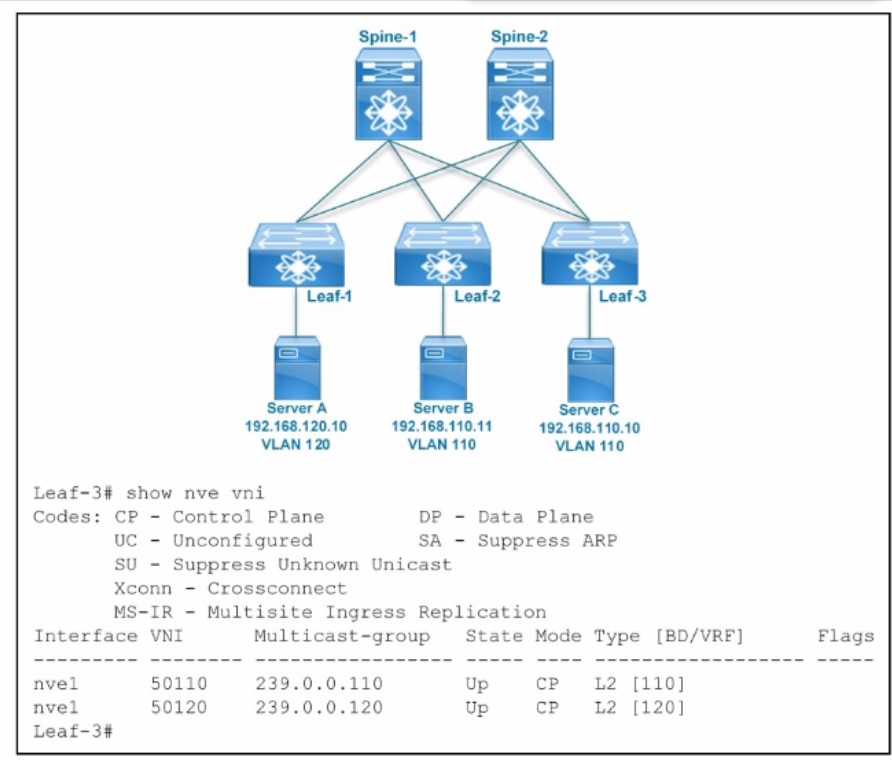
The VXLAN communication fails between Server A and Server C. Server A and Server B can communicate, but Server C can only reach Server B and its default gateway. Which action must be taken on Leaf-3 to resolve the issue?
Answer : A
The answer is Configure a tenant Layer 3 VNI because Cisco Nexus and ACI forwarding depends on exact agreement between the devices participating in the feature. The scenario references VXLAN, VNI; those technologies fail in predictable ways when required parameters do not match or when the required control-plane advertisement is absent. In DCIT troubleshooting, the engineer should identify the failed dependency, correct that dependency, and then verify the operational table that proves the fix. For example, vPC and EVPN checks focus on consistency, VNI/VRF bindings, peer-gateway behavior, and host-route advertisement; routing checks focus on neighbor state, MTU, timers, authentication, next-hop, and route preference. The selected answer addresses the dependency that blocks forwarding. The distractors are plausible because they touch related features, but they do not resolve the specific failure condition. Post-change validation should include protocol state, learned endpoint or route entries, and a traffic test across the affected path.
 All Official Question Types