Page: 1
/ 14
Total 247 questions
Cisco Implementing Cisco Application Centric Infrastructure 300-620 DCACI Exam Questions
Question 1
Refer to the exhibit.
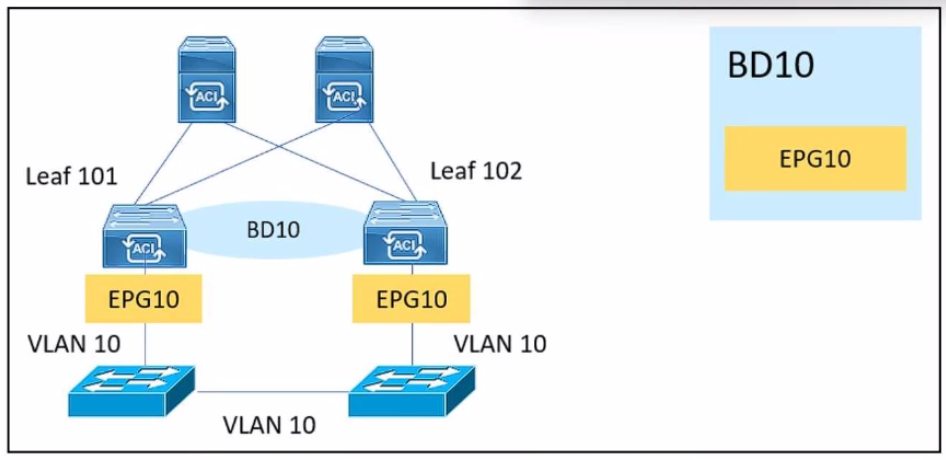
An engineer is implementing a BPDU filter on external switch interfaces That face the Cisco ACI fabric to prevent excessive TCNs from impacting the fabric. Which Configuration must be applied on Cisco ACI to avoid a Layer 2 loop?
Answer : B
Question 2
A customer must upgrade the Cisco ACI fabric to use a feature from the new code release. However, there is no direct path from the current release to the desired one. Based on the Cisco APIC Upgrade/Downgrade Support Matrix, the administrator must go through one intermediate release.
Which set of steps must be taken to upgrade the fabric to the new release?
Answer : A
When upgrading the Cisco ACI fabric through an intermediate release, the following steps should be taken:
Upgrade the APICs to an interim release: This is the first step to ensure that the APICs are running a stable version that is compatible with both the current and the targeted release1.
Upgrade the switches to an interim release: After the APICs are upgraded, the next step is to upgrade the leaf and spine switches to the same interim release.This ensures that the entire fabric is running on a compatible version before moving to the targeted release1.
Upgrade the APICs to the targeted release: Once the fabric is stable on the interim release, the APICs can be upgraded to the targeted release.It's important to verify that the APICs are fully operational before proceeding to upgrade the switches1.
Upgrade the leaf and spine switches to the targeted release: The final step is to upgrade the leaf and spine switches to the targeted release.This should be done after the APICs have been successfully upgraded and are stable on the targeted release1.
By following these steps, the customer can successfully upgrade the Cisco ACI fabric to the new code release that includes the desired feature.
Question 3
Engineer resolves an underlying condition of a fault but notices that the fault was not deleted from the Faults view. Which two actions must be taken to remove the fault? (Choose two.)
Answer : A, B
Question 4
An engineer is extending an EPG out of the ACI fabric using static path binding. Which statement about the endpoints is true?
Answer : D
When extending an EPG out of the ACI fabric using static path binding, it is true thatexternal endpoints are in the same EPG as the directly attached endpoints8.This means that traffic received on a statically bound leaf port with a specific VLAN ID is mapped to the EPG, and the same policies applied to directly attached endpoints are enforced on the external endpoints8.
Question 5
The company ESXi infrastructure is hosted on the Cisco UCS-B Blade Servers. The company decided to take advantage of ACI VMM integration to enable consistent enforcement of policies across virtual and physical workloads. The requirement is to prevent the packet loss between the distributed virtual switch and the ACI fabric. Which setting must be implemented on a vSwitch policy to accomplish this goal?
Answer : B
To prevent packet loss between the distributed virtual switch and the ACI fabric in a company's ESXi infrastructure hosted on Cisco UCS-B Blade Servers, the vSwitch policy must implementMAC Pinning. This setting ensures that each virtual interface card (vNIC) on the UCS servers is pinned to an uplink Ethernet port, providing a stable and consistent path for traffic and preventing packet loss due to path changes.
Question 6
A situation causes a fault to be raised on the APIC. The ACI administrator does not want that fault to be raised because it is not directly relevant to the environment. Which action should the administrator take to prevent the fault from appearing?
Answer : C
To prevent a fault from appearing that is not directly relevant to the environment, the ACI administrator should create afault severity assignment policythat hides the fault.This can be done by selecting ''Ignore Fault'' under System -> Faults in the APIC UI2
Question 7
Refer to the exhibit.
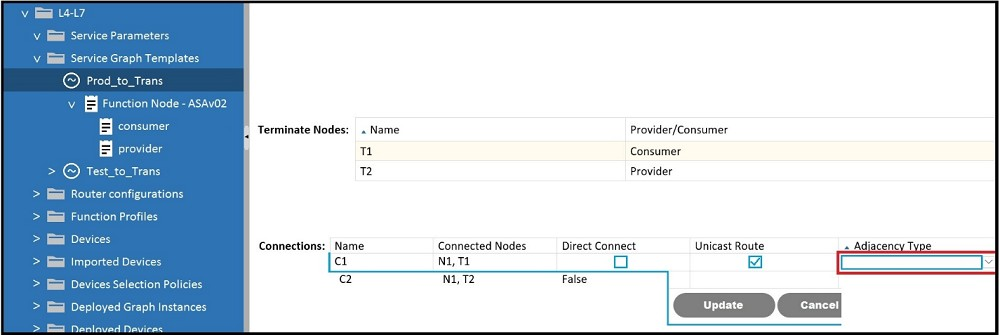
Which Adjacency Type value should be set when the client endpoint and the service node
interface are in a different subnet?
Answer : A
When the client endpoint and the service node interface are in different subnets, the Adjacency Type value should be set toRouted. This setting is used to indicate that routing is required between the client endpoint and the service node interface, as they are not in the same Layer 2 broadcast domain and need Layer 3 routing to communicate.
 All Official Question Types