Page: 1
/ 14
Total 119 questions
Cisco Implementing Cisco Application Centric Infrastructure - Advanced 300-630 DCACIA Exam Questions
Question 1
Refer to the exhibit.
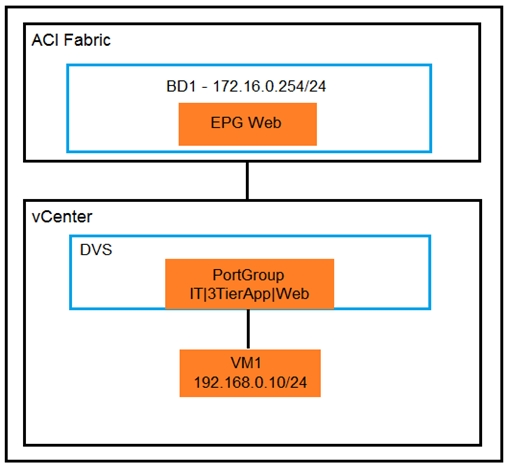
An organization migrates its virtualized servers from a legacy environment to Cisco ACI. VM1 is incorrectly attached to PortGroup IT|3TierApp|Web. Which action limits IP address learning in BD1?
Answer : A
To limit IP address learning in BD1 when VM1 is incorrectly attached to a PortGroup, enabling the Enforce Subnet Check is the correct action. This feature ensures that only IP addresses belonging to the defined subnets under the bridge domain are learned, preventing incorrect IP data from being disseminated across the network.Reference:= ( Implementing Cisco Application Centric Infrastructure Official Cert Guide )
Question 2
Refer to the exhibit.
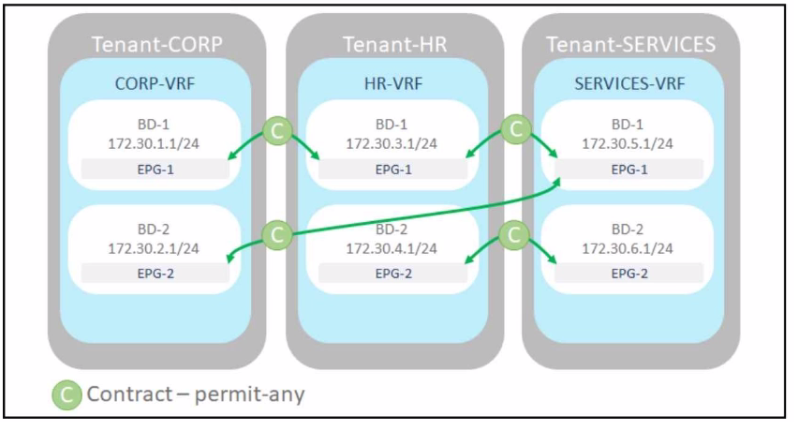
A company merges three of its departments: CORP. HR. and SERVICES. Currently, the connectivity between departments is achieved by using VRF route leaking. The requirement is to redesign the Cisco ACI networking architecture to communicate between EPGs and BDs from any tenant without configuring contracts or VRF route leaking. Which configuration meets these criteria?
Answer : C
In Cisco ACI, Virtual Routing and Forwarding (VRF) instances are used to create separate routing tables for network traffic management. An unenforced VRF does not apply policies or contracts for communication between endpoints, allowing free communication without the need for explicit permissions. By implementing an unenforced VRF in the common tenant and mapping all required Bridge Domains (BDs) to it, each department's BDs can communicate with one another without configuring contracts or VRF route leaking, thus meeting the company's requirement for redesigning their networking architecture.Reference: Implementing Cisco Application Centric Infrastructure Official Cert Guide
Question 3
A company must connect three Cisco ACI data centers by using Cisco ACI Multi-Site. An engineer must configure the Inter-Site Network (ISN) between the existing sites. Which two configuration steps must be taken to implement the ISN? (Choose two.)
Answer : B, E
For the ISN implementation between Cisco ACI data centers using Multi-Site, OSPF must be configured on subinterfaces for dynamic routing, and BIDIR-PIM must be set up on all ISN routers for efficient bidirectional multicast traffic routing.Reference:= (Implementing Cisco Application Centric Infrastructure Official Cert Guide)
Question 4
Refer to the exhibit.
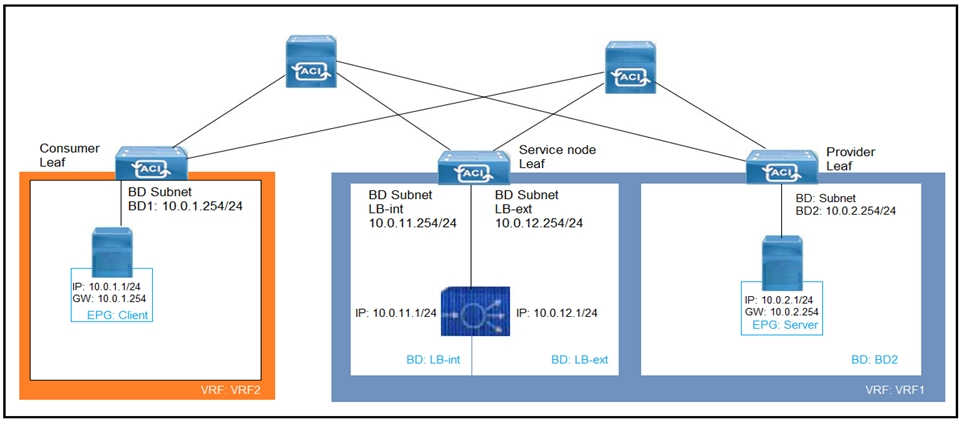
What must be configured to allow the PBR node (LB-int) to monitor the availability of the endpoint that is in the EPG server?
Answer : A
PBR Node Tracking:
Purpose: It is used to monitor the health and availability of endpoints within an Endpoint Group (EPG).
Functionality: When configured, it allows for real-time health checks and traffic redirection based on endpoint status and network conditions.
Benefits: Ensures traffic is directed to healthy endpoints, maintaining application performance and availability.
Question 5
Refer to the exhibit.
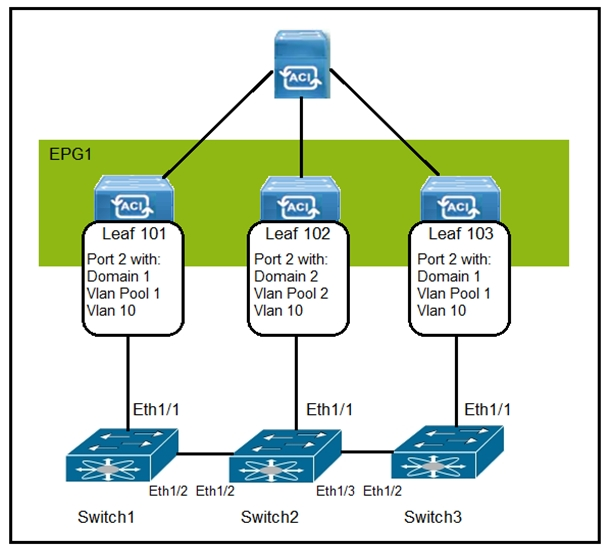
How are the STP BPDUs forwarded over Cisco ACI fabric?
Answer : B
In a Cisco ACI environment, STP BPDUs are not forwarded across the fabric. The ACI fabric is designed to operate without STP, using a policy-driven, multi-path Ethernet model for loop prevention. Thus, STP BPDUs from external switches are dropped by the ACI leaf switches.Reference:= (Implementing Cisco Application Centric Infrastructure Official Cert Guide)
Question 6
Which PIM version must be configured in the Inter-Pod Network to allow broadcast, unknown unicast. and multicast flooding between Cisco ACI pods?
Answer : C
Protocol Independent Multicast sparse mode (PIM-SM) is designed for efficient routing to multiple receivers in a multicast group across an inter-pod network (IPN). PIM sparse mode is best suited for environments where receivers are dispersed because it allows for explicit join messages to control the flow of traffic. This makes it ideal for scenarios where broadcast, unknown unicast, and multicast flooding between Cisco ACI pods is required.Reference:= ( Implementing Cisco Application Centric Infrastructure Official Cert Guide )
Question 7
Refer to the exhibit.
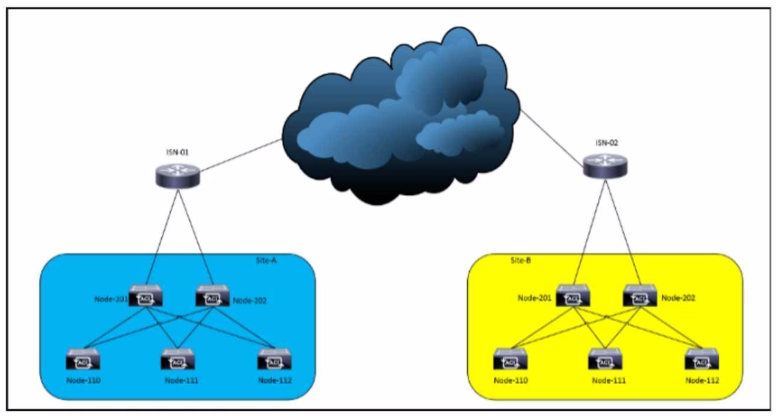
In a Cisco ACI Multi-Site deployment, traffic fails to pass between Site-A and Site-B. and an engineer troubleshoots the link between ISN-01 and Node-201. Which set of actions establishes connectivity?
Answer : C
In a Cisco ACI Multi-Site deployment, proper configuration of the inter-site link is crucial for traffic to pass between different sites. The MTU size is particularly important; if it's not set correctly, packets may be dropped or fragmented, leading to connectivity issues. By configuring the MTU on the link to be at least 100 bytes larger than that of the ACI fabrics, you allow for encapsulation overhead without packet drops due to exceeding MTU limits. Additionally, configuring the link as a routed subinterface using VLAN-4 is necessary for routing across different broadcast domains, which is essential for inter-site communication in an ACI fabric.Reference: Implementing Cisco Application Centric Infrastructure Official Cert Guide
 All Official Question Types