Page: 1
/ 14
Total 372 questions
Cisco Implementing Cisco Enterprise Network Core Technologies 350-401 ENCOR Exam Questions
Question 1
In a Cisco SD-Access solution, which component offers the Anycast Gateway service?
Answer : D
The correct answer is D. fabric edge node.
Key Concept (Cisco SD-Access Anycast Gateway):
In Cisco SD-Access, the Anycast Gateway provides a consistent default gateway for endpoints across the fabric. This allows endpoints to keep the same gateway behavior regardless of where they attach within the fabric.
Why D is correct:
The fabric edge node provides the Anycast Gateway service for connected endpoints. It is the node where endpoints attach to the fabric, and it performs the first-hop gateway function using the distributed Anycast Gateway model.
This design provides:
Consistent default gateway addressing
Simplified endpoint mobility
Optimal forwarding within the fabric
Distributed first-hop gateway services
Why the other options are incorrect:
A . fabric border node
The border node connects the SD-Access fabric to external networks. It does not provide the endpoint Anycast Gateway service.
B . control plane node
The control plane node maintains host tracking and endpoint-to-location mappings using LISP. It is not the default gateway for endpoints.
C . intermediate node
An intermediate node only forwards traffic inside the fabric underlay/overlay path and does not provide gateway services to endpoints.
Final ENCOR Exam Tip:
Remember these SD-Access roles:
Fabric edge node = endpoint connectivity + Anycast Gateway
Control plane node = endpoint mapping database
Border node = external connectivity
Intermediate node = transit forwarding
Anycast Gateway in SD-Access = Fabric Edge Node
Question 2
Which two Cisco SD-Access components provide communication between traditional network elements and the controller layer? (Choose two.)
Answer : A, E
Question 3
What is the structure of a JSON web token?
Answer : D
Question 4
Refer to the exhibit.
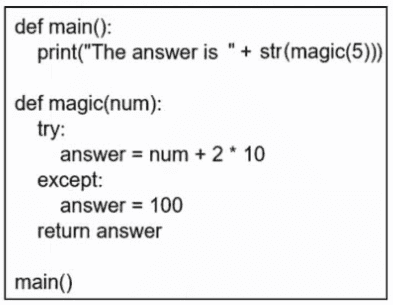
Refer to the exhibit. What is displayed when the code is run?
Answer : B
Question 5
In a Cisco SD-Access solution, what is the role of a fabric edge node?
Answer : B
The correct answer is B. to connect wired endpoints to the SD-Access fabric.
In Cisco SD-Access, the fabric edge node is the device that provides access for endpoints into the fabric. It is the point where user devices such as PCs, phones, printers, and access points attach to the SD-Access network. The edge node handles endpoint onboarding into the fabric and applies the appropriate segmentation and policy.
Why B is correct:
A fabric edge node is specifically responsible for:
Connecting wired endpoints to the fabric
Serving as the access-layer entry point into the SD-Access fabric
Enforcing policy and segmentation for connected endpoints
Extending the fabric to end hosts
This is the main role of the edge node in the SD-Access architecture.
Why the other options are incorrect:
A . to connect the fusion router to the SD-Access fabric
This is not the role of the fabric edge node. The fusion router is used outside the fabric to provide connectivity between the fabric and external networks.
C . to advertise fabric IP address space to external networks
This function is associated with the border node, not the edge node. The border node connects the fabric to external domains and exchanges reachability information.
D . to connect external Layer 3 networks to the SD-Access fabric
This is also the function of the border node, not the edge node.
Final ENCOR Exam Tip:
Remember these SD-Access node roles clearly:
Edge node = connects endpoints
Border node = connects to external networks
Control-plane node = maintains endpoint-to-location mappings
Fusion router = external routing/services outside the fabric
Edge node = endpoint access into the fabric
Question 6
Refer to the exhibit.
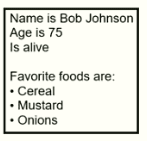
What is the JSON syntax that is formed the data?
A)

B)

C)

D)

Answer : B
Question 7
Refer to the exhibit. A network engineer must log in to the router via the console, but the RADIUS servers are not reachable. Which credentials allow console access?
Answer : C
The correct answer is C. no username and only the password 'cisco123'.
Step-by-Step Analysis of the Configuration:
1. AAA Authentication Method for Console:
aaa authentication login group1 group radius line
This means:
Try RADIUS authentication first
If RADIUS fails/unreachable fallback to line authentication
2. Console Line Configuration:
line con 0
password 0 cisco123
login authentication group1
Because RADIUS servers are not reachable, the router falls back to:
line authentication
3. Line Authentication Behavior:
When using line authentication, the router uses:
The configured line password
No username is required
Thus, login will prompt only for a password:
Password: cisco123
Why Other Options Are Incorrect:
A . username 'cisco' password 'cisco'
This uses the local user database, but local is NOT configured as fallback in group1.
B . password 'test123'
This password is configured under VTY lines, not the console.
D . username 'cisco' password 'cisco123'
Combines local username with console password, but AAA fallback is to line, not local.
Key ENCOR Exam Concept:
AAA authentication order matters:
group radius line fallback is line password
group radius local fallback is local username/password
Console + RADIUS down uses line password only
 All Official Question Types