Page: 1
/ 14
Total 547 questions
Cisco Implementing and Operating Cisco Service Provider Network Core Technologies 350-501 SPCOR Exam Questions
Question 1
Under which circumstance does BGP ignore the best-path algorithm after receiving multiple routes to a destination?
Answer : D
Question 2
Refer to the exihibit.
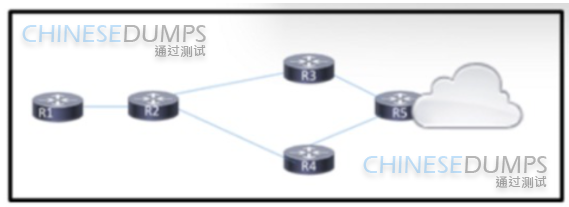
Refer to the exhibit. An engineer is scripting ACLs to handle traffic on the given network. The engineer must block users on the network between R1 and R2 from leaving the network through R5. but these users must still be able to access all resources within the administrative domain. How must the engineer implement the ACL configuration?
Answer : C
In the given scenario, the goal is to restrict users on the network between R1 and R2 from accessing the external network through R5, while still allowing them access to all resources within the administrative domain. The correct approach is to configure an Access Control List (ACL) that permits traffic to all internal networks and denies traffic to any external address. This ACL should be applied to the R2 interface that connects to R1 in the ingress direction. By doing so, traffic originating from users between R1 and R2 destined for external networks will be blocked, while internal traffic will be allowed.
Question 3
What is the purpose of DS-Lite technology?
Answer : A
Question 4
Refer to the exhibit.
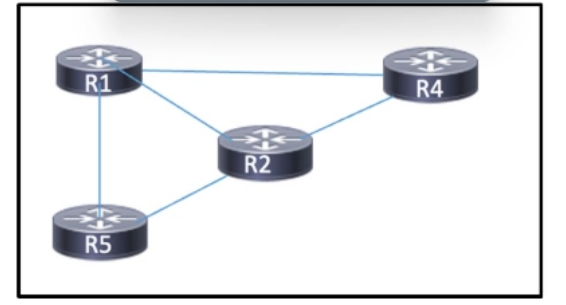
Refer to the exhibit. MPLS is running in the network with OSPF as the IGP. Full routes are shared between the routers, and each connected link has an MPLS neighbor relationship. A network engineer must update the network configuration so that it will maintain LDP neighbor relationships if a directly connected link goes down. Which action must the engineer take as part of the process?
Answer : D
Question 5
What are two features of stateful NAT64? (Choose two.)
Answer : A, B
Question 6
Refer to the exhibit.
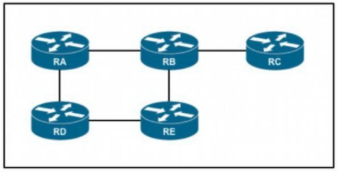
If RC is a stub router, which entry must be injected so that it will send traffic outside the OSPF domain?
Answer : D
If RC is a stub router in an OSPF network, it requires a default route to be injected so that it can send traffic outside the OSPF domain. In OSPF, stub routers do not have any routes external to the OSPF domain in their routing tables. To allow these routers to reach networks outside of their OSPF domain, a default route should be injected into the stub area by the Area Border Router (ABR). This allows all routers in the stub area, including RC, to forward traffic for unknown destinations to the ABR, which then forwards it appropriately.Reference: Implementing and Operating Cisco Service Provider Network Core Technologies source documents or study guide
Question 7
Refer to the exhibit.
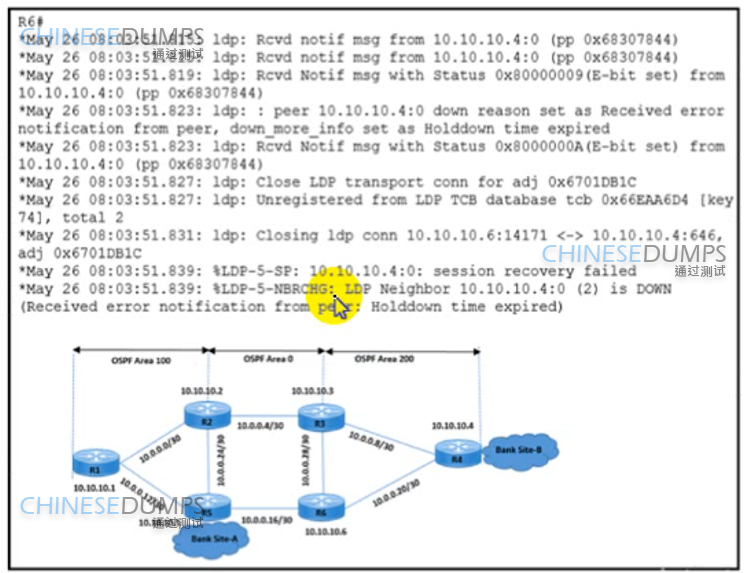
A network engineer is implementing an LDP-based MPLS solution to enable packet flow between the two bank sites The engineer was given two requirements
* LDP peering must stay up when there is a link failure between R3 and R6
* LDP peering must not flap when there is a link failure between R5 and R6
Which action meets these requirements?
Answer : C
 All Official Question Types