Page: 1
/ 14
Total 802 questions
Cisco Implementing and Operating Cisco Security Core Technologies 350-701 SCOR Exam Questions
Question 1
[Security Concepts]
Refer to the exhibit.
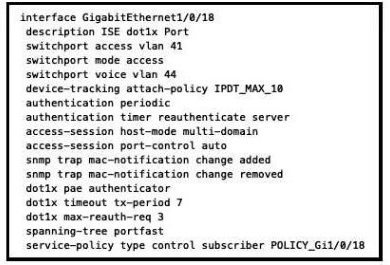
What will occur when this device tries to connect to the port?
Answer : D
Based on the configuration script in the image, the interface GigabitEthernet0/0/18 is configured for both 802.1X and MAB authentication. The commandauthentication port-control autoenables 802.1X authentication on the port, while the commanddot1x pae authenticatorenables the port to act as an authenticator. The commandauthentication host-mode multi-domainenables MAB authentication on the port, and allows two devices to be authenticated, one in the voice VLAN and one in the data VLAN. Therefore, when a device tries to connect to the port, the switch will first attempt 802.1X authentication, and if it fails, it will fall back to MAB authentication using the device's MAC address. The switch will then contact the ISE server, which is configured as the RADIUS server groupise-group, to verify the device's credentials and assign the appropriate access level based on the ISE policy. The ISE policy can also dynamically assign VLANs, ACLs, or service policies to the device based on its identity and posture.Reference:=
Some possible references are:
[Implementing and Operating Cisco Security Core Technologies (SCOR) v1.0], Module 6: Secure Connectivity, Lesson 6.2: Implementing Site-to-Site VPNs, Topic 6.2.2: Group Encrypted Transport VPN
Cisco IOS Security Configuration Guide, Release 15M&T - Configuring IEEE 802.1x Port-Based Authentication
Cisco IOS Security Configuration Guide, Release 15M&T - Configuring MAC Authentication Bypass
Cisco Identity Services Engine Administrator Guide, Release 2.7 - Configure Wired 802.1X and MAB
Question 2
[Security Concepts]
An administrator is configuring a DHCP server to better secure their environment. They need to be able to ratelimit the traffic and ensure that legitimate requests are not dropped. How would this be accomplished?
Answer : A
To understand DHCP snooping we need to learn about DHCP spoofing attack first.
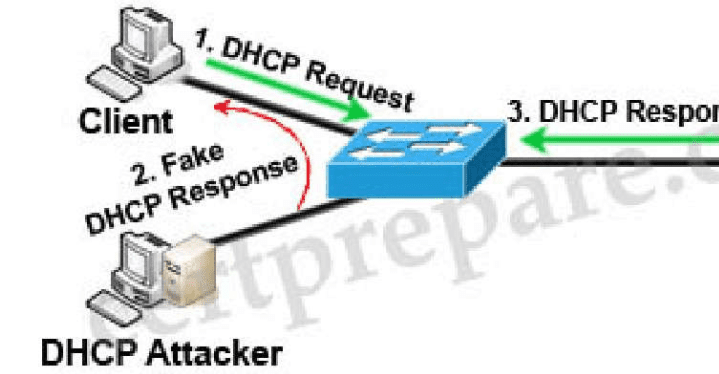
DHCP spoofing is a type of attack in that the attacker listens for DHCP Requests from clients and answers them with fake DHCP Response before the authorized DHCP Response comes to the clients. The fake DHCP Response often gives its IP address as the client default gateway -> all the traffic sent from the client will go through the attacker computer, the attacker becomes a ''man-in-the-middle''.
The attacker can have some ways to make sure its fake DHCP Response arrives first. In fact, if the attacker is ''closer'' than the DHCP Server then he doesn't need to do anything. Or he can DoS the DHCP Server so that it can't send the DHCP Response.
DHCP snooping can prevent DHCP spoofing attacks. DHCP snooping is a Cisco Catalyst feature that
determines which switch ports can respond to DHCP requests. Ports are identified as trusted and untrusted.
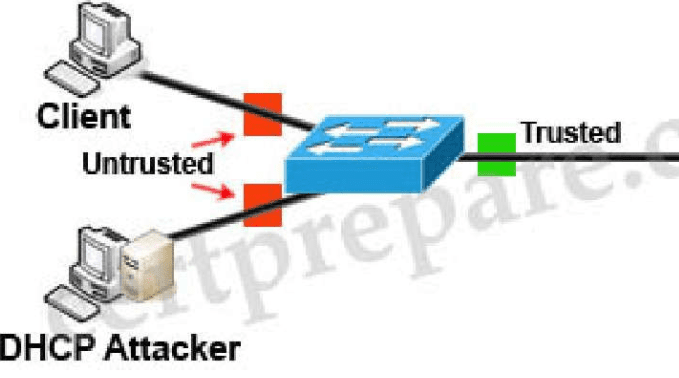
Only ports that connect to an authorized DHCP server are trusted, and allowed to send all types of DHCP
messages. All other ports on the switch are untrusted and can send only DHCP requests. If a DHCP response
is seen on an untrusted port, the port is shut down.
Question 3
[Security Concepts]
Which attack type attempts to shut down a machine or network so that users are not able to access it?
Answer : A
Denial-of-service (DDoS) aims at shutting down a network or service, causing it to be inaccessible to its
intended users.
The Smurf attack is a DDoS attack in which large numbers of Internet Control Message Protocol (ICMP)
packets with the intended victim's spoofed source IP are broadcast to a computer network using an IP
broadcast address.
Question 4
[Secure Network Access, Visibility, and Enforcement]
Which ID store requires that a shadow user be created on Cisco ISE for the admin login to work?
Answer : C
Active Directory (AD) is an ID store that requires that a shadow user be created on Cisco ISE for the admin login to work. A shadow user is a user account that is defined in the ISE internal database, but has the password set to external. This means that the user authentication is performed against an external identity source, such as AD, while the user authorization is based on the ISE admin group membership. A shadow user is useful when the admin wants to assign different roles or permissions to specific AD users, rather than using AD groups. To create a shadow user, the admin must check the External checkbox in the ISE admin user configuration, and make sure that the username matches the AD username.The shadow user must also be assigned to an ISE admin group that has the Type set to External123.Reference:=1:ISE Admin User Shadow AD Account Issue2:ISE Admin user authentication from AD3:Which ID store requires that a shadow user be created on Cisco ISE for the admin login to work?
Question 5
[Security Concepts]
What is the concept of Cl/CD pipelining?
Answer : B
Cl/CD pipelining is a method of software development that aims to deliver software faster and more reliably by automating the process of integrating, testing, and deploying code changes. Cl stands for continuous integration, which means that every code change is merged into a shared repository and verified by automated tests. CD stands for continuous delivery, which means that the code is always in a deployable state and can be released to production environments with minimal human intervention. Cl/CD pipelining enables developers to collaborate more effectively, detect and fix errors earlier, and deliver value to customers more frequently. Cl/CD pipelining is a key practice of DevOps, a culture and set of processes that bridge the gap between development and operations teams.Reference:
https://www.redhat.com/en/topics/devops/what-cicd-pipeline
https://about.gitlab.com/topics/ci-cd/cicd-pipeline/
Question 6
[Securing the Cloud]
Which feature is supported when deploying Cisco ASAv within AWS public cloud?
Answer : B
The ASAv on AWS supports the following features:
+ Support for Amazon EC2 C5 instances, the next generation of the Amazon EC2 Compute Optimized instance
family.
+ Deployment in the Virtual Private Cloud (VPC)
+ Enhanced networking (SR-IOV) where available
+ Deployment from Amazon Marketplace
+ Maximum of four vCPUs per instance
+ User deployment of L3 networks
+ Routed mode (default)
Note: The Cisco Adaptive Security Virtual Appliance (ASAv) runs the same software as physical Cisco ASAs to deliver proven security functionality in a virtual form factor. The ASAv can be deployed in the public AWS cloud.
It can then be configured to protect virtual and physical data center workloads that expand, contract, or shift their location over time. Reference: https://www.cisco.com/c/en/us/td/docs/security/asa/asa96/asav/quick-start-book/asav-96 qsg/asavaws.html
Question 7
[Security Concepts]
An organization recently installed a Cisco Secure Web Appliance and would like to take advantage of the AVC engine to allow the organization to create a policy to control application-specific activity. After enabling the AVC engine, what must be done to implement this?
Answer : A
 All Official Question Types