Page: 1
/ 14
Total 551 questions
Cisco Certified Design Expert 400-007 CCDE Exam Questions
Question 1
The controller has a global view of the network, and it can easily ensure that the network is in a consistent and optimal configuration. Which two statements describe a centralized SDN control path? (Choose two.)
Answer : A, D
A (Scaling challenges for services):Centralized SDN controllers may experience scalability challenges for distributed services like DHCP and load balancing since these often require real-time responsiveness and distributed service locality.
D (Latency in reactive handling):Centralized controllers may introduce additional latency during reactive PACKET_IN event handling as control decisions traverse the control plane before forwarding happens.
Other options explained:
B: Centralized controllers still present failure domain risks; high-availability must be explicitly designed.
C: Smart NICs operate primarily at the host level, often independently of centralized SDN controllers.
E: Legacy equipment often lacks support for many SDN southbound APIs.
Question 2
Which two statements describe the functionality of OSPF packet-pacing timers? (Choose two.)
Answer : C, E
OSPF uses pacing timers to control how quickly it sends LSAs to neighbors to prevent network flooding and CPU spikes:
C . Retransmission-pacing timer: Controls spacing between retransmitted LSAs queued after a lost or unacknowledged transmission.
E . Flood-pacing timer: Controls spacing between consecutive LSAs when flooding new information to peers.
These timers are critical in scaling OSPF in dense or unstable topologies and are key to tuning control plane convergence performance without destabilizing routers.
Question 3
Which two features are advantages of SD-WAN compared to MPLS-based connectivity? (Choose two.)
Answer : B, C
B (Separation of infrastructure and policy):SD-WAN decouples policy control from the underlying transport.
C (Simpler policy-based forwarding):Centralized controllers dynamically steer traffic according to application policies with less complexity than traditional QoS in MPLS.
Other options explained:
A: FEC (Forward Error Correction) is typically not used in standard SD-WAN implementations.
D: SD-WAN does not unify WAN backbones; it abstracts multiple underlays.
E: Both MPLS and SD-WAN have failure management, but SD-WAN focuses more on dynamic path control than simply backup links.
Question 4
Refer to the exhibit.
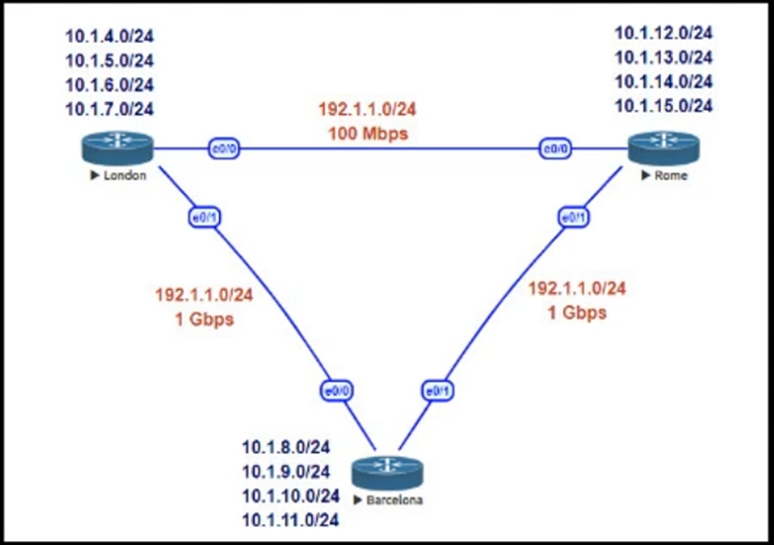
This network is running EIGRP as the routing protocol and the internal networks are being advertised in EIGRP. Based on the link speeds, all traffic between London and Rome is getting propagated via Barcelona and the direct link between London and Rome is not being utilized under normal working circumstances. The EIGRP design should allow for efficiency in the routing table by minimizing the routes being exchanged. The link between London and Rome should be utilized for specific routes. Which two steps accomplish this task? (Choose two.)
Answer : A, D
A (EIGRP summarization):Summarization reduces unnecessary routing information exchange, simplifies the routing table, and improves convergence.
D (Route leaking on London-Rome link):Route leaking allows specific prefixes (such as important routes for direct communication) to be advertised across the London-Rome link, ensuring it's utilized where appropriate.
Other options explained:
B: Filtering routes on Barcelona would prevent reachability unnecessarily.
C: Filtering on London-Rome link would prevent its usage entirely.
Question 5
What are two examples of components that are part of an SDN architecture? (Choose two.)
Answer : B, C
Software-Defined Networking (SDN) architecture is based on the logical decoupling of the control and data planes. According to the SDN reference model, the architecture typically includes the following planes:
Control Plane: This resides in the SDN controller and is responsible for decision-making, including route and policy calculations.
Application Plane: This layer contains business and network applications (e.g., firewalls, QoS policies) that communicate with the controller to request services and enforce policy.
These planes are essential in SDN architecture:
The control plane programs the forwarding behavior of network elements.
The application plane interacts via northbound APIs to define intent and service logic.
Options such as ''Software plane'' and ''Network plane'' are vague or not used in the SDN context. The ''Management plane'' is a separate functional layer and is not part of the architectural definition core to SDN as per CCDE v3.1.
==========
Question 6
Comparing traditional networks with SDN, where the network is only application aware, what is the advantage of SDN architecture?
Answer : C
Question 7
Company XYZ is designing the IS-IS deployment strategy for their multiarea IS-IS domain. They want IS-IS neighbor relationships minimized on each segment and the LSDB size optimized. Which design can be used?
Answer : D
D (L1/L2 for ABRs and L1 for internal routers):This hierarchical approach minimizes LSDB size inside areas (L1 routers only maintain intra-area routes) while L1/L2 routers handle inter-area route propagation, reducing neighbor adjacencies and improving scalability.
Other options explained:
A: Level 2 everywhere results in larger LSDBs across all routers.
B: Only L2 routers at ABRs would isolate L1 domains improperly.
C: Pure L1 design prevents inter-area reachability.
==========
 All Official Question Types