Page: 1
/ 14
Total 210 questions
F5 Networks BIG IP Local Traffic Manager LTM Specialist Maintain & Troubleshoot 301b LTM Exam Questions
Question 1
An LTM Specialist has a OneConnect profile and HTTP profile configured on a virtual server to load balance an HTTP application.
The following HTTP headers are seen in a network trace when a client connects to the virtual server:
Clientside:
GET / HTTP/1.1
Host: 192.168.136.100
User-Agent: Mozilla/5.0
Accept: text/html,application/xhtml+xml,application/xml;q=0.9,*/*;q=0.8
Accept-EncodinG. gzip, deflate
Connection: keep-alive
Serverside:
HTTP/1.1 200 OK
DatE. 5 Jun 1989 17:06:55 GMT
Server: Apache/2.2.14 (Ubuntu)
Vary: Accept-Encoding
Content-EncodinG. gzip
Content-LengtH. 3729
X-Cnection: close
Content-TypE. text/html
The LTM Specialist notices the OneConnect feature is working incorrectly.
Why is OneConnect functioning incorrectly?
Answer : D
Question 2
The output of a tmsh command is: ------------------------------------------------------------ Net::Interface Name Status Bits Bits Errs Errs Drops Drops Colli In Out In Out In Out sions ------------------------------------------------------------ 1.1 down 0 0 0 0 0 0 0 1.2 up 191.4K 0 0 0 374 0 0 1.3 down 0 0 0 0 0 0 0 1.4 up 22.5K 0 0 0 44 0 0 2.1 miss 0 0 0 0 0 0 0 2.2 miss 0 0 0 0 0 0 0 mgmt up 43.2G 160.0G 0 0 0 0 0
Which command was executed on the LTM device to show the output?
Answer : A
Question 3
An LTM Specialist must perform a hot fix installation from the command line.
What is the correct procedure to ensure that the installation is successful?
Answer : D
Question 4
An application owner claims an LTM device is delaying delivery of an HTTP application. The LTM device has two VLANs, an internal and an external. The application servers reside on the internal VLAN. The virtual server and clients reside on the external VLAN.
With appropriate filters applied, which solution is most efficient for obtaining packet captures in order to investigate the claim of delayed delivery?
Answer : A
Question 5
-- Exhibit --
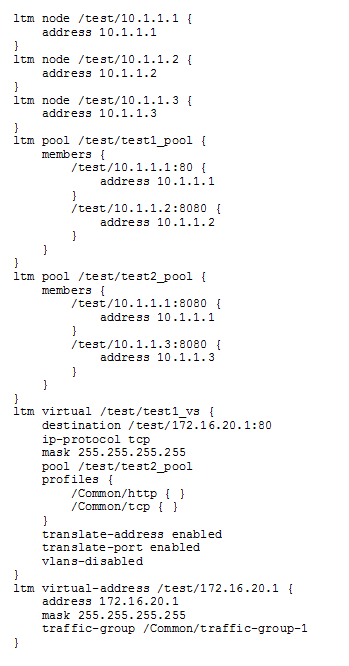
-- Exhibit --
Refer to the exhibit.
An LTM Specialist is reviewing the 'test' partition.
Which objects, in order, can be removed from the partition?
Answer : A
Question 6
There are three servers in the pool: 172.16.20.1, 172.16.20.2, and 172.16.20.3, with the virtual IP address 10.0.20.88.
A user CANNOT connect to an HTTP application. To understand the problem and find a solution, the LTM Specialist runs two concurrent traces on the LTM device, with the following results:
Trace on client side:
tcpdump: verbose output suppressed, use -v or -vv for full protocol decode
listening on 0.0, link-type EN10MB (Ethernet), capture size 96 bytes
22:22:07.423759 IP 172.16.20.100.53875 > 10.0.20.88.80: S 998346084:998346084(0) win 5840
22:22:07.424056 IP 10.0.20.88.80 > 172.16.20.100.53875: S 4671780:4671780(0) ack 998346085 win 4380
22:22:07.424776 IP 172.16.20.100.53875 > 10.0.20.88.80: . ack 1 win 365
22:22:07.424790 IP 172.16.20.100.53875 > 10.0.20.88.80: P 1:149(148) ack 1 win 365
22:22:07.424891 IP 10.0.20.88.80 > 172.16.20.100.53875: . ack 149 win 4528
22:22:12.024850 IP 10.0.20.88.80 > 172.16.20.100.53875: R 1:1(0) ack 149 win 4528
6 packets captured
6 packets received by filter
0 packets dropped by kernel
Trace on server side:
tcpdump: verbose output suppressed, use -v or -vv for full protocol decode
listening on internal, link-type EN10MB (Ethernet), capture size 96 bytes
22:22:07.424881 IP 172.16.20.100.53875 > 172.16.20.2.80: S 51116678:51116678(0) win 4380
22:22:08.424893 IP 172.16.20.100.53875 > 172.16.20.2.80: S 51116678:51116678(0) win 4380
22:22:09.625082 IP 172.16.20.100.53875 > 172.16.20.2.80: S 51116678:51116678(0) win 4380
22:22:10.825194 IP 172.16.20.100.53875 > 172.16.20.2.80: S 51116678:51116678(0) win 4380
4 packets captured
4 packets received by filter
0 packets dropped by kernel
What should the LTM Specialist do to solve the problem?
Answer : D
Question 7
A new VLAN vlan301 has been configured on a highly available LTM device in partition Application A . A new directly connected backend server has been placed on vlan301. However, there are connectivity issues pinging the default gateway. The VLAN self IPs configured on the LTM devices are 192.168.0.251 and 192.168.0.252 with floating IP 192.168.0.253. The LTM Specialist needs to perform a packet capture to assist with troubleshooting the connectivity.
Which command should the LTM Specialist execute on the LTM device command line interface to capture the attempted pings to the LTM device default gateway on VLAN vlan301?
Answer : A
 All Official Question Types