Page: 1
/ 14
Total 183 questions
Fortinet NSE 4 - FortiOS 7.2 NSE4_FGT-7.2 Exam Questions
Question 1
Which of the following are valid actions for FortiGuard category based filter in a web filter profile ui proxy-based inspection mode? (Choose two.)
Answer : A, C
Question 2
Which of statement is true about SSL VPN web mode?
Answer : B
FortiGate_Security_6.4 page 575 - Web mode requires only a web browser, but supports a limited number of protocols.
Question 3
Refer to the exhibit.
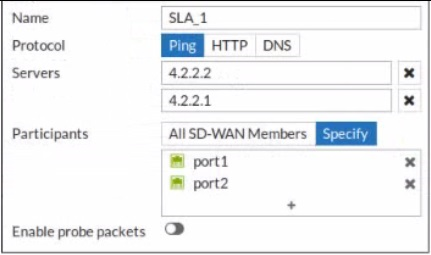
An administrator has configured a performance SLA on FortiGate, which failed to generate any traffic.
Why is FortiGate not sending probes to 4.2.2.2 and 4.2.2.1 servers? (Choose two.)
Answer : B, D
Question 4
Which CLI command allows administrators to troubleshoot Layer 2 issues, such as an IP address conflict?
Answer : D
'If you suspect that there is an IP address conflict, or that an IP has been assigned to the wrong device, you may need to look at the ARP table.'
Question 5
A network administrator has enabled full SSL inspection and web filtering on FortiGate. When visiting any HTTPS websites, the browser reports certificate warning errors. When visiting HTTP websites, the browser does not report errors.
What is the reason for the certificate warning errors?
Answer : D
FortiGate Security 7.2 Study Guide (p.235): 'If FortiGate receives a trusted SSL certificate, then it generates a temporary certificate signed by the built-in Fortinet_CA_SSL certificate and sends it to the browser. If the browser trusts the Fortinet_CA_SSL certificate, the browser completes the SSL handshake. Otherwise, the browser also presents a warning message informing the user that the site is untrusted. In other words, for this function to work as intended, you must import the Fortinet_CA_SSL certificate into the trusted root CA certificate store of your browser.'
Question 6
Which three statements are true regarding session-based authentication? (Choose three.)
Answer : A, C, D
Question 7
Refer to the exhibit showing a debug flow output.

Which two statements about the debug flow output are correct? (Choose two.)
Answer : A, C
 All Official Question Types