Page: 1
/ 14
Total 35 questions
Fortinet NSE 6 - Secure Wireless LAN 6.4 NSE6_FWF-6.4 Exam Questions
Question 1
Where in the controller interface can you find a wireless client's upstream and downstream link rates?
Answer : A
Question 2
When deploying a wireless network that is authenticated using EAP PEAP, which two configurations are required? (Choose two.)
Answer : B, D
Question 3
Refer to the exhibit.

What does the asterisk (*) symbol beside the channel mean?
Answer : D
This frequencies are also used by other licensed applications, wireless LANs have to use a specific method to gain access to certain higher frequencies and this method is known as DFS.
Question 4
Which two phases are part of the process to plan a wireless design project? (Choose two.)
Answer : A, C
According to the web search results, the project information phase and the site survey phase are part of the process to plan a wireless design project. The project information phase involves defining the project scope, objectives, requirements, deliverables, and stakeholders.It also includes creating a project plan, a risk management plan, a communication plan, and a budget.1The site survey phase involves conducting a physical inspection of the site where the wireless network will be deployed, measuring the signal strength and interference levels, identifying the optimal locations for the access points and antennas, and validating the network performance and coverage.2The hardware selection phase and the installation phase are not part of the planning process, but rather part of the implementation process.The hardware selection phase involves choosing the appropriate wireless devices, such as access points, routers, switches, controllers, and cables, based on the network design and specifications.3The installation phase involves installing, configuring, testing, and documenting the wireless network components according to the project plan and best practices.3Reference:Wireless Device Network Planning and Design - Emerson,Telecommunications and Implementation Project Management - BICSI,Project Planning | Wireless Design Services | Digi International
Question 5
Refer to the exhibits.
Exhibit A
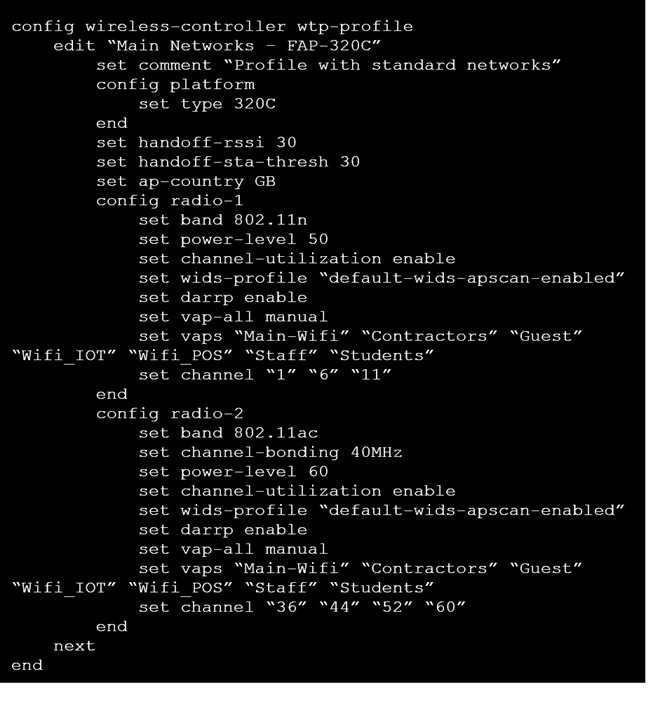
Exhibit B
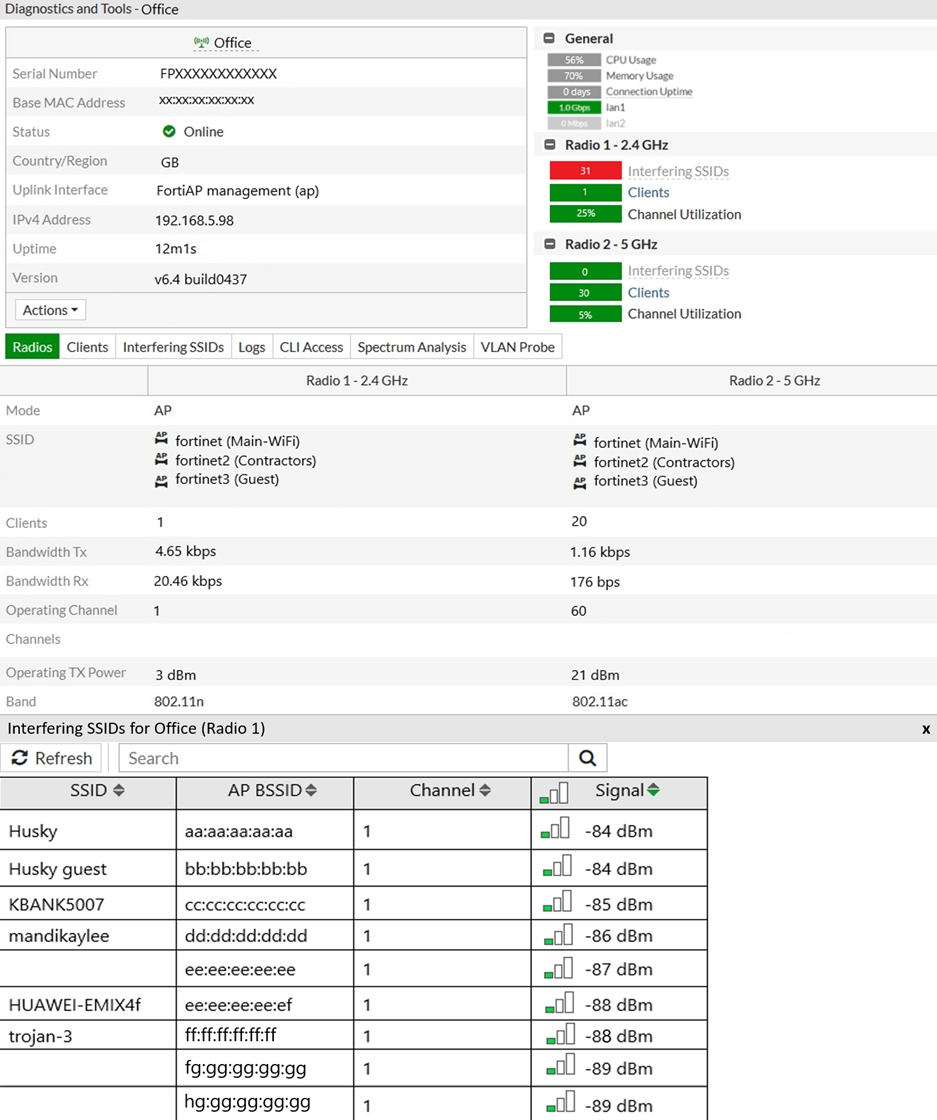
Exhibit C
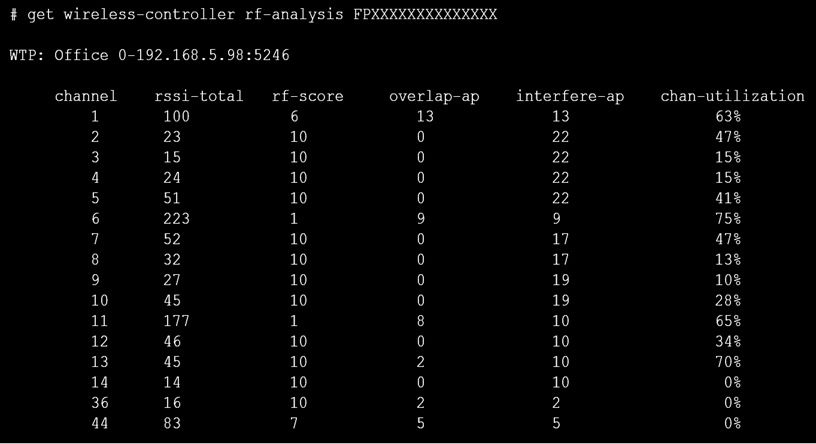
A wireless network has been installed in a small office building and is being used by a business to connect its wireless clients. The network is used for multiple purposes, including corporate access, guest access, and connecting point-of-sale and Io devices.
Users connecting to the guest network located in the reception area are reporting slow performance. The network administrator is reviewing the information shown in the exhibits as part of the ongoing investigation of the problem. They show the profile used for the AP and the controller RF analysis output together with a screenshot of the GUI showing a summary of the AP and its neighboring APs.
To improve performance for the users connecting to the guest network in this area, which configuration change is most likely to improve performance?
Answer : B
Question 6
Refer to the exhibit.
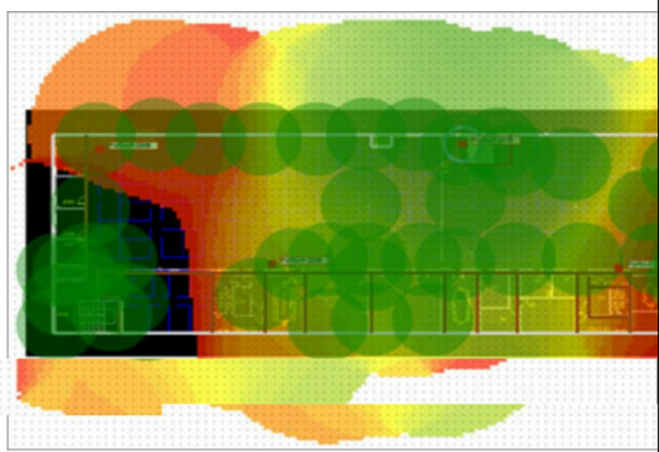
If the signal is set to -68 dB on the FortiPlanner site survey reading, which statement is correct regarding the coverage area?
A. Areas with the signal strength weaker than -68 dB are shown with black background.
B. Areas with the signal strength equal to -68 dB are zoomed in to provide better visibility.
C. Areas with the signal strength weaker than -68 dB are highlighted in orange and red to indicate that no signal was propagated by the APS.
Answer : D
The FortiPlanner site survey reading is a tool that shows the predicted signal strength of the wireless network based on the floor plan, the placement of the APs, and the propagation model. The signal strength is measured in decibels (dB), which is a logarithmic scale that indicates how much power the signal has. The higher the dB value, the stronger the signal.
The site survey reading allows the user to set a threshold value for the signal strength, which is -68 dB by default. This means that any area with a signal strength equal or stronger than -68 dB is considered to have adequate coverage for most wireless applications. These areas are highlighted in green circles on the floor plan. Any area with a signal strength weaker than -68 dB is considered to have poor coverage or no coverage at all. These areas are shown with different colors, such as yellow, orange, red, or black, depending on how weak the signal is.
Therefore, the correct answer is D. Areas with the signal strength equal or stronger than -68 dB are highlighted in green circles.
FortiPlanner 2.0 User Guide, page 28
FortiPlanner Data Sheet, page 2
FortiPlanner 2.2 User Guide, page 19
Question 7
Which two roles does FortiPresence analytics assist in generating presence reports? (Choose two.)
Answer : A, C
FortiPresence analytics is a cloud-based service that provides location analytics and customer engagement tools for wireless networks. FortiPresence analytics assists in generating presence reports by gathering details about on-site visitors, such as their dwell time, frequency, loyalty, and demographics. FortiPresence analytics also assists in comparing current data with historical records, such as trends, patterns, and anomalies. Reference: [FortiPresence Data Sheet], page 1;FortiOS 6.4.0 Handbook - Wireless Controller, page 9.
 All Official Question Types