Page: 1
/ 14
Total 70 questions
HPE Campus Access Switching Expert Written HPE7-A06 Exam Questions
Question 1
You are configuring an SSID that is using 802.IX as a security mechanism. What is the reason tor using WPA3-Ertorpnse (CCM-128) when deploying Wi-Fi 6 networks?
Answer : B
The question asks for the reason for using WPA3-Enterprise (CCM-128) when deploying Wi-Fi 6 networks.
WPA3-Enterprise Modes:
CCM-128: Uses AES-CCMP-128 (same cipher as WPA2). Its main purpose is to provide a transition path from WPA2 to WPA3. It allows both WPA3-capable and WPA2-only clients to connect to the same SSID. It enforces Protected Management Frames (PMF, 802.11w) when possible (required for WPA3, optional for WPA2). It's often called 'Transition Mode' or 'Compatibility Mode'.
GCMP-256: Uses stronger AES-GCMP-256. It operates in 'WPA3-Only Mode' and does not allow WPA2 clients.
Wi-Fi 6 (802.11ax) & WPA3: Wi-Fi 6 certification requires support for WPA3.
Analysis of Options:
A: Incorrectly calls CCM-128 '192-bit mode' and 'WPA3 only'.
B: Correctly calls CCM-128 'Transition Mode' and states it allows WPA2 clients.
C: Correctly calls CCM-128 'Compatibility Mode' and states it allows WPA2 clients. 'Compatibility Mode' and 'Transition Mode' are used interchangeably for this WPA3 mode.
D: Incorrectly calls CCM-128 'Only Mode' and states no WPA2 support.
Conclusion: Both Option B and Option C accurately describe WPA3-Enterprise (CCM-128). It is designed as a transition/compatibility mode to allow environments to adopt WPA3 features (like mandatory PMF for capable clients) while still supporting legacy WPA2 clients on the same network during the migration period. Selecting either B or C would be functionally correct based on common terminology.
Question 2
You arc about lo deploy a gateway that is on factory default. ZTP cannot be used for different reasons, but you are searching for valid alternatives. What are two valid alternatives for ZTP? (Select two.)
Answer : B, C
The question asks for valid alternatives to Zero Touch Provisioning (ZTP) for initially configuring a factory default Aruba gateway when ZTP cannot be used.
Aruba Gateway Initial Provisioning Methods:
ZTP: Automated provisioning using Activate/Central.
One-Touch Provisioning (OTP) / Manual Setup: Involves direct connection for initial configuration.
Web UI: Connecting a laptop to a specific management or designated setup port (often GE0/0/1 on many gateway models) allows access to a web-based setup wizard.
Console Port: Connecting via the serial console port allows CLI access, which includes guided setup scripts or manual configuration.
Analysis of Options:
A: Port 0/0/0 is typically the OOBM port, not the standard OTP web UI port.
B: Port 0/0/1 is commonly used for OTP via Web browser on many Aruba gateway models.
C: Using the console port with terminal software for initial setup (potentially using a 'Full-Setup' wizard or script) is a standard manual method.
D: 'Static-Activate' refers to manual registration with the Activate service, not a console setup mode.
E: Requires setting a static IP, adding complexity beyond the basic OTP connection method described in B.
Conclusion: Using the designated OTP Ethernet port (commonly GE0/0/1) with a web browser (Option B) and using the console port with terminal software (Option C) are the standard, valid alternatives to ZTP for initial gateway setup.
Question 3
Refer to the four numbered steps in the exhibit.
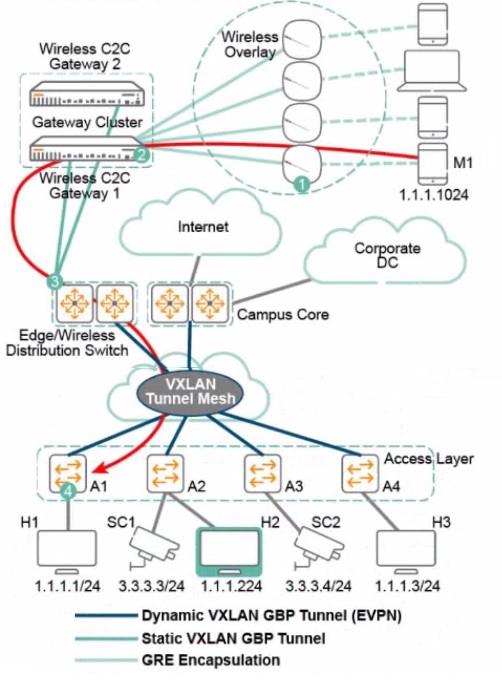
Which action is the first step in applying a role-to-role ACL on the traffic from mobile device M1 to role H2?
Answer : B
The question asks for the first step in applying a role-to-role ACL (Access Control List) on traffic from a mobile device (M1) to a role (H2) in a network using Dynamic Segmentation with VXLAN and role-based policies.
Analysis of Options:
Option A: Describes an intermediate step where the edge switch transfers the Group Policy ID over VXLAN, which occurs later in the process.
Option B: Correct. The first step is the AP forwarding the packet from the mobile device (M1) to the gateway, which initiates the traffic flow in a tunneled Dynamic Segmentation setup.
Option C: Describes a later step where the destination switch (A1) enforces the role-to-role ACL, after the packet has traversed the network.
Option D: Describes a step where the gateway forwards traffic over a VXLAN tunnel, which occurs after the AP forwards the packet.
Why Option B is Correct: In HPE Aruba Networking's Dynamic Segmentation architecture, wireless clients (e.g., M1) connect to an AP, which tunnels traffic to a gateway (e.g., in tunneled mode). The first step in the traffic flow is the AP forwarding the client's packet to the gateway, which then processes the packet for role assignment and policy enforcement. This aligns with the role-to-role ACL application process, where the gateway applies policies based on the source (M1's role) and destination (H2's role) using Group Policy IDs over VXLAN.
Relevance to Certification Objectives:
Security (10%): Involves designing and troubleshooting role-based security policies in customer networks.
WLAN (9%): Includes implementing and troubleshooting wireless traffic flows in Dynamic Segmentation.
Switching (19%): Covers Layer 2/3 interconnection technologies like VXLAN for policy enforcement.
HPE Aruba Networking AOS-10 Configuration Guide: Dynamic Segmentation and VXLAN, detailing traffic flow.
HPE7-A06 Study Guide: Covers role-based ACLs and Dynamic Segmentation workflows.
HPE Aruba Networking Technical Documentation: Tunneled Node and Role-Based Policy Enforcement.
Question 4
The user's device is failing 802.1 X with EAP-TLS authentication. We know that the client-side certificate is valid. What is the likely cause of this issue? (Select two.)
Answer : C, E
The user's device fails 802.1X EAP-TLS authentication, but the client-side certificate is known to be valid. We need two likely causes.
EAP-TLS Process: Involves mutual certificate validation and TLS handshake between client and RADIUS server (proxied by NAD).
Causes (Client Cert OK):
Server Certificate Issues: Client doesn't trust server cert (Untrusted CA, name mismatch, expired).
EAP Type Mismatch: Client supplicant configured for different EAP type than RADIUS server policy.
RADIUS Server Issues: Policy misconfiguration, user not found, internal errors.
NAD <-> RADIUS Communication Failure: Switch cannot reach RADIUS server (IP connectivity, firewall, routing), incorrect shared secret.
Client Supplicant Misconfiguration: Incorrect identity, settings other than the certificate itself.
Network packet loss.
Analysis of Options (Select Two):
A: Wrong gateway affects L3 post-authentication.
B: ACL blocking EAPoL/RADIUS is possible but less common than config errors.
C: EAP-type mismatch: A very common configuration error leading to failure.
D: Wrong MAC address is irrelevant for EAP-TLS failure itself.
E: NAD not able to communicate with DNS servers: DNS isn't directly involved in EAP-TLS. However, if interpreted more broadly as NAD not able to communicate with the RADIUS server (due to IP routing, firewall, or incorrect server address), this is a very common cause of failure.
Conclusion: An EAP-type mismatch (C) is a prime suspect when basic certificate validity is assumed. Failure of the Network Access Device (NAD - the switch) to communicate with the RADIUS server (E, interpreted broadly as RADIUS reachability) is another major category of failure causes.
Question 5
Which tables arc synchronized between a pair of CX 8325 switches in a VSX cluster? (Select two.)
Answer : B, D
The question asks which tables are synchronized between a pair of CX 8325 switches in a Virtual Switching Extension (VSX) cluster. VSX is a high-availability solution that synchronizes specific tables to ensure consistent operation across both switches.
Analysis of Options:
A . BGP Neighbors: BGP neighbor tables are not synchronized in VSX; each switch maintains its own BGP sessions.
B . MAC address: Correct. VSX synchronizes the MAC address table to ensure consistent Layer 2 forwarding across both switches.
C . Spanning-Tree Protocol (STP): STP states are not synchronized; each switch runs its own STP instance, though they coordinate to avoid loops.
D . IP Routing: Correct. VSX synchronizes the IP routing table to ensure consistent Layer 3 forwarding.
E . Link Layer Discovery Protocol (LLDP): LLDP information is not synchronized; each switch maintains its own neighbor information.
Why B and D are Correct: In a VSX cluster, the MAC address table and IP routing table are synchronized to ensure seamless Layer 2 and Layer 3 operations. This synchronization allows both switches to share a common view of the network, enabling features like active-active forwarding and hitless failover. The vsx-sync feature in AOS-CX ensures these tables are kept consistent across the VSX pair.
Relevance to Certification Objectives:
Network Resiliency and Virtualization (8%): Involves designing and troubleshooting VSX for resiliency and redundancy.
Switching (19%): Includes implementing and troubleshooting Layer 2 technologies like MAC address tables.
Routing (16%): Covers IP routing table synchronization in VSX environments.
HPE Aruba Networking AOS-CX Configuration Guide: VSX Configuration, detailing table synchronization.
HPE7-A06 Study Guide: Covers VSX architecture and synchronization mechanisms.
HPE Aruba Networking Technical Documentation: VSX Overview, explaining MAC and routing table synchronization.
VSX (Virtual Switching Extension) synchronizes state information between the two switches in a cluster to enable active-active forwarding and provide a single logical view to downstream devices.
Analysis of Options:
A . BGP Neighbors: BGP sessions are typically established independently by each VSX member. While configurations can be synced, the dynamic state/neighbor table itself is not a core VSX synchronization item.
B . MAC address: The MAC address table is synchronized between VSX members. This is crucial for Layer 2 forwarding consistency and allowing either switch to forward traffic destined for a known MAC address learned via the VSX pair.
C . Spanning-Tree Protocol (STP): STP runs independently on each physical switch. VSX uses technologies like MC-LAG to provide loop-free active-active paths downstream, reducing reliance on STP blocking, but the STP state itself isn't synchronized via the ISL.
D . IP Routing: While the full IP routing table (RIB) is built independently on each switch via routing protocols, VSX Active Gateway synchronizes necessary Layer 3 information (like virtual gateway IP and MAC, and potentially ARP entries) to ensure consistent first-hop routing and failover. Some sources might broadly categorize ARP synchronization under L3/IP routing context in VSX. Given that the ARP table (essential for L3 forwarding consistency) is synchronized, and it's not listed separately, 'IP Routing' might encompass this synchronization aspect.
E . Link Layer Discovery Protocol (LLDP): LLDP information relates to physically connected neighbors of each switch and is not synchronized across the VSX ISL.
Conclusion: The MAC address table (B) is definitively synchronized. The ARP table is also synchronized, which is fundamental for Layer 3 forwarding consistency provided by Active Gateway. As ARP is not explicitly listed, and 'IP Routing' (D) is, D is the most likely second answer intended to cover the necessary L3 state synchronization (primarily ARP and Active Gateway state) performed by VSX.
Question 6
The customer is experiencing periodic uplink congestion between campus-1's AGG-1 and core. This has boon negatively affecting voice communications. The VOIP phones edge mark their packets with DSCP EF. The uplink from AGG-1 to core is LAG1.
The customer has already configured the following class and policy on AGG-1:
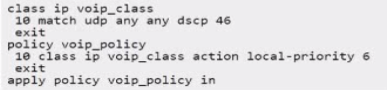
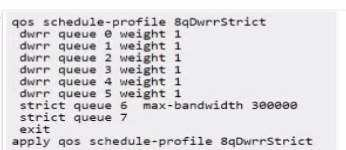
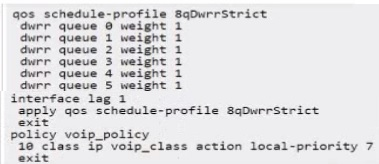
Based on this policy, which scrip), when deployed on AGG-1. will improve the reliable forwarding of voice traffic between AGG-1 and its uplink to the core?
A)
B)
C)
D)
Answer : B
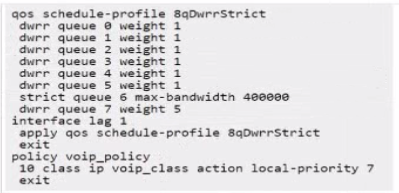
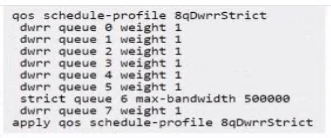
The problem describes uplink congestion affecting VoIP traffic (marked with DSCP EF, value 46) on AGG-1's LAG1 uplink. The existing configuration classifies this traffic into voip_class and applies voip_policy inbound, setting local-priority 6. To improve reliable forwarding during congestion, VoIP traffic needs strict priority queuing on the egress interface (LAG1).
Analysis of Options:
Option A applies a QoS schedule profile globally but doesn't modify the policy's local-priority or apply the schedule profile specifically to the congested LAG.
Option B modifies voip_policy to set local-priority 7 (mapping DSCP 46 traffic to queue 7) and applies the 8qDwrStrict schedule profile to the egress interface lag 1. In the 8qDwrStrict profile, queue 7 is configured for strict priority, ensuring voice traffic gets precedence over lower-priority traffic during congestion. This aligns with best practices for QoS for VoIP.
Option C also sets local-priority 7 and applies the schedule profile to lag 1, but the profile itself configures queue 7 with DWRR (Deficit Weighted Round Robin) instead of strict priority, which is less suitable for delay-sensitive voice traffic.
Option D applies a schedule profile globally and uses DWRR for queue 7.
Conclusion: Option B is the correct solution because it maps the DSCP EF traffic to the highest local priority (7) and applies a QoS schedule profile to the specific congested uplink (lag 1) that treats queue 7 with strict priority. This ensures voice traffic is prioritized reliably.
Question 7
A client would like to use the HPE Aruba Networking Switch MultiEdit Software function in HPE Aruba Networking Central. Which option is available?
Answer : D
The question involves a client wanting to use the HPE Aruba Networking Switch Multi-Edit Software function in HPE Aruba Networking Central to manage multiple switches. The task is to identify the available option.
Analysis of Options:
Option A (Use templates and apply them to selected switches): Incorrect. Templates are used for configuration management in Central but are not part of the Multi-Edit Software function.
Option B (Apply a configuration to an interface range for selected switches): Incorrect. Multi-Edit focuses on CLI scripting, not specifically interface range configurations.
Option C (Run the same NAE scripts for selected switches): Incorrect. Network Analytics Engine (NAE) scripts are for monitoring, not configuration via Multi-Edit.
Option D: Correct. Multi-Edit Software in Central allows administrators to apply CLI scripts to multiple selected switches for configuration changes.
Why Option D is Correct: HPE Aruba Networking Central's Multi-Edit Software feature enables administrators to create and apply CLI scripts to multiple AOS-CX switches simultaneously, streamlining configuration tasks. This is particularly useful for bulk changes, such as VLAN configurations or policy updates, across selected switches. The feature supports direct CLI input or script uploads, ensuring consistent application of commands, as per HPE Aruba Networking's management tools. This aligns with the client's need for efficient multi-switch management.
Relevance to Certification Objectives:
Connectivity (9%): Developing configurations for multiple devices based on customer requirements.
Troubleshooting (10%): Applying consistent configurations to resolve network issues.
Network Stack (4%): Analyzing solutions for network management automation.
HPE Aruba Networking Central User Guide: Multi-Edit Software Feature, detailing CLI script application.
HPE7-A06 Study Guide: Covers network management tools in Central.
HPE Aruba Networking Technical Documentation: Multi-Edit Software Best Practices.
 All Official Question Types