Page: 1
/ 14
Total 75 questions
HPE Network Security Expert Written HPE7-A10 Exam Questions
Question 1
A customer operates two AOS-10 HPE Aruba Networking gateways at a site. The gateways are part of an SD-Branch solution managed by HPE Aruba Networking Central, and their cluster setting uses WLAN mode (the non-default gateway mode).
You are configuring a manual HPE Aruba Networking gateway cluster for dynamic authorization. The gateways have these IP addresses on a subnet that CPPM can access:
Gateway 1 = 10.56.20.2
Gateway 2 = 10.56.20.3
Which VRRP IP address assignments are valid for the gateways? Assume that all IP address options are available.
Answer : B
In AOS-10 gateway clustering architectures, clustering dynamic authorization (RFC 3576 / CoA) enables ClearPass Policy Manager to send Disconnect and CoA requests to an active cluster instance without needing to track which individual physical gateway is currently terminating the client's session.
When configuring dynamic authorization on gateway clusters operating in WLAN / non-default gateway mode, ArubaOS requires establishing dual VRRP redundancy instances. Each gateway in the cluster is assigned its own dedicated VRRP virtual IP address. Under this active-active dual-VRRP design, Gateway 1 hosts VRRP Instance 1 (acting as Master with its own unique virtual IP, such as `10.56.20.4`), while Gateway 2 hosts VRRP Instance 2 (acting as Master with its own unique virtual IP, such as `10.56.20.5`).
VRRP virtual IP addresses must be distinct, unassigned IP addresses within the subnet and cannot duplicate the physical interface IP addresses of the gateways (`10.56.20.2` and `10.56.20.3`), making `Gateway 1 = 10.56.20.4 and Gateway 2 = 10.56.20.5` the valid configuration.
Question 2
You are helping a developer create a custom NAE script for an AOS-CX switch. What information might you need to provide so the developer can define the parameters correctly?
Answer : B
The Aruba Network Analytics Engine (NAE) framework separates monitoring logic from operational configuration by allowing developers to write generalized Python scripts that can be instantiated into multiple distinct NAE agents.
To make an NAE script adaptable across different switch roles, access layers, or monitoring points, developers utilize the `ParameterDefinitions` dictionary within the NAE manifest. Parameters define input variables---such as specific interface identifiers, utilization thresholds, target RADIUS server IPs, or BGP autonomous system numbers---that operators configure during agent creation.
To define these parameters accurately, the developer requires input on which operational values must be adjusted on a per-agent basis. This ensures the script provides the necessary input types, default values, and validation boundaries. Actions, Solution Exchange tags, and global switch hardware limits do not govern parameter dictionary construction.
Question 3
Refer to the scenario.
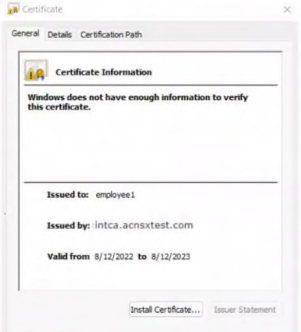
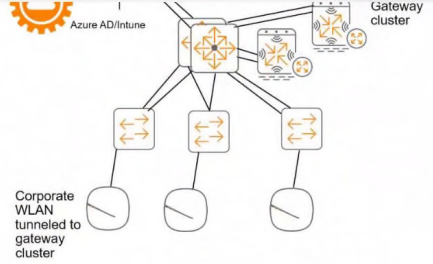
You must configure HPE Aruba Networking ClearPass Onboard to issue client certificates for Azure AD-joined devices. Which step is required to accomplish this objective?
Answer : D
Issuing client certificates from ClearPass Onboard to Microsoft Entra ID (Azure AD)-joined devices managed via Microsoft Intune requires integrating the Simple Certificate Enrollment Protocol (SCEP) with Intune's certificate validation API.
ClearPass utilizes the Microsoft Intune Onboard Enrollment (Intune SCEP) extension to securely interface between the Onboard Certificate Authority (CA) and Microsoft Intune. When an Intune-managed device receives a SCEP configuration profile, it contacts the SCEP enrollment URL exposed by ClearPass Onboard. ClearPass must validate the incoming SCEP transaction challenge token with Microsoft Cloud Graph/Intune APIs before the Onboard CA signs and issues the client certificate.
Because the Onboard enrollment URL and SCEP service endpoints are hosted and serviced by the ClearPass subscriber nodes (typically bound to the subscriber cluster Virtual IP address), the Intune SCEP extension must be deployed directly onto all ClearPass subscriber servers that handle device enrollment traffic. Installing the extension enables each subscriber to locally process and validate SCEP challenge payloads in real time.
Question 4
Refer to the scenario.
A customer has AOS-CX switches with this configuration on their edge ports:
port-access onboarding-method concurrent enable
aaa authentication port-access mac-auth enable
quiet-period 60
aaa authentication port-access dot1x authenticator enable
The switch authenticates clients to HPE Aruba Networking ClearPass Policy Manager (CPPM), which has these services:
An 802.1X service that uses an EAP-TLS method for most clients
A MAC-Auth service that uses the [MAC-Auth] method for devices such as printers imported from an inventory manager
The customer now wants to give limited access to wired guest devices and new devices that must be enrolled with certificates. You have configured these rights in an AOS-CX role named "guest-login."
How should the "guest-login" role be applied on the switches?
Answer : B
AOS-CX switches support concurrent onboarding, where 802.1X and MAC-Authentication run simultaneously to expedite device onboarding without waiting for one method to time out before starting the other.
When guest endpoints or un-enrolled corporate devices connect to an edge port, they lack valid 802.1X credentials and their MAC addresses are not yet present in the inventory repository. To provide initial network access---such as obtaining an IP address via DHCP and accessing ClearPass Onboard for certificate provisioning---the switch must grant immediate, limited access prior to authentication completion.
The `port-access preauth-role` command assigns a locally defined role (in this case, 'guest-login') to an edge port that takes effect immediately when link state comes up, remaining active while authentication methods are pending. Configuring a `reject-role` is inappropriate because it requires authentication to explicitly fail first, introducing significant delays or outright blocking onboarding workflows. Similarly, relying on CPPM default enforcement profiles fails to address unmanaged endpoints that cannot complete initial authentication handshakes.
Question 5
A customer needs the following rights for clients in the medical-mobile AOS firewall role on HPE Aruba Networking Mobility Controllers (MCs):
* They may receive IP addresses through DHCP.
* They may access DNS services at 10.8.9.7, and no other server.
* They may access all subnets in the 10.1.0.0/16 range, except 10.1.12.0/22, which must be denied.
* They must be denied access to other 10.0.0.0/8 subnets.
* They may access the Internet.
* They must be denied WLAN access for a period of time if they send any SSH traffic.
* They must be denied WLAN access for a period of time if they send any Telnet traffic.
* They must be denied access to all high-risk websites.
* External devices must not be allowed to initiate sessions with medical-mobile clients; they may send only return traffic.
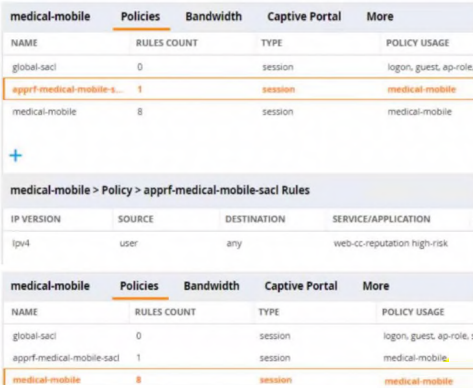
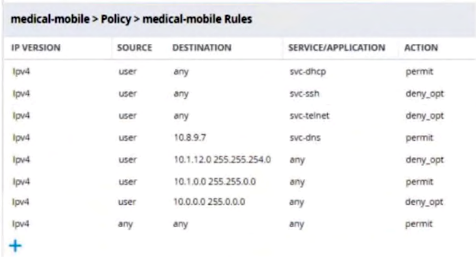
Refer to the scenario. The exhibits below show the role configuration.
* Role policies: `apprf-medical-mobile-sacl` (Rule: `user any web-cc-reputation high-risk deny`) and `medical-mobile` (8 rules configured).
Which setting not shown in the exhibits must you check to ensure the scenario requirements are met?
Answer : A
The policy requirements dictate that clients assigned to the `medical-mobile` user role must be denied access to high-risk websites. In ArubaOS, filtering web traffic based on reputation categorization is powered by Web Content Classification (WebCC), which operates as a specialized component of Application Programming and Recognition Framework (AppRF).
While the session ACL `apprf-medical-mobile-sacl` includes an ACE matching `web-cc-reputation high-risk`, this rule remains inert unless Web Content Classification and AppRF are globally enabled on the Mobility Controller and enabled within the assigned role configuration. WebCC queries cloud-hosted reputation feeds to dynamically score URLs into risk tiers.
Regarding other requirements: the Policy Enforcement Firewall (PEF) is inherently stateful and bidirectional by default, automatically allowing session return traffic while preventing externally initiated sessions without manual stateful activation. Therefore, verifying that AppRF and WebCC are actively operational is the critical requirement.
Question 6
A customer wants to avoid using RadSec between AOS-CX switches and ClearPass Policy Manager (CPPM) in order to reduce the need to manage switch certificates. Given this condition, what can you recommend to enhance security?
Answer : D
Legacy RADIUS (RFC 2865 / RFC 2866) operates over UDP and lacks native transport layer encryption. The shared secret is used exclusively to generate an MD5 authenticator hash for packet integrity and to obfuscate the User-Password attribute; all other attributes---including usernames, Framed-IPs, assigned user roles, and VLAN IDs---are transmitted across the network in plaintext.
RadSec (RFC 6614) resolves these architectural deficiencies by encapsulating RADIUS datagrams within a TLS tunnel over TCP port 2083, requiring mutual certificate-based authentication. If the customer elects to bypass RadSec to avoid managing PKI certificates on access switches, the unencrypted RADIUS control plane traffic remains inherently vulnerable to packet sniffing, eavesdropping, and man-in-the-middle tampering if routed across untrusted or shared infrastructure.
The primary architectural recommendation to mitigate this risk is to isolate RADIUS management traffic onto a dedicated, trusted network segment. This is achieved using an out-of-band management (OOBM) VRF, dedicated management VLANs, or encrypting the underlying transit path using MACsec or IPsec overlays. Simply using long shared secrets or importing HTTPS/EAP certificates on switches does not encrypt legacy UDP RADIUS transport.
Question 7
A customer operates an HPE Aruba Networking ClearPass cluster. The customer has AOS-CX switches that use 802.1X authentication with HPE Aruba Networking ClearPass Policy Manager (CPPM).
The switches use local port-access policies. The customer wants to begin tunneling only wired clients that successfully pass user authentication to an HPE Aruba Networking gateway cluster. The gateway cluster must place these clients in the eth-internet role. The gateway must also assign clients to VLAN 20.
The planned enforcement policy and profiles are shown below:
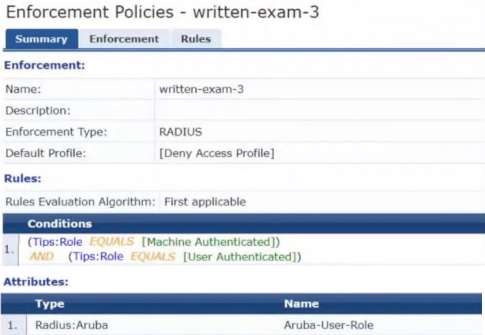
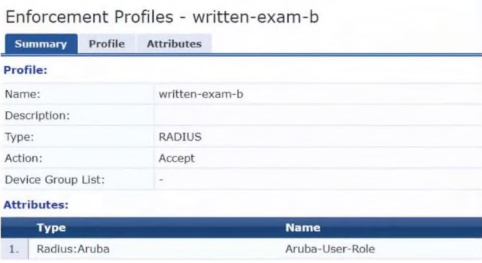
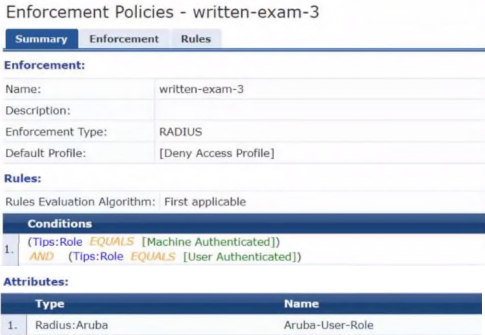
* Policy: `written-exam-3`
* Conditions: `(Tips:Role EQUALS [Machine Authenticated]) AND (Tips:Role EQUALS [User Authenticated])`
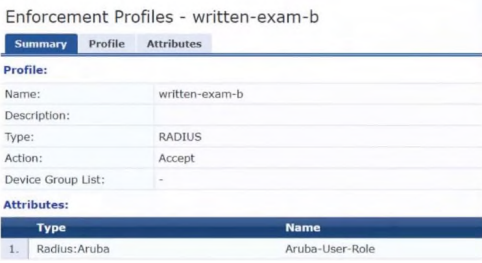
* Profile: `written-exam-b` (Attributes: `Radius:Aruba-User-Role = Aruba-User-Role`)
The gateway cluster includes two gateways with the following IP addresses:
Gateway 1: VLAN 4085 (system IP) = 10.20.4.21 | VLAN 20 (users) = 10.20.20.1 | VLAN 4094 (WAN) = 198.51.100.14
Gateway 2: VLAN 4085 (system IP) = 10.20.4.22 | VLAN 20 (users) = 10.20.20.2 | VLAN 4094 (WAN) = 198.51.100.12 | VRRP on VLAN 20 = 10.20.20.254
Refer to the scenario. Assume the correct UBT zone and port-access role settings have been configured. However, the solution does not work.
What else must you ensure you do?
Answer : C
In HPE Aruba Networking Dynamic Segmentation utilizing User-Based Tunneling (UBT) on AOS-CX switches, client traffic encapsulation is handled via point-to-point GRE tunnels to the gateway cluster.
When UBT is configured using Local/Reserved VLAN mode, the gateway assigns the user's true operational VLAN (VLAN 20) and firewall policies at the gateway termination point. However, on the AOS-CX switch, client frames arriving on the physical port cannot be placed directly into an unconfigured or unassigned Layer 2 domain. The switch requires a dedicated, locally created reserved VLAN defined specifically as the `ubt-client-vlan`.
The command `port-access ubt-client-vlan <VLAN_ID>` designates this local transit VLAN, which acts as the internal datapath holding and forwarding vehicle before the switch wraps the frame into GRE towards the gateway. If this VLAN does not exist in the switch database and is not mapped to the UBT zone, the switch drops the traffic before tunnel encapsulation.
 All Official Question Types