Page: 1
/ 14
Total 50 questions
HP Advanced HPE Edge-to-Cloud Solutions HPE7-V01 Exam Questions
Question 1
You are planning a data center networking solution for your customer.
The plan includes:
A VXLAN/EVPN solution
Aruba CX8325H as TOR switches
Aruba CX8320 as core switches
How should you configure the ports from the TOR switches to the core switches?
Answer : A
The correct answer is A because VXLAN/EVPN data-center fabrics are normally built on a routed Layer 3 underlay. In this design, each top-of-rack switch forms independent routed links toward the core or spine layer, and equal-cost multipath routing is used to provide scale-out bandwidth and resilience. The VXLAN/EVPN overlay then provides Layer 2 and Layer 3 tenant connectivity above that routed underlay. Option B is incorrect because LAG member Layer 2 ports represent a traditional Layer 2 aggregation design, not the preferred underlay model for EVPN/VXLAN. Option C is also incorrect because standalone Layer 2 links would create an underlay that lacks the routed ECMP characteristics expected in this fabric architecture. Option D is not the best answer because LAG is not required between TOR and core switches in an EVPN routed fabric; independent routed links provide better fabric behavior and failure isolation. The course includes Aruba networking and advanced virtualization/data-center design topics, and this question tests the candidate's ability to select the correct port model for an HPE Aruba EVPN/VXLAN solution.
Question 2
Your customer is planning to deploy several HPE ProLiant DL360 Gen11 servers with Windows Server 2025, for a bare-metal use case with no hypervisors.
The customer is concerned about the time it takes to scan and deploy the servers for new firmware and driver updates.
What HPE management tool can be used in this scenario to apply firmware updates to servers, with direct integration to HPE repositories?
Answer : B
The correct answer is B. HPE Compute Ops Management is the correct cloud-based management service for fleet-level HPE ProLiant lifecycle operations, including firmware baseline management and update execution. HPE describes Compute Ops Management as supporting HPE ProLiant ML/DL/MicroServer Gen10, Gen10 Plus, and Gen11 servers with iLO 5 and later, and includes automatic firmware-baseline update capability. HPE also provides firmware-update workflows for servers managed by Compute Ops Management. This fits the scenario precisely: bare-metal DL360 Gen11 servers, Windows Server installed directly, no hypervisor layer, and a requirement to reduce the operational time required to scan and deploy firmware/driver updates. HPE OneView is better suited for infrastructure managed through OneView domains and profiles, especially composable or converged environments. HPE iLO Amplifier is not the current strategic answer for GreenLake-era ProLiant fleet lifecycle management. Microsoft Endpoint Configuration Manager can manage operating system software, but it is not the HPE-native server firmware lifecycle tool with direct HPE repository integration. Reference/topics: HPE Compute Ops Management, ProLiant Gen11 lifecycle management, firmware baselines, HPE GreenLake cloud operations.
Question 3
Your customer has requested a solution with HPE Alletra Storage MP B10000 that needs four SFP28 ports per node, for iSCSI connectivity.
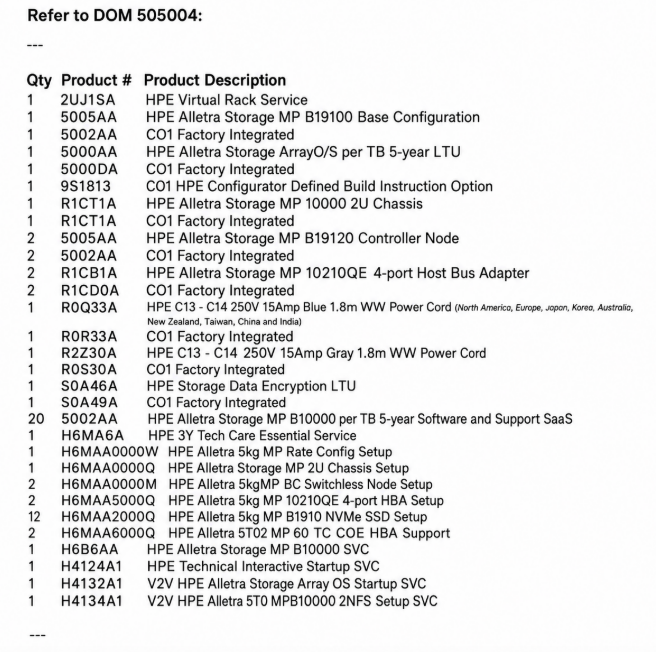
A junior architect has prepared a BOM for the solution.
What needs to be changed in the BOM to meet the requirement?
Answer : C
The correct answer is C. The customer requirement is explicit: four SFP28 iSCSI ports per controller node. An HPE Alletra Storage MP B10000 controller pair has two nodes, so the design requires eight usable SFP28 optical connections in total when all four 25GbE ports on each node are to be populated. The BOM already includes the Ethernet host bus adapters required for the iSCSI personality; the gap is the number of optical transceivers. HPE Alletra Storage MP B10000 supports host-port configuration by node, and HPE QuickSpecs list host port limits by controller model. HPE also identifies the 10/25GbE 4-port Host Bus Adapter as the correct Ethernet HBA class for Alletra Storage MP connectivity, while the Q2P64B item is the 25Gb SFP28 short-wave extended-temperature optical transceiver. Option A incorrectly removes the HBAs. Option B adds unnecessary HBAs instead of completing the optics population. Option D replaces adapters unnecessarily when the correct Ethernet HBA capacity is already present. The required correction is to add the missing four SFP28 transceivers so that all eight 25GbE ports can be used for iSCSI. Reference/topics: B10000 host-port sizing, iSCSI connectivity, SFP28 transceiver validation, BOM review.
Question 4
Your customer has HPE Superdome Flex running VMware ESXi 8.x. Current setup consists of:
One Rack Management Controller
One HPE Superdome Flex Base chassis
One HPE Superdome Flex Expansion chassis
The existing complex has a single nPartition. The customer plans to expand the existing nPartition with two additional expansion chassis.
Which statement about the planned expansion is true?
Answer : C
The correct answer is C because adding additional expansion chassis changes the physical hardware boundary of the HPE Superdome Flex complex and the resources assigned to the existing nPartition. Such a change cannot be treated like a live virtual-machine operation or a simple online software adjustment. The existing nPartition must be powered off before the physical expansion and partition-resource changes can be completed safely and consistently. Option A is incorrect because HPE OneView management does not require removing the nPartition from management merely to perform a hardware expansion; HPE OneView supports management of Superdome Flex-class infrastructure. Option B is incorrect because adding expansion chassis does not require replacing an expansion chassis with another base chassis for I/O redundancy in the way stated. Option D is also insufficient because placing the partition into a maintenance mode from the Rack Management Controller CLI is not equivalent to powering off the partition for a chassis-level expansion. The course includes Superdome Flex and scale-up compute designs for database and mission-critical workloads, so this question validates correct lifecycle planning for large HPE scale-up systems.
Question 5
Which statement about HPE SimpliVity is true?
Answer : D
The correct answer is D. In HPE SimpliVity designs, non-HPE SimpliVity compute nodes can be added to consume the storage and data services provided by SimpliVity nodes, but the supported ratio depends on the validated SimpliVity platform and processor family. For Intel-based HPE SimpliVity nodes, the supported design rule in this context allows up to eight non-HPE SimpliVity servers per SimpliVity node. Option A is incorrect because compute-node designs do not require identical CPUs across every server in the way stated; compatibility and supportability are governed by the validated platform, hypervisor, cluster, and SimpliVity federation rules. Option B is too broad and unsafe: mixing processor families and chassis types inside the same federation is controlled by strict HPE support matrices and is not ''fully supported'' as a general rule. Option C gives the wrong AMD-based ratio for the scenario. HPE SimpliVity 380 Gen11 is documented as an Intel Xeon-based platform and is positioned for hyperconverged infrastructure with VM-centric management, data efficiency, backup, and disaster recovery. Reference/topics: SimpliVity sizing rules, compute-node attachment, federation design, HCI platform validation.
Question 6
One of your customers is planning to refresh their current campus wired and wireless networking equipment. They are currently moving to a pay-per-use model for their whole IT solution.
They are wondering if there is a possibility to get new networking equipment in this model without capital expenses. They are also interested in moving LAN management to an external service provider. You are presenting HPE GreenLake for Aruba Networking.
Which statement is true for this customer situation?
Answer : A
The correct answer is A because the customer is asking for a network refresh without traditional capital purchase and also wants externalized operational management. HPE GreenLake for Networking is positioned as a Network-as-a-Service model that allows customers to consume HPE Aruba Networking capabilities in a cloud-like operating model rather than buying every component upfront. HPE's GreenLake for Networking QuickSpecs describe it as a comprehensive NaaS offering for consuming HPE Aruba Networking Edge Services Platform capabilities in a cloud-like way. HPE Managed Services can also provide remote monitoring, management, and optimization of supported infrastructure, which aligns with the customer's desire to move LAN management to an external provider. Option B is too narrow because the offer is not merely a software-license subscription. Option C confuses HPE GreenLake for Networking with Aruba Central-style cloud management. Option D is incorrect because the service is built around HPE Aruba Networking solutions, not generic expert support for arbitrary third-party wireless platforms. Reference/topics: HPE GreenLake for Networking, NaaS positioning, HPE Managed Services, business-outcome mapping.
Question 7
Which statement about Omnissa Horizon workloads is correct?
Answer : A
The correct answer is A. Omnissa Unified Access Gateway is the edge access component used with Horizon to provide secure remote access from an external network to internal Horizon desktops and applications. It is commonly positioned in a DMZ and avoids exposing internal Horizon infrastructure directly to external users. Omnissa documentation describes Unified Access Gateway as enabling secure remote access from external networks to Workspace ONE and Horizon resources, and Horizon installation guidance describes it as the default gateway for secure access to remote desktops and applications from outside the corporate firewall. Option B is incorrect because Horizon support is not limited to a minimum of more than 720 desktops, nor is it only supported through a generic HPE Compute qualification. Option C is technically wrong because Horizon can use supported VMware datastore types such as VMFS, NFS, and vVols depending on the validated design. Option D is also wrong because GPU resources are required only for graphics-accelerated use cases, not for every Horizon cluster. Reference/topics: workload requirement analysis, VDI architecture, HPE compute platform positioning, secure access design.
 All Official Question Types