Page: 1
/ 14
Total 180 questions
Huawei HCIE Carrier IP (Written) V1.0 H31-161 Exam Questions
Question 1
Interface Ethernet 3/1/0 is configured as follows:
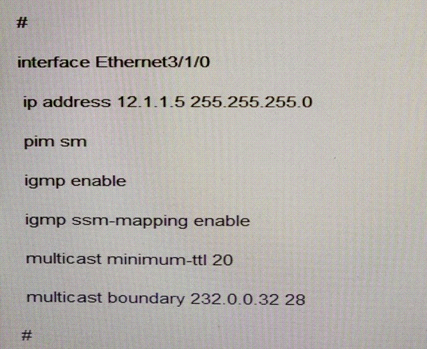
Ethernet 3/1/0 receives multicast group 232 0.0.31 IGMFV2 Report messages, If no multicast traffic sent to group 232.0.31 can be detected on Ethernet 3/1/0, which of the following causes may be true?
Answer : A, B, D
Question 2
Which statement describes the delay requirement of the voice service for the IP bearer network?
Answer : A
Question 3
The inner VLAN tag in layer 2 user packets is used to differentiated key services from other services. If packets are not processed after being encapsulated by QinQ, the 802. 1p information of the inner VLAN tag becomes invalid. After the QinQ is employed, three methods can be used to configure conditions for sensing 8021p configuration of the inner VLAN tag:
1. Reset the 802.1p of the outer VLAN tag regardless of the existing 02 1p configurations of the inner VLAN tag.
2. Automatically swap the 802. 1p configurations of the inner VLAN tag to that of the outer VLAN tag.
3. Reset the 802.1p configurations of the outer VLAN tag based on the existing 802.1p configurations of the different VLAN tags
Answer : A
Question 4
About the merits and demerits of inter-AS VPN-IPv4 Option B using MP-EBGP between ASBRs,
which statement is true?
Answer : C
Question 5
Which of the following reserved IP multicast addresses is the address of all PIM routers?
Answer : B
Question 6
Refer to the exhibit.
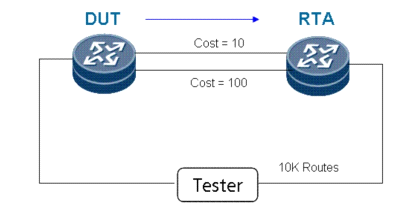
As shown in the topology, RTB directly connects to RTC through the POS
interface. To implement the TE function, RTB and RTC are configured as follows:
Configuration of RTB:
mpls lsr-id 2.2.2.2
mpls
mpls te
mpls rsvp-te
mpls te cspf
#
isis 1
is-level level-2
cost-style compatible
network-entity 00.2222.2222.2222.00
traffic-eng level-1-2
log-peer-change
#
interface Pos4/1/0
clock master
link-protocol ppp
ip address 22.33.22.33 255.255.0.0
isis enable 1
mpls
mpls templs rsvp-te
Configuration of RTC:
#
mpls lsr-id 3.3.3.3
mpls
mpls te
mpls rsvp-te
mpls te cspf
#
isis 1
is-level level-2
cost-style wide
network-entity 00.3333.3333.3333.00
traffic-eng level-1-2
log-peer-change
# #
interface Pos5/1/0
link-protocol ppp
ip address 22.33.33.22 255.255.0.0
isis enable 1
mpls
mpls te
mpls rsvp-te
When a neighbor relationship is set up between RTB and RTC and becomes robust, the following information can be found in the LSDB of RTB.
Database information for IS-IS(1)
--------------------------------
Level-2 Link State Database
LSPID Seq Num Checksum Holdtime Length ATT/P/OL
2222.2222.2222.00-00* 0x00007191 0x6689 1190 239 0/0/0
SOURCE 2222.2222.2222.00
NLPID IPV4
AREA ADDR 00
INTF ADDR 22.33.22.33
NBR ID 3333.3333.3333.00 COST: 10
+NBR ID 3333.3333.3333.00 COST: 10
IP-Internal 22.33.0.0 255.255.0.0 COST: 10
+IP-Extended 22.33.0.0 255.255.0.0 COST: 10
Router ID 2.2.2.2
3333.3333.3333.00-00 0x0000001c 0x14a3 1184 188 0/0/0
SOURCE 3333.3333.3333.00
NLPID IPV4
AREA ADDR 00INTF ADDR 22.33.33.22
+NBR ID 2222.2222.2222.00 COST: 10
+IP-Extended 22.33.0.0 255.255.0.0 COST: 10
Router ID 3.3.3.3
Two records are generated for the same NBR ID, as shown in bold fonts. Which statement is true?
Answer : B
Question 7
Exhibit:
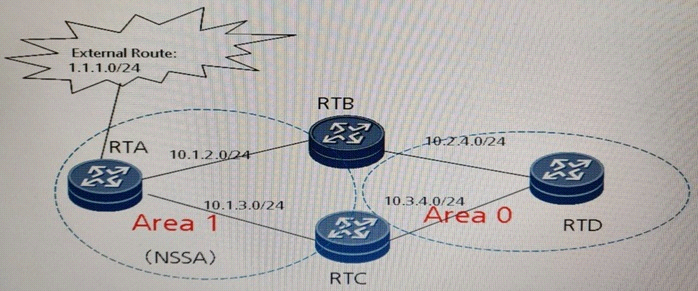
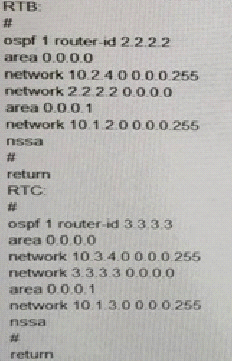
As shown in the figure, external route 1.1.1.0/24 is imported to RTA that is located in the NSSA area RTD is a backbone area router. RTB and RTC are both area border router (ABRs). OSPF configuration are as follows.
Which statement is true?
Answer : C
 All Official Question Types