Page: 1
/ 14
Total 121 questions
IBM Integration Bus v10.0 Solution Development C9530-001 Exam Questions
Question 1
While processing messages in a message flow, Java exceptions are encountered. Where should more details on these Java exceptions be found?
Answer : A
When a node in a message flow throws an exception this is assigned a BIP number. As the exception is propagated up the flow, possibly being processed by various exception handling routines attached to the catch terminal of nodes it may be 'wrapped' in several outer exceptions. This forms a 'stack' of exceptions known as an ExceptionList.
If an exception reaches an input node without being handled by any branch of the flow then the input transaction is rolled back and each message in the ExceptionList is output to the syslog.
References: https://developer.ibm.com/integration/docs/ibm-integration-bus/troubleshooting/diagnostic-tools/
Question 2
A developer plans to create two new message flows. Flow1 that uses TimeoutControl and TimeoutNotification nodes in Controlled mode, and Flow2 that uses only the TimeoutNotification node in Automatic mode.
The Integration Node is installed on a system without IBM MQ installed. What problems will the developer encounter?
Answer : B
Information about the state of in-flight messages is held on storage queues that are controlled by WebSphere MQ, so you must install WebSphere MQ on the same computer as your integration node if you want to use the capabilities provided by the TimeoutControl node.
References: https://www.ibm.com/support/knowledgecenter/SSMKHH_10.0.0/com.ibm.etools.mft.doc/bc28150_.htm
Question 3
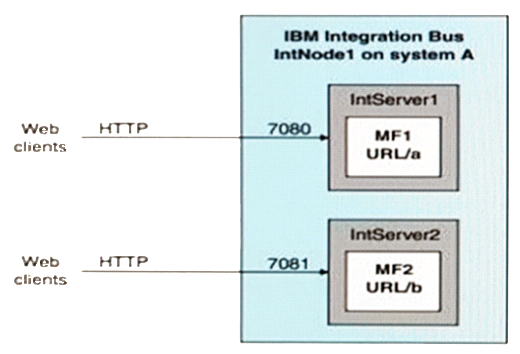
Two different sets of applications are deployed to Integration Server 1 and Integration Server 2 respectively, as shown in the image below.
What is the advantage of using the Integration Server embedded HTTP listener to the Integration Node listener?
Answer : B
Each connector has its own assigned port, which is allocated from a range of numbers, as required. The default range for the HTTPConnector is 7800 - 7842; the default range for the HTTPSConnector is 7843 - 7884. The first integration server to start an embedded listener is allocated port 7800, the second is allocated 7801, and so on.
If you deploy a message flow to multiple integration servers, the port number is incremented by one for each successive deployment. Assume that no embedded listeners have as yet been started for these integration servers. In this case, the message flow that is deployed to the first integration server receives requests on port 7800. The next message flow uses port 7801, and so on, up to the specified limit of 7842. In this scenario, you typically use an intermediary router that listens on one port, then distributes the requests across the range of ports that you are using.
References: https://www.ibm.com/support/knowledgecenter/en/SSMKHH_10.0.0/com.ibm.etools.mft.doc/bc43700_.htm
Question 4
The security team has informed the Integration Bus developers that they need to start using SSL when using the web user interface. Administration security is still disabled. What does the developer need to do to now access the web user interface?
Answer : B
To enable access to broker resources through the web user interface, configure the
IBM Integration Bus web user interface server.
If you are using HTTPS, run the following command:
mqsichangeproperties brokerName
-b webadmin -o HTTPSConnector -n port,keystoreFile,keystorePass
-v portValue,fileName,password
- brokerName is the name of your broker.
- portValue is the HTTPS port value that you want to use for the web
user interface.
- fileName is your keystore file.
- password is the password for the keystore file.
References: IBM Integration Bus 9.0.0 Administering , page 128
ftp://public.dhe.ibm.com/software/integration/integrationbus/docs/V9.0/iib_v9r0_admin.pdf
Question 5
Which protocol for security is not supported by IBM Integration Bus?
Answer : A
Setting up message flow security
Set up security on a message flow to control access based on the identity of a message passing through the message flow.
You can configure the broker to perform end-to-end processing of an identity carried in a message through a message flow. Administrators can configure security at message flow level, controlling access based on the identity flowed in a message. This security mechanism is independent of both the transport and the message format.
To work with an identity, you must configure the policy sets and bindings for the relevant capabilities:
References: https://www.ibm.com/support/knowledgecenter/en/SSMKHH_9.0.0/com.ibm.etools.mft.doc/ap04170_.htm
Question 6
A developer creates a message flow that uses a DecisionService Node. Which command must the developer use before deploying the message flow?
Answer : B
Before you deploy message flows that contain a DecisionService node, you must enable the mode extension by using the mqsimode command:
mqsimode -x DecisionServices
Question 7
Which statement is a reason to use external eXtreme Scale data cache with IBM Integration Bus?
Answer : C
Choose an external grid if you have any of the following requirements:
You have an architectural preference for the cached data not to be placed in the integration servers themselves.
You want to separate the availability of the cache from the availability of the integration servers.
You need an enterprise cache, with multiple applications (other than IBM Integration Bus) that are accessing the data.
You have (or want) sophisticated, or custom, tools to manage the cache.
The cache needs to span multiple data centers for disaster recovery.
You need to configure the grid for specific capabilities that are not supported by the embedded global cache.
References: https://www.ibm.com/support/knowledgecenter/SSMKHH_9.0.0/com.ibm.etools.mft.doc/bn23733_.htm
 All Official Question Types