Page: 1
/ 14
Total 40 questions
iSQI A4Q Certified Selenium Tester Foundation CSeT-F Exam Questions
Question 1
Which of the following statements is true about test automation metrics?
Answer : D
Meaningful test automation metrics are part of demonstrating business value. Test automation metrics provide a quantitative way to measure the success of the test automation process, helping to identify areas where it is working well and areas where it could be improved. These metrics can be used to demonstrate the value of test automation to stakeholders, such as by showing the cost savings and increased productivity it can provide. Common test automation metrics include test execution time, test coverage, defect detection rate, and the cost of maintaining test scripts.
Question 2
Which of the following statements about XPath is true?
Answer : D
XPath is a query language used to traverse and find nodes in XML documents. It uses a syntax expression to identify elements and attributes in an XML document, allowing you to select and extract specific data. XPath does not use CSS selectors to identify nodes, it uses its own syntax. Additionally, XPath is not used to gather input from users, but rather to traverse and find nodes in XML documents.
Question 3
Which of the following methods can find an element by its class name? Select two options
Answer : A, D
The correct methods for finding an element by its class name are A. findelementbycssselector and D. findelementbytagname. The findelementbycssselector() method can be used to locate an element by its class name, while the findelementbytagname() method can be used to locate an element using the tag name of the element (such as 'div', 'span', 'a', etc).
Question 4
In the web application you are testing, a button on a page can be enabled or disabled Given the following code
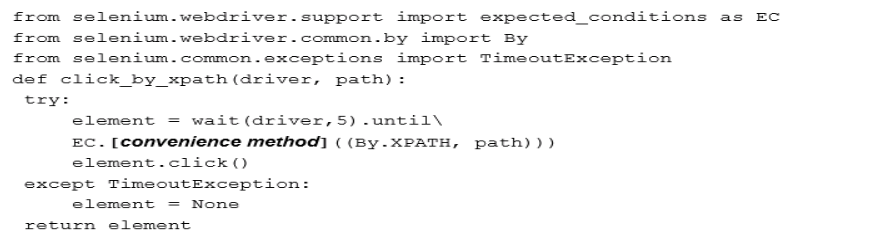
Which of the following wait convenience methods is the MOST appropriate to replace [convenience method] above to click on an enabled button?
Answer : B
This method will wait until the element is both visible and enabled, ensuring that the button is in a clickable state before attempting to click on it.
Question 5
Given that only one alert message in your web application says. "Account deleted", which line(s) of code will allow you to know that the "Account deleted" alert is displayed?
A)

B)

C)

D)

Answer : C
The line of code to allow you to know that the 'Account deleted' alert is displayed is: alert = driver.switch_to.alert assert 'Account deleted' in alert.text
Question 6
Which of the following BEST explains how Selenium fits within the test automation architecture?
Answer : B
Selenium interfaces with the System Under Test (SUT) to interact with it and run tests on it [1]. Selenium is a tool that is used to automate web browsers, which allows testers to create automated tests to verify the functionality of the SUT. It helps to reduce the need for manual testing and allows testers to test multiple browsers quickly and efficiently.
Selenium is a software tool that is used for automating web browsers. It interfaces with the System Under Test (SUT) by interacting with the web browser and the web application that is being tested. Selenium uses a set of APIs that allow you to control the browser and interact with elements on the web page, such as buttons, text fields, and links. By automating the browser and interacting with the web application in the same way that a user would, Selenium can be used to automate functional tests, regression tests, and other types of tests.
Question 7
Given a modal dialog with an ID = "modal1" and a button in the modal with a class name = "modal1-butlon1", which line(s) of code will click on the modal button?
A)

B)

C)

D)

Answer : D
 All Official Question Types