Page: 1
/ 14
Total 45 questions
ISTQB Certified Tester Security Tester CT-SEC Exam Questions
Question 1
As a security tester, you are ensuring that source code and/or sensitive data is protected from copy/paste through network packet capture.
Which ONE of the following techniques BEST describes your work?
Answer : A
Data obfuscation is a security technique used to transform information or source code into a representation that is difficult for unauthorized individuals to understand, interpret or reuse. Its primary objectives include protecting sensitive information, intellectual property and proprietary application logic against unauthorized copying and reverse engineering.
The ISTQB Security Tester syllabus identifies obfuscation as a mechanism for protecting sensitive data and source code against unauthorized copying, including attempts to circumvent software licensing protections or understand proprietary algorithms.
In this scenario, the security tester evaluates whether information obtained through network packet capture remains intelligible and potentially reusable. Effective protection should prevent intercepted content from exposing sensitive information in an easily understandable format.
Encryption is particularly important when protecting sensitive information transmitted across networks. Although the syllabus classifies encryption as a form of obfuscation, simple encoding and source-code obscuration do not provide equivalent cryptographic confidentiality.
Data reconnaissance concerns gathering information about a target. Data manipulation involves modifying information, potentially compromising its integrity. Boundary defense focuses on controlling communications between networks or security zones.
Option A therefore most closely matches the described security technique. In practical implementations, authenticated encryption should be used where confidentiality and integrity of transmitted information are required.
Official Reference: ISTQB CT-SEC Syllabus 2016, Sections 5.7.1 -- Understanding Data Obfuscation and
5.7.2 -- Testing the Effectiveness of Data Obfuscation Approaches, pages 66--67; Section 5.3 -- Encryption.
Question 2
In the scenario above, which ONE of the following security test-planning objectives and key security test-plan elements is absent?
Answer : A
Security test planning must address both the effectiveness of implemented security mechanisms and the prevention of vulnerabilities introduced during software development.
Section 3.2.1 of the ISTQB Security Tester syllabus identifies quality assurance activities and best practices throughout architecture, design and coding as important measures for preventing unintended security vulnerabilities.
Architecture-level security activities establish fundamental protection mechanisms, trust boundaries and structural security requirements. However, secure architecture alone cannot guarantee that the resulting application will be implemented securely.
Design-level activities evaluate authentication mechanisms, authorization models, data protection requirements and interactions between components. Coding-level activities examine implementation practices, input validation, error handling, memory management and adherence to secure coding standards.
If quality assurance activities address architecture but omit detailed design and coding, significant vulnerabilities may remain undetected until later testing stages.
Option B concerns quality assurance during testing rather than preventive development practices. Option C represents an important planning constraint involving achievable scope and available resources. Option D concerns applicable standards and compliance requirements.
Option A specifically identifies the development activities that must accompany architecture-level security assurance to prevent the introduction of implementation-related vulnerabilities.
Verification note: The introductory scenario is missing from the ODT. Answer A assumes that architecture-level quality assurance is already addressed, as indicated by the accompanying source material.
Official Reference: ISTQB CT-SEC Syllabus 2016, Sections 3.2.1 -- Security Test Planning Objectives and
3.2.2 -- Key Security Test Plan Elements, pages 38--39.
Question 3
Which TWO of the following acceptance criteria are valid for this requirement?
Choose two.
Answer : A, E
Security acceptance criteria define measurable conditions that must be satisfied to demonstrate that a security requirement has been implemented correctly. For authentication mechanisms involving a one-time password (OTP), acceptance criteria should address successful authentication, unsuccessful verification attempts and the enforcement of applicable retry restrictions.
Entering a correct and valid OTP should allow an otherwise authenticated user to complete the login process, provided that all other authentication requirements have been satisfied. Option A therefore represents a positive acceptance criterion.
Option E establishes expected negative behavior when an incorrect OTP is entered. Assuming that the requirement permits fewer than three consecutive unsuccessful attempts before account lockout, the system should reject the submitted OTP and display an appropriate error message.
Option B introduces account lockout based on non-receipt of an OTP. Failure to receive a message does not necessarily constitute an unsuccessful authentication attempt.
Option C fails to establish a measurable security outcome for an incorrect OTP submission.
Option D describes circumstances in which the authentication mechanism can be bypassed, contradicting the purpose of requiring OTP verification.
The ISTQB syllabus emphasizes defining testable security requirements and acceptance criteria that evaluate both correct security behavior and responses to invalid actions.
Verification note: The original OTP requirement is missing. Answers A and E assume that OTP verification is mandatory and that the first two incorrect attempts permit retries.
Official Reference: ISTQB CT-SEC Syllabus 2016, Sections 3.1.2 -- Aligning the Security Testing Process to a Particular Application Lifecycle Model, pages 37--38; 4.5.2 -- The Role of Security Testing in Acceptance Testing, page 56; and 5.2.2 -- Testing the Effectiveness of Authentication and Authorization Mechanisms, page 62.
Question 4
Which ONE of the following input-value sets provides 100% coverage of two boundary values for the string length?
Answer : B
Boundary Value Analysis (BVA) is a specification-based test design technique used to identify defects occurring at the boundaries between equivalence partitions. It is particularly relevant to security testing because incorrect input-length restrictions can contribute to inadequate input validation, application instability and other security weaknesses.
The original question stem omits the permitted string-length range. The accompanying material establishes a minimum permitted length of six characters and a maximum permitted length of twelve characters.
Under two-value boundary value analysis, each boundary is tested using the boundary value and its closest neighboring value in the adjacent equivalence partition.
The required coverage values are:
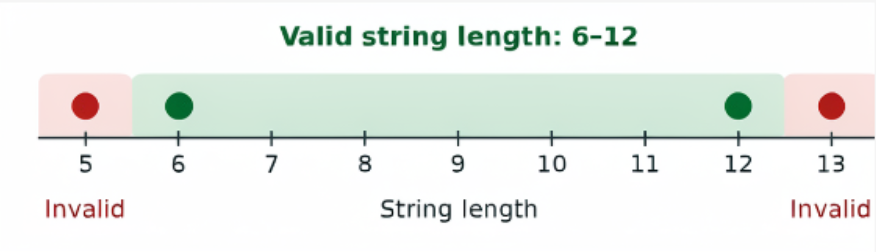
Illustration of two-value boundary coverage.
Test input Length
Expected length validation
aB#@5 5
Rejected aB#@56 6
Accepted bbBb?!bB48bb 12
Accepted abCd?!gH48klm 13
Rejected
Option B contains all four required boundary coverage values: 5, 6, 12 and 13.
Option A substitutes an eleven-character string for the required twelve-character value. Option C omits the five-character boundary value. Option D omits both six and thirteen.
Consequently, option B provides complete two-value boundary coverage for the specified length restriction. This establishes coverage of string-length boundaries, rather than complete security coverage of every possible string characteristic.
Official Reference: ISTQB CT-SEC Syllabus 2016, Sections 3.3.1 -- Security Test Design and 4.4.2 -- Security Test Design at the Component Level. Supporting technique: ISTQB Foundation Level -- Boundary Value Analysis.
Question 5
Security risk assessment prioritizes security risks so that testing aligns with business security objectives.
Which ONE of the following options would cause a misalignment between the business security objectives and the tests?
Answer : C
Security risk assessment establishes the relationship between organizational assets, potential threats, existing vulnerabilities, likelihood of occurrence and the consequences resulting from successful exploitation. This relationship provides the basis for prioritizing security testing activities according to business requirements.
The ISTQB Security Tester syllabus explains that alignment between security testing and business security objectives depends on accurately representing organizational security threats, affected stakeholders and the assets requiring protection.
Treating security threats as independent of assets removes an essential component of risk analysis. Although a particular threat may affect multiple assets, its significance depends on the characteristics, value, exposure and business importance of each affected asset.
For example, unauthorized access to a publicly available marketing document and unauthorized access to a confidential customer database represent substantially different business consequences, despite potentially involving similar attack techniques.
Option A supports stakeholder communication and informed risk management. Option B contributes to identifying relevant threats and establishing security test coverage. Option D addresses likelihood, which is one of the fundamental components of risk assessment alongside adverse impact.
An asset-independent approach can result in inappropriate prioritization, inadequate testing of critical systems and excessive testing of comparatively low-risk resources. Security tests must therefore remain traceable to the assets, threats and business consequences identified during risk assessment.
Official Reference: ISTQB CT-SEC Syllabus 2016, Sections 1.1.1 -- The Role of Risk Assessment in Security Testing and 1.1.2 -- Asset Identification, pages 12--14.
Question 6
Max is attempting to collect as much information as possible about a specific target. He wants to identify the technology used by its website, IP addresses, employee details, and similar information.
Using the information collected, he will choose the tools and techniques to hack the target.
Which TWO of the following tools can help him perform this task passively, without actually connecting to the target system?
Choose two.
Answer : A, D
Reconnaissance, also referred to as footprinting, is an information-gathering activity used to establish an understanding of a target's publicly visible infrastructure, technologies and associated organizational information. Reconnaissance techniques are classified as passive or active according to whether they directly interact with the target system.
Passive reconnaissance relies on information available through independent repositories, publicly accessible databases and external information services. The ISTQB Security Tester syllabus explicitly identifies Whois and the RIPE database as examples of resources that support passive information gathering.
Whois services provide registration-related information associated with internet resources, including domain names and IP address allocations. Information availability depends on the relevant registry and applicable privacy restrictions.
The RIPE database contains internet number resource registration information, including IP address allocations, autonomous system numbers and associated organizational or network information.
Both resources can be consulted without directly establishing a connection to the target organization's infrastructure.
TCP and UDP scanning generally involves transmitting network traffic to target systems to identify accessible communication ports. Service fingerprinting, as described in the syllabus, involves examining responses from discovered services. Xprobe2 performs operating system identification through active network-based techniques.
Consequently, Whois and the RIPE database satisfy the stated passive reconnaissance requirement. Security testing activities should remain within formally authorized assessment boundaries.
Official Reference: ISTQB CT-SEC Syllabus 2016, Section 6.1.2 -- Understanding the Attacker Mentality, pages 69--70; Chapter 10, references Web-12 and Web-13.
Question 7
Which ONE of the following actions could give an attacker information during the reconnaissance phase of an attack?
Answer : C
Reconnaissance is the information-gathering phase of an attack during which an attacker attempts to establish an understanding of the target organization, its technical infrastructure, personnel and potential vulnerabilities. Information disclosed through publicly accessible sources may contribute significantly to subsequent attack planning.
The ISTQB Security Tester syllabus identifies search engines, social networks, professional networking platforms and publicly accessible technical information as potential reconnaissance sources.
Public technical discussions concerning organizational systems may disclose software products, operating system versions, network architecture, infrastructure configurations, authentication mechanisms or operational practices. Such information can increase an attacker's understanding of the organization's exposure without requiring direct interaction with its protected systems.
Option A concerns an internal social network, while option B involves an internal intranet forum. Assuming access controls operate correctly, these sources are not ordinarily accessible to external attackers.
Option D may also disclose useful information, including employee identities, responsibilities and technical expertise. However, option C describes direct public disclosure of information concerning organizational systems and therefore provides the strongest answer.
Organizations should maintain appropriate information-disclosure policies and security awareness training to reduce the unintended publication of sensitive technical details.
The question is not completely unambiguous because professional profiles can also support reconnaissance, as explicitly recognized in the syllabus.
Official Reference: ISTQB CT-SEC Syllabus 2016, Sections 6.1.1 -- The Impact of Human Behavior on Security Risks and 6.1.2 -- Understanding the Attacker Mentality, page 69.
 All Official Question Types