Page: 1
/ 14
Total 28 questions
ISTQB Certified Tester Expert Level Assessing Test Processes CTEL ITP ATP Exam Questions
Question 1
As a test manager, you have been asked to use an industry test-process-improvement model and apply it to your team. Your manager asks you to ensure that you choose a model that does not require improvements to be implemented in a particular order, because they have a clear view of the priorities.
Which ONE of the following models is MOST appropriate to select?
Answer : B
Comprehensive and Detailed Explanation::
The Systematic Test and Evaluation Process (STEP) is a content-based test process improvement model that provides structured guidance concerning effective testing practices without prescribing a mandatory sequence for implementing improvements.
The ISTQB Expert Level syllabus explicitly states that STEP does not require improvements to occur in a specific order. Its underlying methodology treats testing as a lifecycle activity that begins during requirements formulation and continues until system retirement.
This flexibility makes STEP particularly suitable for organizations that have already established their improvement priorities and wish to implement changes according to specific business needs, operational risks and resource constraints.
The improvement characteristics of the available models can be summarized as follows: Model
Improvement representation Implementation order CMMI
Staged or continuous in the syllabus version Depends on representation
STEP
Content-based Non-prescriptive TPI Next
Continuous with improvement clusters
Some prescribed dependencies TMMi
Staged
Predefined maturity progression
Although TPI Next provides considerable flexibility through its continuous representation, its checkpoint clusters introduce dependencies that require certain improvements to occur in a specified order.
TMMi explicitly establishes a staged maturity hierarchy. CMMI provides broader software process improvement guidance rather than the targeted, non-prescriptive testing approach offered by STEP.
Therefore, STEP directly satisfies management's requirement to implement testing improvements according to established business priorities without following a predefined improvement sequence.
Official Reference: ISTQB CTEL-ITP Syllabus 2011, Section 3.4.1 -- STEP, page 27; Section 3.3.1 -- TPI Next, pages 25--26; Section 5.1 -- Selecting Test Process Improvement Approaches, page 36.
Final Answer Verification Summary -- Questions 1--25 Question
Answer Verification status 1
D
Confirmed 2
D
Corrected from A 3
A
Confirmed 4
B
Corrected from C
5
B
Imprecise question 6
D
Confirmed 7
---
Incomplete question 8
D
Ambiguous; reassessed 9
C
Confirmed 10
A
Corrected from B 11
D
Confirmed 12
C
Confirmed 13
C
Confirmed 14
B
Confirmed 15
B
Confirmed 16
D
Confirmed 17
D
Confirmed 18
C
Confirmed 19
A
Corrected from D 20
B
Confirmed 21
D
Confirmed
22
B
Confirmed 23
C
Confirmed with metric limitation 24
C
Reassessed from A; conditional 25
B
Confirmed
Outstanding quality issues before publication:
Question 7 requires reconstruction because metrics I--VI are missing. Questions 5 and 8 require wording improvements to eliminate ambiguity. Question 23 requires additional metrics for complete GQM alignment.
Question 24 should explicitly define the severity classification scale.
Question 2
SIMULATION
Question Type: Essay / TPI Next Assessment and Root Cause Analysis Maximum Points: 50
In this essay question, you will be asked to do the following:
1. Evaluate assessment results shown on a TPI Next matrix and provide recommendations.
2. Evaluate results from defect root cause analysis and provide recommendations.
3. Propose recommendations and conclusions based on the above information.
GCF provides software applications that manage the financial strategies of global companies in the banking sector. GCF has received some negative feedback from its customers relating to its Galaxy series of products. As an initial reaction to this, the following activities have been conducted by an external assessment organization:
1. A test process assessment was performed to determine whether the basic aspects of testing were being performed. The assessment covered the initial two clusters A and B as defined in TPI Next.
2. Defects reported by the help desk over the last six months were analyzed to gain insights into root causes.
The results of these two initial activities are shown below. Figure 1 shows the assessment of clusters A and B on a TPI Next matrix. Tables 1 and 2 list the checkpoints for these two clusters.
In the context of the above, GCF has defined several business objectives regarding testing:
1. Improve the effectiveness of testing.
2. Improve transparency of testing to its stakeholders.
3. Improve test management practices.
Task 1: Recommendations based on TPI Next assessment (Maximum 20 points)
Analyze the results shown on the TPI Next matrix (Figure 1). Use Tables 1 and 2 as a reference if necessary.
Propose five recommendations based on the results of the TPI Next assessment. Enter your answers in Table
3. Each recommendation must clearly state:
1. What should be done.
2. What the positive impact will be on the business objectives of the GCF company.
EXHIBIT -- Figure 1: TPI Next Matrix for Clusters A and B in Maturity Level ''Controlled''
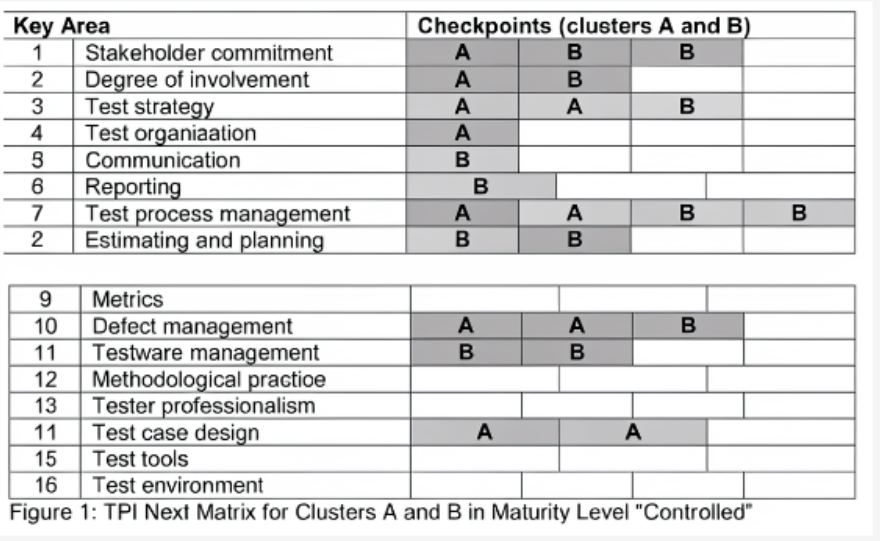
Original matrix cropped from pages 20--21 of the official sample examination.
In Figure 1, the checkpoints successfully achieved are shaded dark grey. The checkpoints not achieved are shaded light grey. All other checkpoints, including those relating to higher maturity levels, are out of scope.
Table 1: Checkpoints for TPI Next Cluster A Key area
Cluster A: Checkpoint Number / Checkpoint Stakeholder commitment
1. The principal stakeholder is defined (not necessarily documented) and known to the testers.
Degree of involvement
1. The test assignment, scope and approach are negotiated early with the principal stakeholder as one of the first test activities.
Test strategy
1. The principal stakeholder agrees with the documented test strategy.
Test strategy
2. The test strategy is based on a product risk analysis.
Test organization
1. People involved know where to find the persons (or department) responsible for test services.
Test reporting
1. The reporting contains aspects of time and/or costs, results, and risks.
Test process management
1. At the start of the test project a test plan is created. The test plan includes at least the test objectives, the test scope, the test planning, the roles, and responsibilities.
Test process management
2. The test plan is agreed to by the principal stakeholder.
Defect management
1. The defect lifecycle is defined (including a retest) and applied.
Defect management
2. The following items are recorded for each defect: unique ID, related test case ID (if applicable), person reporting the defect, date, severity, description (the actions to reproduce the defect, expected and observed result) and defect status.
Test design
1. The test cases are recorded on a logical level.
Test design
2. The test cases consist of a description of: a) initial situation, b) change process = test actions to be performed, c) predicted result.
Table 2: Checkpoints for TPI Next Cluster B Key area
Cluster B: Checkpoint Number / Checkpoint Stakeholder commitment
2. Budget for test resources is granted by and negotiable with the principal stakeholder.
Stakeholder commitment
3. Stakeholders deliver the committed resources.
Degree of involvement
2. Test activities are started early, timely before test execution, with the goal of keeping the test activities off the project's critical path.
Test strategy
3. There is a differentiation in test levels, test types, coverage, and test depth, depending on the analyzed risks.
Communication
1. Every team member is aware of decisions being made and of internal progress.
Test process management
3. Each test activity is monitored and when necessary, adjustments are initiated.
Test process management
4. The test plan is agreed with the relevant stakeholders.
Estimating and planning
1. For test effort estimation, simple techniques are used such as ratios.
Estimating and planning
2. For each test activity there is an indication of the period in which it runs, the resources required and the products to be delivered. Activities to be identified are test planning and management, defining test cases and executing test cases.
Defect management
3. For further handling of defects the responsibilities are defined.
Testware management
1. The test basis, the test object and all testware are identified by name and version.
Testware management
2. Each test case is related to a test basis in a transparent way.
Task 2: Defect analysis (Maximum 10 points)
Table 4 shows defect data recorded by the help desk over the last six months relating to the three most common root causes affecting the Galaxy range of products.
Products in the Galaxy range:
Galaxy-TX: Mainframe application for processing financial transactions. Galaxy-Go: Mainframe application for issuing customer account statements.
Galaxy-Self: Web-based application allowing customers access to their accounts. Galaxy-App: Mobile application allowing customers mobile access to their accounts. Analyze the data shown in Table 4 and propose two (2) improvement recommendations. Each recommendation must clearly state:
1. What should be done.
2. What the positive impact will be on the business objectives of GCF. Enter your answers in Table 5.
EXHIBIT -- Table 4: Results of Root Cause Analysis for Defects Affecting the Galaxy Product Range Galaxy product
Galaxy-TX Galaxy-Go Galaxy-Self Galaxy-App Defects
Number of defects 30
20
30
50
% high severity 67%
20%
0%
10%
% medium severity 17%
60%
50%
10%
% low severity 16%
20%
50%
80%
Top three root causes
Testing not completed as planned 80%
60%
0%
10%
Poor release management 10%
30%
10%
80%
Stakeholder expectations not fulfilled 10%
20%
90%
10%
Task 3: Summary of conclusions (Maximum 20 points)
You are requested to present your conclusions to high-level management, who do not have a detailed technical understanding of testing. Each statement must be understandable, address company objectives, relate to the findings (TPI Next and root cause analysis) and must not use technical terms. It must be clear what actions management needs to take.
Make the following five (5) summary statements:
The current test process maturity.
For each of the three business objectives, indicate how the recommended test process improvements will provide benefit to the company. The statements should consider your answers to Tasks 1 and 2 above without repeating them literally.
Where to set priorities for improving the test process (identify the top three priorities). Enter your answers in Table 6.
Answer : A
Comprehensive and Detailed Model Answer
Task 1 Answer: Recommendations based on TPI Next assessment (20 points)
The assessment identifies fundamental weaknesses in test strategy, test design, stakeholder agreement, reporting, communication, estimation and test progress control.
Although several foundational practices are established, the organization has not achieved all the checkpoints required for the initial improvement clusters. Improvement activities should therefore address these deficiencies rather than concentrate on advanced maturity capabilities.
Table 3: Recommendations Based on the Results of the TPI Next Assessment Problem area
Recommendation
Positive impact on business objectives
1. Inadequate test case design
Introduce a standard test case specification containing preconditions, test actions and expected results. Provide training in appropriate test design techniques.
Test effectiveness: More systematic testing increases the probability of identifying significant defects before release.
2. Insufficient stakeholder agreement
Establish formal reviews and obtain stakeholder approval of the test strategy and test plan before substantial testing activities begin.
Transparency and test management: Stakeholders understand testing objectives, priorities, limitations and responsibilities.
3. Absence of risk-based test strategy
Conduct product risk workshops and prioritize test levels, test types, coverage and testing depth according to business risk.
Test effectiveness and test management: Available testing resources are concentrated on functionality presenting the greatest business exposure.
4. Inadequate communication and reporting
Introduce regular progress meetings and concise reports containing test results, outstanding risks, expenditure and significant decisions.
Transparency: Stakeholders receive timely and reliable information about product quality and testing progress.
5. Insufficient estimation and progress control
Establish evidence-based effort estimation, monitor actual progress against the plan and initiate corrective actions when deviations threaten completion.
Test management and effectiveness: More realistic planning reduces incomplete testing and supports informed release decisions.
These five recommendations address the actual weaknesses identified in the TPI Next matrix. Existing successful practices, such as defect management and testware management, should be maintained and used to support the improvements.
Task 2 Answer: Defect analysis (10 points)
The defect information identifies 130 reported defects across the four Galaxy products. Total reported defects: 130. Estimated high-severity defects: 29.
Product
High severity Medium severity Low severity
Galaxy-TX 20
5
5
Galaxy-Go 4
12
4
Galaxy-Self 0
15
15
Galaxy-App 5
5
40
Defect counts by severity are approximated from the percentages in Table 4.
Galaxy-TX is particularly concerning because approximately 20 of its 30 reported defects are high severity. Although Galaxy-App has more total defects, most are classified as low severity.
The root cause distribution indicates different improvement needs across the product range. Product
Incomplete testing
Poor release management Unfulfilled expectations Galaxy-TX
80%
10%
10%
Galaxy-Go 60%
30%
20%
Galaxy-Self 0%
10%
90%
Galaxy-App 10%
80%
10%
Galaxy-Go percentages total 110% in the original source. Values have been preserved without normalization. Table 5: Recommendations Based on the Results of Root Cause Analysis
Recommendation
Positive impact on business objectives
Recommendation 1 -- Improve mainframe test planning and completion. Prioritize Galaxy-TX and Galaxy-Go. Establish realistic estimates, monitor progress regularly, allocate resources according to product risks and escalate incomplete critical testing before release.
Test effectiveness: More significant defects are detected before production. Test management: Improved planning and control reduce incomplete testing. Transparency: Management receives reliable information about outstanding risks.
Recommendation 2 -- Improve stakeholder validation for Galaxy-Self. Involve representative end users during requirements validation, test design, usability evaluation and beta testing. Obtain feedback before production release.
Test effectiveness: Greater alignment between delivered functionality and customer expectations. Transparency: End users participate directly in the validation of the product before release.
Additional observation: Galaxy-App requires improved release coordination because poor release management accounts for 80% of its reported defects. This is a valid additional improvement opportunity, although only two recommendations are required by the examination question.
Task 3 Answer: Summary of conclusions (20 points)
The following statements are structured for presentation to senior management without requiring detailed technical knowledge.
Table 6: Summary of Conclusions Management assessment area
Summary and recommended management action
1. Current test process maturity
Current testing practices are insufficient to fully support the company's quality objectives. Several basic practices exist, but weaknesses in planning, communication and the way tests are prepared reduce their effectiveness. Management should establish a coordinated improvement initiative with clear responsibilities.
2. Business objective 1 -- Improve effectiveness of testing
Too many defects are reaching customers because important checks are incomplete or inadequately prepared. Management should support better preparation of tests, staff development and increased customer involvement before products are released.
3. Business objective 2 -- Improve transparency of testing to stakeholders
Relevant business representatives need clearer information about planned testing, progress and unresolved problems. Management should ensure stakeholders participate in planning decisions and receive regular, understandable reports.
4. Business objective 3 -- Improve test management practices
Testing schedules and resource estimates are not sufficiently controlled. Management should appoint responsible individuals to monitor progress, address delays and ensure that important product risks receive adequate attention.
5. Top three improvement priorities
First, improve risk-based planning and completion of testing, particularly for Galaxy-TX and Galaxy-Go. Second, establish consistent preparation of test cases. Third, strengthen stakeholder participation and communication throughout development and testing.
Overall assessment conclusion
The organization should not pursue a higher maturity rating merely as an administrative objective. Its immediate priority must be reducing customer-reported failures and improving the reliability of information used for management decisions.
TPI Next provides a structured assessment of testing practices, while the defect analysis supplies evidence of product-specific problems. Combining these approaches enables GCF to identify improvements that address actual business needs rather than simply conforming to a generic maturity framework.
Official References: ISTQB CTEL-ITP Syllabus 2011, Section 3.3.1 -- TPI Next; Section 4.2 -- Causal Analysis; Section 6.3.5 -- Analysis of Results; Section 6.3.7 -- Recommending Improvement Actions; Section
6.4.1 -- Setting Priorities. ISTQB Sample Exam A -- Answers v1.1, pages 25--31. Learning Objectives EITP-
3.2.6 (K5), EITP-5.3.3 (K6) and EITP-5.3.5 (K5).
Source verification notes: The original document contains several inconsistencies, which have been retained or explicitly corrected as appropriate:
Galaxy-Go root cause percentages total 110%. They may represent overlapping causes or a source data error. The Task 2 answer template contains three recommendation rows, although the instructions require only two.
The Task 3 answer template repeats Business Objective 1 instead of identifying Business Objective 3. The completed answer corrects this label.
The reporting checkpoint is listed under Cluster A in Table 1 but appears under Cluster B in the original matrix.
Question 3
Which ONE of the following statements is the LEAST suitable reason for improving the testing process?
Answer : D
Comprehensive and Detailed Explanation::
Test process improvement aims to enhance the effectiveness and efficiency of testing activities while supporting wider organizational quality objectives. Improvement initiatives should deliver measurable business benefits, including improved product reliability, reduced operational failures, lower development and maintenance costs, and increased customer satisfaction.
Reducing the number of defects reported by customers is a legitimate improvement objective because effective testing should identify significant defects before software enters production. Earlier defect detection also reduces the costs and elapsed time associated with corrective maintenance, making option B an appropriate business justification.
Meeting third-party certification requirements is another valid objective. Organizations may need to demonstrate compliance with applicable standards or achieve a specified process capability level to satisfy contractual, regulatory or supplier qualification requirements.
Improving the efficiency of requirements management, however, primarily belongs to requirements engineering and broader software process improvement. Although effective requirements management contributes to better testability, traceability and test coverage, improving that process is not ordinarily a direct objective of test process improvement.
The ISTQB syllabus recognizes that testing improvements may reveal the need for complementary improvements in requirements management and other development processes. Nevertheless, option D remains the least suitable direct justification for improving the testing process itself.
Official Reference: ISTQB CTEL-ITP Syllabus 2011, Sections 2.1 and 2.2 -- Why Improve Testing? and What Can Be Improved?, pages 13--15; Learning Objectives LO 2.1.1 and LO 2.1.2.
Question 4
SIMULATION
Question Type: Essay / Comparative Assessment and Analytical-based Improvement Maximum Points: 50
You work as a test team lead for a major bank in their IT department. The bank has decided to update their ATM machines. The project has very tight timescales and is using an iterative development model. It is important that the project succeeds for the bank to maintain its competitive edge with other major banks.
It is also vital that all existing functional suitability operates as before and that there is no degradation in usability and performance. The bank does not use a standard test process, but rather several random best practices that the test professionals learned while attending training courses. Currently, all development and testing activities take place in-house, with a limited number of contractors.
Two previous projects, one on the savings application, and one on the credit card application, have not succeeded in terms of adequate product quality. Although it is not clear in which area the problem lies, management has decided that some test process improvement needs to take place in this project to ensure all defects are found before the application goes live.
There is not a huge budget allocated for the test process improvement activities, so it needs to be extremely focused.
The defect data (well-documented) from previous projects is stored in a defect management system. A large percentage of the defects that are being found after release seem to be somehow related. The organization does not have a history of test process improvement and there is no real long-term strategy in place. The major and perhaps only focus of the test improvements should be on making the ATM project successful.
Questions:
1. You have been asked by management to recommend a test improvement model for the project.
a. Identify the two major test improvement models. (2 points)
b. Identify four (4) criteria that can be used to compare the models. (4 points)
c. Evaluate both models against the defined criteria in the context of this project. (Maximum 16 points)
d. Make a substantiated management recommendation, including which one of the test improvement models is best in this context. (3 points)
2. You have now visited a leading testing conference where you listened to a presentation discussing analytical-based improvement. This was totally new to you but seems remarkably interesting and you have been inspired.
a. Identify and explain four (4) reasons why an analytical-based approach could be beneficial to the bank and ATM project. (Maximum 16 points)
b. In case an analytical-based approach is going to be used, which analytical-based approach would you use and why? Also briefly explain the analytical-based approach that you have chosen. (5 points)
c. As part of the project, to justify the small investment and to measure the effect on activities, a test process improvement indicator (metrics) needs to be identified. Which metrics would you choose and why? Also briefly explain each metric. (4 points)
Answer : A
Comprehensive and Detailed Model Answer
Task 1(a): Identify two major test improvement models (2 points)
The two principal test process improvement models applicable to this scenario are: TPI Next -- Test Process Improvement Next
A business-driven process improvement model that evaluates testing capabilities across sixteen key areas using a form of continuous maturity representation.
TMMi -- Test Maturity Model integration
A staged test process improvement model that establishes progressively increasing organizational testing maturity through predefined process areas, goals and practices.
Task 1(b): Identify four comparison criteria (4 points)
The following four criteria provide an appropriate basis for comparing the models:
1. Type of model and maturity representation.
2. Relationship with software process improvement models.
3. Scope and focus of assessment.
4. Overall improvement approach.
These criteria are particularly relevant because the bank requires immediate project-specific improvements rather than a long-term organizational maturity program.
Task 1(c): Evaluate both models against the criteria (16 points) Comparison criteria
TPI Next TMMi
1. Type of model
Continuous representation allows improvement efforts to concentrate on selected key areas. This suits the ATM project's tight schedule and limited improvement budget.
Staged maturity representation requires attention to defined process areas associated with successive maturity levels. This is more suitable for sustained organizational improvement.
2. Relationship with software process improvement
Independent of a particular software process improvement model. This provides flexibility because the bank has no established improvement framework.
Closely aligned with the CMMI structure, although it can be used independently. The structural relationship with CMMI offers limited immediate benefit because the bank has no established software process improvement initiative.
3. Scope and focus
Provides a broad overview of testing across sixteen key areas, allowing detailed investigation of the most significant weaknesses affecting the ATM project.
Provides detailed assessment of process areas at specified maturity levels. A maturity-level-focused assessment may be disproportionately broad or exclude higher-level capabilities relevant to the immediate problem.
4. Overall improvement approach
Business-driven and focused on testing engineering capabilities. Improvement recommendations can be linked directly to ATM reliability, functionality, usability and performance.
Emphasizes management commitment, structured process institutionalization and sustained development of testing maturity. These are valuable but may require investment beyond the immediate project.
Model suitability for the ATM project: conceptual comparison, not measured assessment scores. TPI Next
TMMi
Flexible improvement across selected key areas, subject to checkpoint dependencies. Structured progression through predefined organizational maturity levels.
Task 1(d): Management recommendation (3 points) Recommended model: TPI Next.
TPI Next is the more suitable model because the bank requires targeted, short-term improvements within a single strategically important project. The organization does not currently have a long-term improvement strategy, an established software process improvement framework or sufficient resources for an extensive maturity program.
A focused TPI Next assessment should identify weaknesses in risk-based testing, regression coverage, test design, test planning and progress monitoring. Improvements should be implemented incrementally and evaluated during successive development iterations.
The bank should avoid committing to an organization-wide maturity target at this stage. Broader process improvement may be considered after the ATM project has demonstrated measurable benefits.
Task 2(a): Four reasons for using analytical-based improvement (16 points) Reason
Application to the bank and ATM project
1. Specific recurring problems require investigation.
The savings and credit card projects experienced inadequate product quality, and many post-release defects appear related. Analytical improvement can investigate common failure patterns and identify preventive measures relevant to the ATM project.
2. Historical defect information is available.
The bank maintains a defect management system containing well-documented data from previous projects. Existing information provides an economical foundation for causal analysis without requiring extensive new data collection.
3. The root causes may exist outside testing.
Management has requested test improvements, but the actual deficiencies remain unknown. Problems may originate from requirements, architecture, implementation, integration or release management. Analytical investigation allows improvement activities to target the actual causes.
4. Improvement resources are limited.
The ATM project operates under tight timescales and a small improvement budget. A focused analysis of significant recurring defects enables the organization to prioritize improvements with the greatest potential business benefit.
Analytical improvement is particularly appropriate because it uses organization-specific evidence. Rather than assuming that adopting additional testing practices will resolve the quality problems, the bank can first determine why previous projects failed and then introduce measures designed to prevent recurrence.
Task 2(b): Select and explain an analytical-based approach (5 points) Recommended approach: Root Cause Analysis (RCA).
Root Cause Analysis is the most appropriate analytical approach because the bank has historical defect information and evidence suggesting that multiple production defects may share common underlying causes.
A comprehensive measurement initiative using GQM could provide additional value, but establishing an extensive measurement program may require more resources and organizational commitment than the immediate project allows.
Root Cause Analysis can be conducted through the following process:
Step
Root Cause Analysis Process
1. Select defects for analysis
Use defect severity, frequency, recurrence and Pareto analysis.
2. Collect and organize evidence
Examine defect records, requirements, test results and development practices.
3. Identify underlying causes
Apply cause-effect diagrams and validate causal relationships.
4. Develop improvement recommendations
Introduce preventive actions addressing the verified root causes.
For example, analysis may establish that previous banking applications experienced recurring defects because transaction interruption and recovery scenarios were inadequately tested.
The ATM project could then introduce targeted tests for network interruption, cash-dispensing errors, transaction reversal, account balance consistency and recovery following hardware or software failures.
The effectiveness of the corrective actions should subsequently be evaluated during iterative development cycles.
Task 2(c): Identify appropriate improvement metrics (4 points)
The primary business objective is to improve product quality by reducing defects that escape testing and become observable during production use. Therefore, test effectiveness metrics should be selected.
Metric 1 -- Defect Detection Percentage (DDP)
DDP measures the proportion of known defects identified during testing rather than following release. DDP = (Defects found during testing / Total known defects) 100
For example, if testing finds 180 defects and a further 20 defects are identified following release: DDP = (180 / 200) 100 = 90%
An increasing DDP indicates that a greater proportion of known defects is being detected before the software enters production.
Metric 2 -- Post-release defect rate
This metric measures defects reported following production release, normalized against software size. Post-release defect rate = Post-release defects / KLOC
KLOC represents thousands of lines of code. Measurements should be taken over a consistent post-release observation period, with appropriate differentiation between severity categories.
A decreasing post-release defect rate provides evidence that product quality is improving and fewer defects are escaping the testing process.
Defect Detection Percentage -- Illustrative example Value
Defects found during testing 180
Post-release defects 20
Defect Detection Percentage 90%
Static worked example of the chat calculator.
Requirements coverage may additionally be monitored to ensure that existing ATM functionality, usability and performance requirements are adequately tested. However, coverage is an indirect indicator and should not replace direct measures of defect detection effectiveness.
Overall assessment conclusion
The recommended strategy is to combine a focused TPI Next assessment with targeted root cause analysis of previous production defects. TPI Next provides a structure for identifying testing process weaknesses, while causal analysis establishes which weaknesses are most relevant to the bank's recurring product quality problems.
Improvements should be introduced incrementally during the ATM project's iterative development lifecycle and evaluated using appropriate defect detection and product quality indicators.
Management's aspiration to detect all defects before release should be translated into realistic, measurable objectives because testing cannot demonstrate the complete absence of defects.
Official References: ISTQB CTEL-ITP Syllabus 2011, Section 3.1.2 -- Continuous and Staged Representations; Section 3.3.3 -- Comparing TPI Next to TMMi; Section 4.2 -- Causal Analysis; Sections
4.4.2.1 and 4.4.2.2 -- Test Effectiveness Metrics; Section 5.1 -- Selecting Test Process Improvement Approaches; Section 10.1 -- Adapting to Different Life Cycle Models. ISTQB Sample Exam A -- Answers v1. 1, pages 32--35. Learning Objectives EITP-2.3.7 (K5) and EITP-4.1.2 (K6).
Complete Essay and Assessment Summary Question
Assessment topic Maximum points Cognitive level
1
TMMi assessment, process areas, interviews and motivation 50
K5, K6 2
TPI Next matrix assessment, root cause analysis and management recommendations 50
K5, K6 3
Comparison of improvement models, analytical approaches and metrics 50
K5, K6
Total 150
All three essay questions have been extracted from pages 19--27 of the uploaded examination document, with their original scenarios, individual assessment tasks, point allocations, reproduced exhibits, comprehensive model answers and official references.
The answers are intentionally more extensive than 150--250 words per essay because each question contains several independently graded tasks worth a combined 50 points.
Source acknowledgement: International Software Testing Qualifications Board (ISTQB), Sample Exam Set A, Version 1.1. If this material is intended for commercial publication, the usage restrictions in the original document must be observed.
Question 5
Which ONE of the following tool types would be MOST appropriate to implement to detect the defects earlier?
Answer : C
Comprehensive and Detailed Explanation::
Code coverage tools provide objective information concerning the extent to which software structures have been exercised during dynamic testing. They enable developers and testers to identify unexecuted statements, decision outcomes, branches and other structural elements that may require additional test cases.
The scenario establishes that the affected component was insufficiently tested before release. The absence of detected defects during testing, followed by a substantial number of production defects, indicates that existing tests did not adequately exercise the component.
Code coverage analysis directly addresses this deficiency by revealing structural coverage gaps. Additional tests can subsequently be designed to exercise previously untested code and evaluate its behavior under appropriate conditions.
The ISTQB Expert Level syllabus specifically identifies code coverage tools as supporting the implementation of component-level exit criteria. Establishing suitable structural coverage targets can strengthen the component-testing process by providing measurable criteria for evaluating test completeness.
Statistical tools may help identify recurring defect patterns but do not directly reveal which software structures were untested. Regression automation tools improve repeatability and execution efficiency but may repeatedly execute an inadequate test suite. Requirements management tools improve traceability but do not directly measure structural code coverage.
Although high code coverage does not guarantee defect-free software, coverage tools provide the most relevant technical mechanism for identifying the incomplete component testing described in this scenario.
Official Reference: ISTQB CTEL-ITP Syllabus 2011, Section 2.5.4.2 -- Test Process Improvement by Using Tools, page 19; Section 4.4.6.2 -- Coverage Indicators, pages 34--35.
Question 6
SIMULATION
Question Type: Essay / TMMi Assessment Maximum Points: 50
Your business unit has decided to improve its test process due to some shortcomings in the quality of the recent release of their product, the car navigation system. There is a demand to identify improvements especially in coverage because the development manager has analyzed that the functional area where the customer reported defects had less tests than other functional areas.
Some of the test team members feel that coverage is generally good and the real reasons for quality shortcomings are poor architecture and design. They are not very enthusiastic about the upcoming assessment and resulting improvements.
Your company has already invested in CMMI level 2 improvements in recent years although not yet a full CMMI level 2 for the company, and thus your boss now thinks you can find test improvements most easily with TMMi. You accept the assignment to conduct a TMMi assessment for your business unit.
Questions:
1. Which TMMi process areas will you focus on and explain why? (Maximum 25 points). Explain using the structure of TMMi and details of the relevant process areas.
2. Who will you typically interview during an assessment such as this? (Maximum 10 points). State the reasons why you would interview persons in these roles and mention at least five (5) different roles to be interviewed.
3. List the topic(s) that you will discuss per role. (Maximum 7 points).
4. Explain how you will motivate the interviewees in this situation. (Maximum 8 points).
Answer : A
Comprehensive and Detailed Model Answer
Task 1: Identifying relevant TMMi process areas (25 points)
TMMi provides a staged maturity framework through which organizations systematically establish and improve their testing capabilities. Each maturity level establishes a foundation for subsequent process improvements.
Maturity level Name
5
Optimization 4
Measured 3
Defined 2
Managed -- primary assessment focus 1
Initial
Given the incomplete implementation of CMMI Level 2 and the identified product quality problems, the assessment should examine all five TMMi Level 2 process areas, with particular emphasis on Test Planning and Test Design and Execution.
TMMi process area Assessment focus Justification
PA 2.1 -- Test Policy and Strategy
Test objectives, product risk strategy and performance indicators Establish whether coverage objectives reflect business and customer risks. PA 2.2 -- Test Planning
Product risk assessment, test approach, estimation and planning
Determine whether the affected navigation functionality received sufficient testing priority and resources. PA 2.3 -- Test Monitoring and Control
Coverage monitoring, deviations and corrective actions
Establish why insufficient coverage was not detected and corrected before release. PA 2.4 -- Test Design and Execution
Test techniques, test coverage, test execution and incident management Identify deficiencies in test conditions, test cases and execution coverage. PA 2.5 -- Test Environment
Environment requirements, configuration and test data
Establish whether operational conditions were adequately represented during testing. Primary focus: Test Design and Execution
The assessment should establish whether appropriate test design techniques were selected, whether test cases adequately covered the requirements and whether coverage was measured against meaningful criteria.
Navigation-specific scenarios could include route recalculation, positioning errors, map updates and loss of GPS signals.
Secondary focus: Test Planning
The assessment must determine whether product risks were correctly identified, evaluated and prioritized. A functional area receiving fewer tests does not necessarily indicate inadequate coverage; the number of tests must be interpreted against complexity, risk, coverage criteria and expected behavior.
The assessment should also investigate architectural and design weaknesses. It must not assume that insufficient testing is the sole root cause merely because the development manager identified fewer test cases.
Task 2: Identifying interviewees and justification (10 points)
The assessment should involve stakeholders from both testing and development to obtain a balanced and evidence-based understanding of the quality problems.
Role
Reason for interviewing Test Manager
Understand test planning, risk prioritization, coverage objectives and resource allocation. Test Analyst / Tester
Establish how test conditions were identified and how test cases were designed and executed. Software Developer
Investigate code quality, component testing and potentially defect-prone functionality. Software Architect
Evaluate whether architectural weaknesses contributed to the reported failures or reduced testability. Project Manager
Identify scheduling pressures, resource constraints and release decisions that affected testing. Business Analyst
Examine requirements completeness, acceptance criteria and traceability. Product Owner / Business Owner
Understand customer expectations, critical functionality and business consequences of production defects.
Interviewing stakeholders outside the testing team is particularly important because the reported quality problems may originate from requirements, architecture, design or implementation rather than testing alone.
Task 3: Topics to discuss with each role (7 points) Interviewee
Interview discussion topics Relevant TMMi process area Test Manager
Risk assessment, test approach, coverage targets, entry and exit criteria, test progress PA 2.2, PA 2.3
Test Analyst
Test design techniques, requirements coverage, test execution evidence and expected results
PA 2.4
Developer
Component coverage, code reviews, defect history and integration risks PA 2.4
Software Architect
Design decisions, system dependencies, architectural complexity and testability PA 2.2, PA 2.4
Project Manager
Estimates, resource availability, deadlines, deviations and release approval PA 2.2, PA 2.3
Business Analyst
Requirements quality, traceability, acceptance criteria and changes PA 2.2, PA 2.4
Product Owner
Customer-reported defects, business risks and prioritized navigation functions PA 2.1, PA 2.2
Task 4: Motivating interviewees (8 points)
The assessment must be conducted in a manner that encourages cooperation and minimizes resistance. Existing disagreements between the development manager and the testing team create a significant risk of defensive behavior and biased evidence.
Confidentiality: Explain how individual interview comments will be protected and reported. Assessment findings should concentrate on process deficiencies rather than attributing blame to particular individuals.
Non-punitive assessment: Establish that the purpose of the assessment is improvement rather than individual performance evaluation. Testers should be able to discuss weaknesses, constraints and unsuccessful activities without fear of punishment.
Recognition and involvement: Encourage interviewees to propose improvements and acknowledge their contribution. Involving the team in developing recommendations increases ownership and willingness to implement change.
Question 7
You are the test manager at a large bank. A recent release had 8 defects detected during user acceptance testing and in live operation. Given the business context and the time and money invested in testing, both are considered unacceptable. You have been asked to analyze the defects and select a subset for analysis, rather than analyzing every defect.
The defects have the following characteristics: Exhibit:
Defect ID Phase Detected Phase Injected Severity Developer Root Cause Component
1
UAT
Requirements A
A
Code A
2
Live Development C
C
Data B
3
Live Design A
B
Environment B
4
Live Design D
B
Environment D
5
UAT
Design C
B
Environment A
6
UAT
Development B
C
Data C
7
UAT
Development D
A
Code C
8
Live Requirements B
A
Code D
Which ONE of the following methods is MOST appropriate for selecting defects for further analysis?
Answer : C
Comprehensive and Detailed Explanation::
The ISTQB syllabus identifies several approaches for selecting defects for causal analysis, including Pareto analysis, statistical outlier analysis and defect severity classifications. Selecting the most appropriate approach requires consideration of the available data, distribution of defects and business consequences.
In this scenario, only eight defects are available, and their characteristics do not reveal a dominant concentration that strongly supports Pareto-based selection.
Analysis of defect distribution
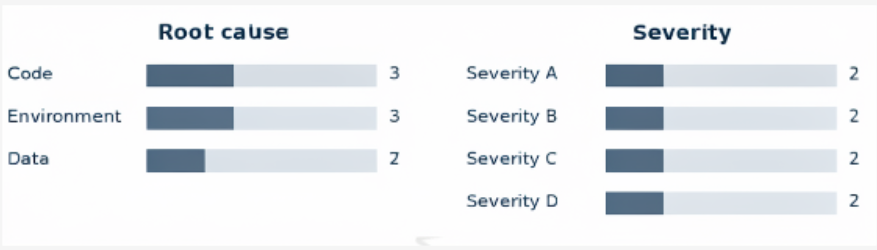
No single root-cause category accounts for more than 37.5% of the defects. Each severity category contains two defects.
Code-related and environment-related defects each account for three incidents, while data-related defects account for two. Similarly, the defects are distributed evenly across the four components.
Given the banking environment, prioritizing defects according to their business impact provides a more defensible basis for selecting a limited investigation subset. Assuming severity A represents the highest severity, defects 1 and 3 should receive initial attention, followed by severity B defects if additional investigation resources are available.
Statistical outlier analysis is less suitable because the dataset is small and does not contain meaningful continuous measurements for identifying statistically significant deviations. Fishbone analysis is useful for investigating the underlying causes of selected defects but is not primarily a defect-selection mechanism.
Severity-based analysis therefore provides the most appropriate risk-oriented selection method under the circumstances described.
Official Reference: ISTQB CTEL-ITP Syllabus 2011, Section 4.2.4 -- Selecting Defects for Causal Analysis, page 31; Learning Objective LO 4.2.7 (K4).
Verification correction: The original practice document recommends A. However, the actual exhibit does not demonstrate a sufficiently dominant defect category to make Pareto analysis the strongest choice. C is more defensible in the stated business context, assuming the severity categories are ordered from A (highest) to D (lowest). The absence of an explicit severity scale introduces minor ambiguity.
 All Official Question Types