Page: 1
/ 14
Total 95 questions
Juniper Junos, Associate (OS 21.2) JN0-106 JNCIA-Junos Exam Questions
Question 1
Your team alerts you that users connected to ge-0/0/5 are experiencing intermittent slowness. You log in to the switch and want to see live, real-time traffic updates for that interface to determine whether the link is being over-utilized. Which monitoring command should you use in this scenario?
Answer : B
In the Junos OS environment, distinguishing between static diagnostic data and real-time telemetry is crucial for effective troubleshooting. While commands like show interfaces provide a cumulative snapshot of counters since the last reboot or counter clear, they do not easily reveal instantaneous spikes or fluctuating utilization patterns. To address the requirement for 'live, real-time traffic updates,' the monitor interface command is the correct operational tool.
When an architect executes monitor interface ge-0/0/5, the CLI launches an interactive, ncurses-based screen that refreshes every second. This display provides immediate visibility into input and output bits-per-second (bps), packets-per-second (pps), and error increments. Unlike static commands, this real-time stream allows a technician to observe micro-bursts or sustained high-utilization periods as they occur, which is essential for diagnosing 'intermittent slowness' caused by congestion. In contrast, show chassis hardware focuses on physical inventory, and show interfaces terse only provides administrative and operational status. Even the extensive version of the show command only offers a point-in-time calculation of averages. Therefore, monitor interface is the primary mechanism for interactive performance auditing of individual ports on the Packet Forwarding Engine.
Question 2
Which two statements are correct about a Routing Engine? (Choose two.)
Answer : A, D
The architecture of a Junos device is bifurcated into two primary functional planes: the Control Plane, managed by the Routing Engine (RE), and the Data Plane, managed by the Packet Forwarding Engine (PFE). The Routing Engine serves as the 'brain' of the device. One of its primary responsibilities is the processing of management traffic, which includes handling CLI sessions (SSH, Telnet), SNMP requests, and system logging. Because the RE runs the Junos OS kernel, it provides the environment for all administrative tasks and system management utilities.
Additionally, the Routing Engine is responsible for the intelligence of the network, which involves running routing protocols (such as OSPF, BGP, or IS-IS) and maintaining the master routing tables. It populates the Routing Information Base (RIB) with all learned paths and then calculates the best paths to build the Forwarding Information Base (FIB). This FIB is then pushed to the PFE for hardware-level packet switching. It is a common misconception that the RE handles transit traffic; however, the RE only handles 'exception traffic' or traffic destined for the device itself. This separation ensures that the control plane remains stable and responsive even during periods of heavy transit load on the forwarding plane. Reference: Junos OS Fundamentals, Architectural Overview, Control Plane vs. Forwarding Plane.
Question 3
Which statement accurately describes the purpose of route preference in Junos OS?
Answer : B
In the Junos OS architecture, the routing table often receives prefix information from various sources, including direct connections, static configurations, and multiple dynamic interior and exterior gateway protocols. Route preference, frequently referred to as administrative distance in other vendor environments, serves as the primary tie-breaking mechanism used by the Routing Engine to select a single 'active' route when multiple entries for the exact same destination prefix exist from different protocol sources. Each routing source is assigned a default numerical value, where a lower numerical value indicates a more preferred or 'trustworthy' source. For instance, a direct route typically carries a preference of 0, while OSPF internal routes default to 10 and BGP routes default to 170.
The selection process evaluates these values; the route with the lowest preference is installed in the forwarding table and used for transit traffic. If preferences are equal, Junos secondary tie-breakers like local preference or metric are considered. Understanding this hierarchy is critical for traffic engineering and ensuring predictable routing behavior across the fabric. Modification of these default values via routing policy allows administrators to influence path selection without altering the underlying protocol metrics themselves.
Question 4
Refer to the exhibit.
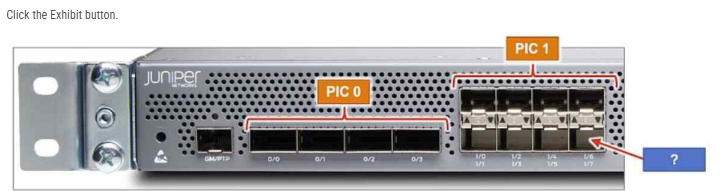
The MX204 has 12 built-in ports. Referring to the exhibit, to which interface does the arrow point?
Answer : C
The Juniper MX204 is a fixed-configuration router that utilizes a specific hierarchical naming convention for its physical interfaces: type-fpc/pic/port. In the MX204 architecture, there is a single built-in Flexible PIC Concentrator (FPC), which is always designated as FPC 0. This FPC is subdivided into two logical Physical Interface Cards (PICs): PIC 0 and PIC 1.
As shown in the exhibit, PIC 0 contains four high-speed ports (labeled 0/0 through 0/3) that typically support 40GbE or 100GbE speeds. PIC 1 contains eight ports (labeled 1/0 through 1/7) designed for 1GbE or 10GbE connectivity. These ports are arranged in a stacked, $2 \times 4$ grid. The labeling system on the chassis indicates the port numbers for each column. In the fourth column of the PIC 1 block, the top port is identified as 1/6 and the bottom port as 1/7.
The blue arrow in the exhibit points directly to the bottom-right interface in the PIC 1 section. Correlating this physical location with the chassis labels confirms that the port number is 7. When combined with the FPC and PIC identifiers, the full interface name is xe-0/1/7 (assuming a 10GbE transceiver is installed). Understanding this physical-to-logical mapping is essential for accurate cabling and configuration within the Junos OS, ensuring that administrators apply the correct logical unit and protocol settings to the intended physical hardware.
Question 5
Refer to the exhibit.
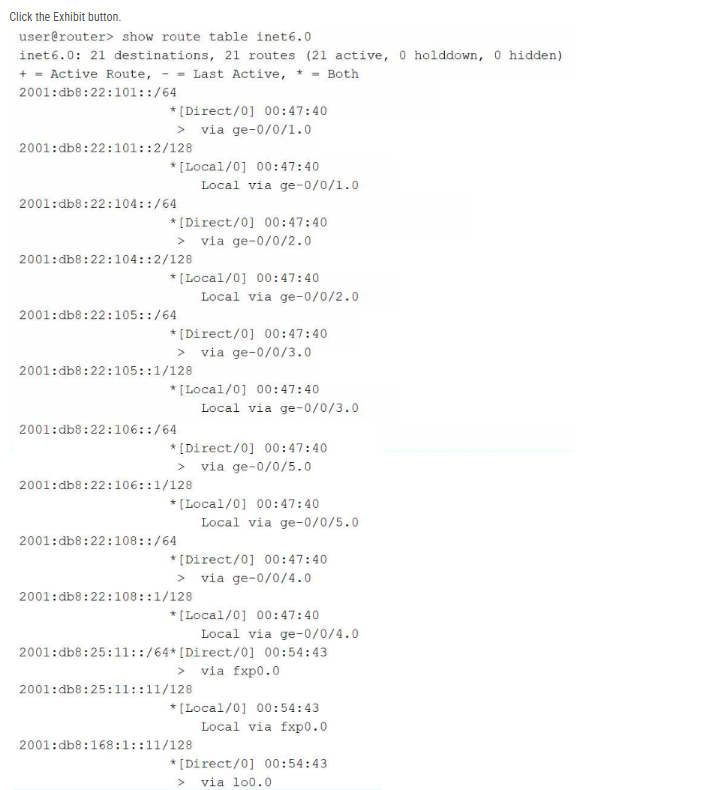
Referring to the exhibit, which two statements about IPv6 routing are correct? (Choose two.)
Answer : A, B
The provided exhibit displays the output of the show route table inet6.0 command, which represents the master routing table for IPv6 unicast traffic in Junos OS. Analysis of the specific route entries reveals that all listed destinations are categorized as either [Direct/0] or [Local/0]. These route types indicate that the table only contains networks physically connected to the router's interfaces and the specific IP addresses assigned to those interfaces.
Because there are no routes identified by dynamic protocols (such as OSPFv3, IS-IS, or BGP) or static entries, it is verified that the router is not learning IPv6 routes from any neighbors or peers. Consequently, the routing table lacks reachability information for any non-local or remote IPv6 segments. Without these routes or a configured default gateway (::/0), the router is unable to forward traffic to remote IPv6 networks. Statements C and D are factually incorrect based on the exhibit: the 2001:db8:22:108::/64 network is associated with interface ge-0/0/4.0 (not ge-0/0/5.0), and the 2001:db8:22:107::/64 network is entirely absent from the displayed routing table.
Question 6
Which statement describes the primary purpose of a routing policy in Junos OS?
Answer : A
In Junos OS, a routing policy is a powerful tool used to manage the flow of routing information between the Routing Information Base (RIB) and routing protocols. Unlike forwarding decisions, which are handled by the Packet Forwarding Engine, routing policies function within the control plane on the Routing Engine. Their primary purpose is to define specific criteria for importing routes into the routing table from neighbors or exporting routes from the routing table to neighbors.
Routing policies consist of terms containing from (match) and then (action) statements. They allow administrators to filter prefixes (e.g., denying specific BGP routes), modify route attributes (e.g., changing OSPF metrics or BGP communities), and manipulate path selection behavior. For example, an export policy might be used to ensure that only specific internal subnets are advertised to an ISP via BGP, preventing the accidental leakage of private infrastructure addresses. By default, Junos applies 'default policies' for each protocol (such as OSPF accepting all OSPF routes), but custom policies allow for granular control over how the device interacts with the rest of the network. This ensures that the routing table contains only the desired paths for optimal traffic engineering.
Question 7
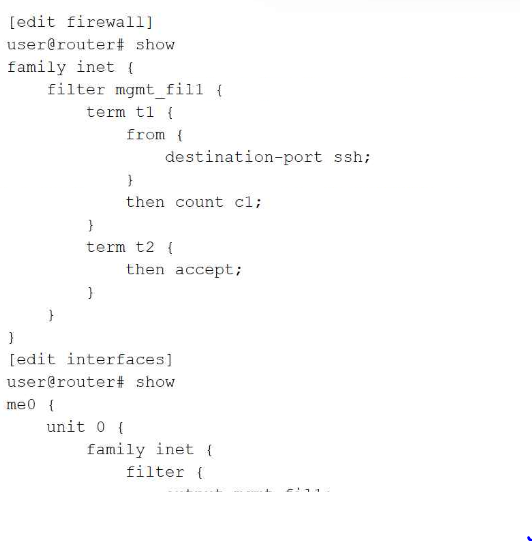
Which two statements are true about the firewall filter configuration shown in the exhibit? (Choose two.)
Answer : A, C
The exhibit illustrates the configuration of a firewall filter named mgmt_fill and its subsequent application to an interface. The first true statement is that the filter is applied to a physical interface. The configuration shows the filter attached to me0, which in Junos nomenclature represents the Management Ethernet port---a dedicated physical port for out-of-band management traffic. This is separate from logical or virtual interfaces, as me0 provides the physical link for administrative access.
The second true statement is that the filter evaluates SSH packets egressing from the management interface. In the provided snippet, term t1 specifically matches the destination-port ssh, and the filter is applied to the interface unit. When a filter is applied to an interface, it can monitor traffic entering or leaving the device. Furthermore, the filter utilizes a count action (count c1), which is a non-terminating action used to provide telemetry on specific traffic types passing through that physical port. There is no mention of a syslog or log action in the configuration, meaning that while packets are counted, they are not being written to the system log files. This configuration is a standard method for hardening the management plane and tracking administrative session activity on the Routing Engine. Reference: Routing Policy and Firewall Filters, Firewall Filter Actions, Management Interfaces.
 All Official Question Types