Page: 1
/ 14
Total 65 questions
Juniper Service Provider Routing and Switching, Specialist JN0-364 JNCIS-SP Exam Questions
Question 1
Which BGP attribute is optional, transitive, and is passed unchanged to other BGP peers if not recognized?
Answer : C
BGP attributes are categorized into four distinct types based on how they are handled by a BGP speaker: Well-known mandatory, Well-known discretionary, Optional transitive, and Optional non-transitive. Understanding these categories is essential for traffic engineering and ensuring consistent policy across an Autonomous System.
According to Juniper Networks technical documentation, the Community attribute is classified as an optional transitive attribute. The term 'optional' implies that a BGP implementation is not required to support or recognize the attribute. However, because it is 'transitive,' if a Juniper router receives an update containing a community tag that it does not recognize or has no specific policy for, it must accept the attribute and pass it along to other BGP peers unchanged. This ensures that community-based policies can be signaled across intermediate ASes that may not be configured to act upon those specific tags.
In contrast:
Origin (Option A) and AS Path (Option B) are well-known mandatory attributes. Every BGP update must include these, and every BGP-compliant router must recognize them.
MED (Option D) (Multi-Exit Discriminator) is an optional non-transitive attribute. If a router receives a MED and advertises that route to an EBGP peer, the MED is typically stripped away (unless specific configurations like path-selection cisco-non-deterministic are used), as it is intended only to influence the immediate neighboring AS.
The Community attribute (defined in RFC 1997) is a powerful tool in Junos OS, often used for tagging routes to trigger specific routing policies, such as setting local preference or identifying the geographic origin of a prefix. By being transitive, it allows for sophisticated administrative control across complex multi-provider environments.
Question 2
Which OSPF packet type is used to initiate and maintain neighbor relationships?
Answer : A
The Hello packet is the most basic, yet most vital, component of the OSPF protocol. It serves as the primary mechanism for neighbor discovery, parameter negotiation, and 'keepalive' functionality. Per Juniper Networks' routing documentation, OSPF routers use the Hello protocol to dynamically discover other OSPF-enabled routers on their directly connected segments.
When OSPF is enabled on a Junos interface, the router begins multicasting Hello packets (typically to the 224.0.0.5 'All OSPF Routers' address). This initiates the neighbor relationship. For two routers to move beyond the Init state and become neighbors, they must agree on several critical parameters contained within the Hello packet:
Area ID: Routers must be in the same OSPF area.
Authentication: Passwords or keys must match.
Timers: The Hello and Dead intervals must be identical.
Options: Such as Stub area flags.
Beyond the initial 'initiation,' the Hello packet is used to maintain the relationship. By continuously sending these packets at a fixed interval (the Hello interval), a router signals to its peers that it is still functional. If a router stops receiving Hello packets from a neighbor for a duration exceeding the Dead Interval, it declares the neighbor 'down,' flushes the associated LSAs from the database, and triggers a new SPF calculation.
Furthermore, on multi-access networks like Ethernet, the Hello packet is the vehicle for the election of the Designated Router (DR) and Backup Designated Router (BDR). By exchanging priority values and Router IDs within the Hello packets, the segment can elect a central point of contact to minimize the number of adjacencies required on the wire.
Question 3
What happens if an IS-IS router receives a link-state PDU with a higher sequence number than the one in its database?
Answer : B
IS-IS is a link-state protocol that relies on the rapid and consistent flooding of Link-State PDUs (LSPs) to ensure that every router in an area has an identical view of the topology. To manage the 'freshness' of information, IS-IS uses a Sequence Number---a 32-bit unsigned integer that increments every time the originating router makes a change to its LSP.
According to Juniper Networks technical documentation, when a router receives an LSP, it performs a comparison between the received LSP and the version it currently holds in its Link-State Database (LSDB). If the received LSP has a higher sequence number, the router concludes that this is 'newer' and more accurate information. The router will then perform two immediate actions:
Update: It replaces the older LSP in its LSDB with the newly received version.
Flood: It propagates the new LSP to all other neighbors (except the one that sent it) to ensure the entire area converges on the new data.
If the sequence numbers were equal, the router would ignore the incoming PDU as it already has the information. If the received sequence number were lower, the router would conclude its own database is more recent and would actually send its own 'newer' version back to the neighbor to bring them up to date (a process called 'poisoning' or refreshing the neighbor). Complete Sequence Number PDUs (CSNPs) (Option C) are used during initial database synchronization or periodic checks on broadcast links, but the primary response to a 'newer' LSP is immediate database update and flooding.
Question 4
By default, which routing table contains a list of all ingress LSPs?
Answer : B
In the Juniper Networks Junos operating system, the management of routing information is partitioned into several distinct routing tables (RIBs), each serving a specific architectural purpose. When dealing with Multiprotocol Label Switching (MPLS), understanding the distinction between inet.0 and inet.3 is fundamental for troubleshooting and traffic engineering.
The inet.3 routing table is specifically designed to store the egress IPv4 addresses of Label-Switched Paths (LSPs). When an ingress router successfully establishes an LSP (via RSVP or LDP), it places the host address of the egress router (the tail-end) into the inet.3 table. This table is not used for general packet forwarding; instead, it is primarily used by the Border Gateway Protocol (BGP) for next-hop resolution. When BGP receives a route, it checks both inet.0 and inet.3 to resolve the next hop. If a matching entry exists in inet.3, the router knows it can reach that destination via an MPLS tunnel, allowing for the encapsulation of BGP traffic within MPLS.
In contrast, inet.0 is the default unicast routing table used for standard IPv4 forwarding and contains routes learned via IGPs (OSPF, IS-IS) or static routing. inet.1 is utilized for multicast forwarding (MBGP), and inet.2 is typically used for Multicast Source Discovery Protocol (MSDP) or RPF checks in multicast environments. By isolating LSP egress points in inet.3, Junos prevents MPLS-specific paths from interfering with standard IGP path selection unless the administrator explicitly chooses to merge them (e.g., using the traffic-engineering bgp-igp command). Therefore, by default, the ingress router maintains its list of reachable LSP endpoints in inet.3.
Question 5
Exhibit:
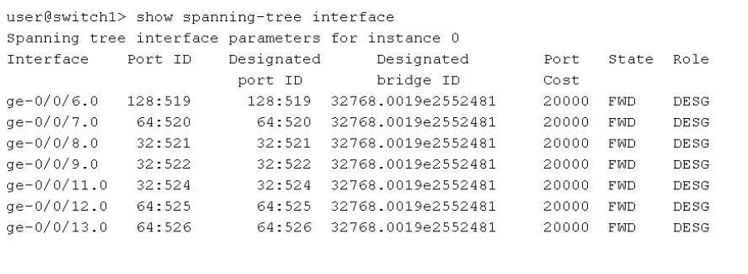
Referring to the exhibit, which two statements are correct? (Choose two.)
Answer : B, D
In the provided exhibit, the output of the command show spanning-tree interface for switch1 reveals critical details about the Spanning Tree Protocol (STP) operational state.
The first correct statement is that the switch1 device is the root bridge (Option B). This is determined by comparing the 'Port ID' column with the 'Designated port ID' column, as well as checking the 'Designated bridge ID'. In the exhibit, for every interface listed (from ge-0/0/6.0 to ge-0/0/13.0), the Port ID and the Designated port ID are identical. Furthermore, every port is in the 'FWD' (Forwarding) state with the 'DESG' (Designated) role. In a Spanning Tree topology, the root bridge is the only device where all active participating interfaces serve as designated ports, as it has no need for a 'Root' port role (which points toward a root bridge).
The second correct statement is that the bridge priority for switch1 is 32k (Option D). Looking at the 'Designated bridge ID' column, we see the value 32768.0019e2552481. In Junos and general networking standards, the Bridge ID is composed of a bridge priority and the device's MAC address. The default priority for most Spanning Tree variants (STP, RSTP, MSTP) is 32,768, which is commonly referred to in shorthand as '32k'.
Regarding the incorrect options:
Option A: There is no evidence of VSTP (VLAN Spanning Tree Protocol); the output shows 'instance 0,' which is typical for IEEE standard RSTP or STP.
Option C: The Port IDs for ge-0/0/8, ge-0/0/9, and ge-0/0/11 all start with '32' (e.g., 32:521), whereas the default port priority is typically 128 (as seen in ge-0/0/6.0 with 128:519). This indicates that the interface priorities for these specific ports have been manually tuned to a non-default value.
Question 6
Which two protocols would be used for dynamic routing in IPv6 environments? (Choose two.)
Answer : B, D
The transition to IPv6 requires routing protocols that are capable of carrying 128-bit address information. Juniper Networks Junos OS supports several 'IPv6-ready' protocols for dynamic routing.
1. IS-IS (Option B):
As discussed in previous questions, IS-IS is inherently extensible due to its use of TLVs (Type, Length, Value). To support IPv6, the protocol did not need a major rewrite; instead, new TLVs (such as TLV 236 for IPv6 reachability and TLV 232 for IPv6 interface addresses) were added. A single IS-IS process in Junos can simultaneously carry both IPv4 and IPv6 routing information, making it a highly efficient choice for 'dual-stack' service provider backbones.
2. BGP (Option D):
BGP was updated to support multiple protocols through Multiprotocol Extensions (MP-BGP), defined in RFC 4760. By using Address Family Identifiers (AFI) and Subsequent Address Family Identifiers (SAFI), a single BGP session can exchange NLRI (Network Layer Reachability Information) for IPv4 unicast, IPv6 unicast, and even VPNv4/VPNv6 routes. In Junos, this is configured under the family inet6 unicast hierarchy within the BGP protocols configuration.
Why other options are incorrect:
IGMP (Option A): This is a management protocol for IPv4 multicast (Internet Group Management Protocol). Its IPv6 equivalent is MLD (Multicast Listener Discovery).
OSPFv2 (Option C): OSPF version 2 is strictly for IPv4. To run OSPF in an IPv6 environment, OSPFv3 must be used, as it was specifically redesigned to handle the IPv6 address space and link-local communication.
Question 7
Which statement about RSVP-signaled LSPs is correct?
Answer : B
In a Juniper Networks environment, Resource Reservation Protocol (RSVP) is a signaling protocol used to establish Label-Switched Paths (LSPs). While RSVP handles the actual signaling (requesting labels and reserving bandwidth along a path), it does not inherently know which path to take. This is where Constrained Shortest Path First (CSPF) comes into play.
CSPF is an advanced version of the Dijkstra algorithm used specifically for traffic engineering. Unlike the standard SPF used by IGPs, which only considers the shortest metric, CSPF takes into account multiple constraints such as available bandwidth, link coloring (administrative groups), and explicit hop requirements. According to Juniper technical documentation, when an LSP is configured, the Ingress router uses CSPF to calculate a loop-free path that satisfies all these constraints before RSVP begins signaling. This is why statement B is the correct description of the operational flow.
Statement D is a common distractor. While CSPF uses the Traffic Engineering Database (TED) to perform its calculations, the path is not 'calculated by the TED' itself; the TED is merely the repository of link-state information (provided by OSPF or IS-IS extensions). Statement C refers to Segment Routing Global Block (SRGB), which is relevant to Segment Routing (SR-TE), not standard RSVP-signaled LSPs. Finally, statement A is incorrect because admin-groups (link coloring) are actually one of the primary constraints that require CSPF to determine a valid path.
 All Official Question Types