Page: 1
/ 14
Total 72 questions
Juniper Enterprise Routing and Switching, Professional JN0-650 JNCIP-ENT Exam Questions
Question 1
Which two statements are correct about EVPN/VXLAN deployments? (Choose two.)
Answer : B, D
In an EVPN-VXLAN architecture, the interaction between the control plane (EVPN) and the data plane (VXLAN) is defined by specific functional components:
VTEP (VXLAN Tunnel End Point): These are the entities responsible for the encapsulation and de-encapsulation of Layer 2 Ethernet frames into Layer 3 UDP/IP packets. A VTEP can be a physical switch (like a QFX or EX series) or a software-based entity. When traffic enters the fabric, the ingress VTEP wraps it in a VXLAN header; the egress VTEP removes this header before delivering it to the destination host. (Option B)
VNI (Virtual Network Identifier): The VNI is a 24-bit field in the VXLAN header that allows for up to 16 million unique identifiers. It is used to identify specific broadcast domains (or VLANs) within the overlay network. Each VNI effectively represents a virtualized Layer 2 segment that is stretched across the Layer 3 underlay. (Option D)
Incorrect statements: Option A is incorrect because VNIs are identifiers, not the 'engine' that performs encapsulation---that is the VTEP's job. Option C is incorrect because VTEPs identify the endpoints of a tunnel, not the individual broadcast domains themselves.
Question 2
Your existing enterprise network uses OSPFv3 on Juniper devices. You need to extend the networking into a new building, and it needs to be in its own OSPF are
a. Your team is debating about making the area a stub
Which two statements are correct in this scenario? (Choose two.)
Answer : C, D
OSPF stub areas are used to reduce the size of the Link-State Database (LSDB) in routers with limited resources by restricting the flooding of external routes.
Virtual Links (Option C): According to OSPF standards (both v2 and v3), virtual links cannot pass through stub areas. A virtual link must transit a 'transit area,' which must be a standard (non-stub) area with a full routing table.
Totally Stubby Areas (Option D): A stub area (which blocks Type 5 External LSAs) can be further restricted into a totally stubby area. In Junos OS, this is done by adding the no-summaries statement to the stub configuration. This blocks both Type 5 and Type 3 (Inter-area) LSAs, replacing them with a single default route.
Incorrect Statements: Option A is incorrect because standard stub areas cannot contain an ASBR; only Not-So-Stubby Areas (NSSA) allow for an ASBR. Option B is incorrect because an area is either a Stub or an NSSA; they are mutually exclusive configurations for the same area.
Question 3
You want to validate a recursive lookup for an EVPN route designation. Which route table query will accomplish this task?
Answer : C
In Junos OS, particularly in BGP-based environments like EVPN-VXLAN or MPLS, the router often needs to perform a recursive lookup to resolve the BGP next-hop of a route.
Next-Hop Resolution (Option C): When an EVPN route (found in default-switch.evpn.0) is received, the protocol next-hop is typically the loopback IP of the remote VTEP. To actually forward traffic, the switch must know how to reach that loopback IP.
The inet.3 table is the default table in Junos used to store egress interface information for BGP next-hops.
While inet.0 handles standard unicast routing, inet.3 is specifically consulted for resolving the path toward BGP peers. In an EVPN context, this ensures that the VXLAN tunnel endpoint is reachable and properly resolved through the underlay.
Other Tables: * inet.2 (Option A) is used for Multicast RPF checks.
default-switch.evpn.0 (Option B) stores the EVPN routes themselves (MAC/IP), but it is the source of the lookup, not the table where the recursive resolution occurs.
vxlan.inet (Option D) is an internal table used to track active VXLAN tunnels but is not the primary table for recursive BGP next-hop validation.
Question 4
You run a multivendor switching environment where you have configured VSTP. You have 450 VLANs and notice that some of your VLANs do not function properly. How should you change the configuration to get all 450 VLANs working?
Answer : B
VSTP (VLAN Spanning Tree Protocol) is Juniper's implementation that provides a separate spanning tree instance for each VLAN, ensuring compatibility with Cisco's PVST+. However, it has significant scaling limitations:
Instance Limits: On many Juniper EX and QFX series switches, VSTP is restricted to a maximum of 253 or 510 VLAN instances depending on the software version (ELS vs. non-ELS). In your scenario, having 450 VLANs exceeds the standard 253-instance limit found on many platforms.
The Solution (Option B): When the number of VLANs exceeds the VSTP capacity, the recommended best practice is to enable RSTP (Rapid Spanning Tree Protocol). Unlike VSTP, RSTP runs a single spanning tree instance for the entire switch, regardless of how many VLANs are configured. This ensures that all 450 VLANs are protected from loops without hitting the hardware's instance-count limit.
Other Options: Option A (force-version) only affects the BPDU format for compatibility but doesn't solve the instance limit. Option C and Option D are parameter tuning actions that do not address the architectural limitation of the number of running instances.
Question 5
Exhibit.
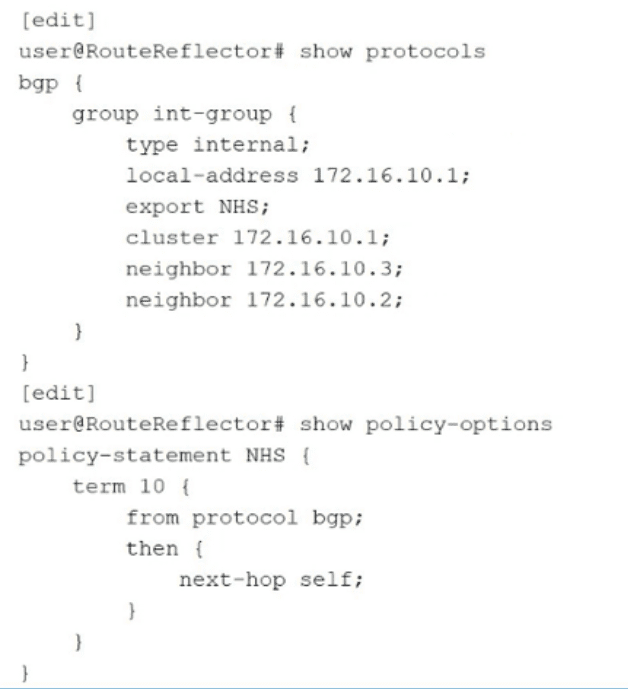
You have determined that traffic in your network is being routed through your route reflector instead of using the optimal path. Referring to the exhibit, what are two configuration changes on the route reflector that would solve the problem? (Choose two.)
Answer : C, D
The exhibit shows a BGP Route Reflector (RR) configuration where an export policy named NHS (Next-Hop Self) is applied to the internal BGP group int-group. The policy NHS sets the next-hop self attribute for BGP routes.
The Problem (Traffic Tromboning): In a standard BGP Route Reflector design, the RR should reflect routes without modifying the BGP next-hop attribute. By applying a next-hop self policy on the export to clients, the RR tells all its clients that it is the exit point for those routes. Consequently, all data plane traffic is sent to the RR first before being forwarded to the actual destination, rather than following the optimal direct path between clients. This is known as 'traffic tromboning' or suboptimal routing.
The Solution (Option C): The most direct way to fix this is to delete the export policy that is forcing the next-hop to be the RR. By deleting protocols bgp group int-group export NHS, the RR will resume standard behavior and reflect the original next-hop received from the route source, allowing clients to route traffic directly to the correct destination.
The Refined Solution (Option D): If you must keep the NHS policy (perhaps for routes learned from external peers), you should ensure it only applies to those specific routes. By adding from route-type internal to the policy term and then potentially changing the logic (or simply narrowing the scope), you can prevent the RR from incorrectly applying next-hop self to internal routes that it is merely reflecting. In the context of this specific problem, Option D combined with a change in the policy's action or scope helps ensure reflected internal routes maintain their original, optimal next-hops.
Option A is incorrect because setting next-hop self for external routes is common practice, but it doesn't solve the problem of internal reflected routes being diverted to the RR.
Option B is incorrect because applying this as an import policy would change how the RR itself sees the routes, but it wouldn't fix the attributes being sent out to the clients in the reflection process.
Question 6
Click the Exhibit button.
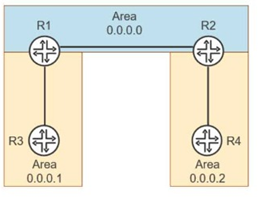
You are troubleshooting suboptimal routing in an enterprise OSPFv2 deployment:
-- R1 is an ABR between Area 0 and Area 1.
-- R2 is an ABR between Area 0 and Area 2.
-- R3 in Area 1 advertises a network that should be reachable by routers in Area 2.
-- The ABRs are connected in the backbone (Area 0).
On router R2, the show ospf database does not display router LSAs or network LSAs from Area 1, but an interarea route to R3's network exists in the routing table. R2 does not have Type-1 or Type-2 LSAs from Area 1 in its OSPF database.
Referring to the exhibit, which statement is correct?
Answer : D
The behavior described is the fundamental operational principle of OSPF's hierarchical area structure.
LSA Flooding Scope: In OSPFv2, Type-1 (Router) and Type-2 (Network) Link-State Advertisements (LSAs) are restricted to a local area flooding scope. They contain detailed topology information (such as which routers are connected to which links) that is only relevant for calculating the Shortest Path First (SPF) tree within that specific area.
ABR Functionality: Area Border Routers (ABRs), such as R1 in this scenario, act as the gateway between areas. The ABR does not forward Type-1 or Type-2 LSAs from one area to another. Instead, it extracts the prefix information (the network address and mask) from those LSAs and generates a Type-3 (Summary) LSA.
Interarea Reachability: This Type-3 LSA is then flooded into the backbone (Area 0) and subsequently into other non-backbone areas, such as Area 2. This explains why R2 sees an 'interarea route' to R3's network in its routing table and has the corresponding Type-3 LSA in its database, but cannot see the original Type-1 or Type-2 LSAs from Area 1.
Why other options are incorrect: Option A is incorrect because this is standard protocol behavior, not the result of a manual filter. Option B is incorrect as there is no such 'disable' feature; the protocol design inherently prevents these LSAs from crossing boundaries. Option C is incorrect because OSPFv3 still uses Type-1 and Type-2 LSAs (renamed but functionally similar for topology), and the prompt specifically identifies the deployment as OSPFv2.
Question 7
Exhibit.
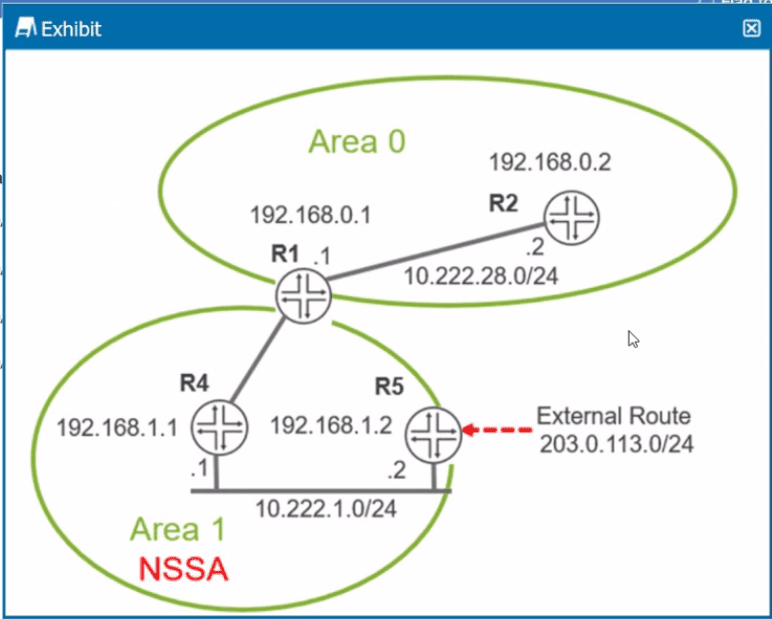
Referring to the exhibit, which two statements are correct? (Choose two.)
Answer : C, D
The exhibit shows an OSPF network where Area 1 is configured as a Not-So-Stubby Area (NSSA). R5 is an Autonomous System Boundary Router (ASBR) injecting an External Route (203.0.113.0/24) into this area.
NSSA ASBR Behavior (Option D): Within an OSPF NSSA, external routes cannot be advertised as standard Type 5 LSAs because stubby areas do not support them. Instead, the ASBR (R5) advertises the external prefix using a Type 7 LSA (NSSA External LSA). This LSA is flooded throughout Area 1.
ABR Translation Behavior (Option C): When the Type 7 LSA reaches the Area Border Router (R1), the ABR is responsible for translating it into a Type 5 LSA (AS External LSA). This allows the external route to be propagated into the backbone (Area 0) and subsequently to the rest of the OSPF domain.
Incorrect Statements (A & B): Option A is incorrect because Type 7 LSAs are local to the NSSA and are never advertised into Area 0. Option B is incorrect because Type 5 LSAs are strictly prohibited within an NSSA.
 All Official Question Types