Page: 1
/ 14
Total 168 questions
Microsoft Designing and Deploying Microsoft Exchange Server 2016 70-345 Exam Questions
Question 1
Your company has one Exchange Server 2016 database availability group (DAG) across two data centers.
You need to load balance a single namespace across both data centers. The solution must be able to check service health check.
Which two solutions should you use? Each correct answer presents part of the solution.
Answer : A, B
You should use an unbound model. With an unbound model, a single namespace is used across two datacenters.
You should use a Layer 7 load balancer. In this scenario, a DAG has active databases across two datacenters.
Users are distributed with a load balancer across the two datacenters.
A Layer 7 load balancer checks service health at the application level.
You should not use a bound model. A bound model uses two separate namespaces across two datacenters.
You should not use DNS round-robin. DNS round-robin load balancing uses a single namespace, but it does not check the health of the application or server.
Question 2
You have an Exchange Server 2016 organization that contains multiple Hub Transport servers.
You need to recommend a message hygiene solution to meet the following requirements:
- Block servers that are known to send spam
- Minimize administrative effort
What should you recommend?
Answer : B
Question 3
Your company has a data center. The data center contains a server that has Exchange Server 2016 and the Mailbox server role installed. Outlook anywhere clients connect to the Mailbox server by using the name outlook.contoso.com.
The company plans to open a second data center and to provision a database availability group (DAG) that spans both data centers.
You need to ensure that Outlook Anywhere clients can connect if one of the data centers becomes unavailable.
What should you add to DNS?
Answer : A
References: https://technet.microsoft.com/en-gb/library/dd638104(v=exchg.150).aspx?f=255HYPERLINK 'https://technet.microsoft.com/en-gb/library/dd638104(v=exchg.150).aspx?f=255&MSPPError=-2147217396'&HYPERLINK 'https://technet.microsoft.com/en-gb/library/dd638104(v=exchg.150).aspx?f=255&MSPPError=-2147217396'MSPPError=-2147217396
Question 4
You have an Exchange Server 2016 on-premises organization and a Microsoft Office 365 tenant.
All mailboxes are hosted on-premises.
You need to implement an archiving solution for all users.
The solution must ensure that all mailbox content older than 18 months is moved to Personal Archives in Office 365.
What should you implement?
Answer : B
Question 5
You plan to configure the Exchange organization for site failovers.
You need to recommend how many certificates must be deployed to meet the availability requirements and the security requirements.
What is the minimum number of certificates you should recommend deploying?
Answer : C
Question 6
Your company has two offices. Each office contains a data center. Each data center is configured as a separate Active Directory site. The data centers contain five servers that have Exchange Server 2016 installed. The servers are configured as shown in the following table.
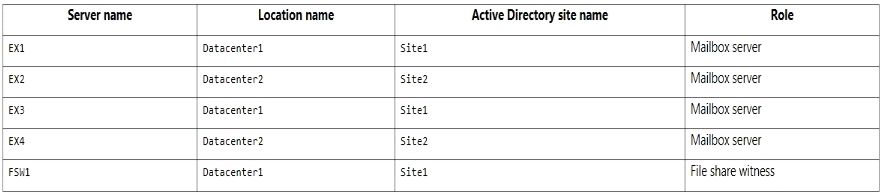
All of the servers are members of a database availability group (DAG) named DAG1. Each server contains several mailbox database copies. You plan to shut down ex1 to replace several hardware components. You expect that ex1 will be restarted in one week. You need to manually exclude ex1 from cluster voting during the planned maintenance period.
What should you run?
Answer : B
References:
https://docs.microsoft.com/en-us/powershell/module/exchange/database-availability-groups/stop-databaseavailabilitygroup?view=exchange-ps
https://docs.microsoft.com/en-us/powershell/module/exchange/database-availability-groups/restore-databaseavailabilitygroup?vieHYPERLINK 'https://docs.microsoft.com/en-us/powershell/module/exchange/database-availability-groups/restore-databaseavailabilitygroup?view=exchange-ps'w=exchange-ps
Question 7
You have an Exchange Server 2016 organization.
The organization contains an Edge transport server.
Users report that a message with the following anti-spam headers is delivered to their Inbox folder in Microsoft Outlook.
X-MS-Exchange- Organization- PCL : 7
X-MS-Exchange- Organization- SCL : 6
X-MS-Exchange- Organization -Antispam-Report : DV : 3.1.3924.1409; SID : SenderIDStatus
Fail; PCL: PhishingLevel SUSPICIOUS; CW: CustomList; PP: Presolved; TIME:
TimeBasedFeatures
You need to prevent similar messages from being delivered. The solution must generate a non-delivery report (NDR) when the messages are prevented from being delivered to all user mailboxes.
What should you do?
Answer : A
 All Official Question Types