Page: 1
/ 14
Total 453 questions
Microsoft Configuring Advanced Windows Server 2012 Services 70-412 Exam Questions
Question 1
You have a server named Server1 that runs Windows Server 2012 R2. Server1 has the DNS Server server role installed.
You need to configure Server1 to resolve queries for single-label DNS names.
Which two actions should you perform? (Each correct answer presents part of the solution. Choose two.)
Answer : A, E
Deploying a GlobalNames zone
The specific steps for deploying a GlobalNames zone can vary somewhat, depending on the AD DS topology of your network.
Step 1: Create the GlobalNames zone (E)
Step 2: Enable GlobalNames zone support (A)
The Set-DnsServerGlobalNameZone cmdlet enables or disables single-label Domain Name System (DNS) queries. It also changes configuration settings for a GlobalNames zone.
Etc.
http://technet.microsoft.com/en-us/library/cc731744.aspx
http://technet.microsoft.com/en-us/library/jj649907(v=wps.620).aspx
Question 2
Your network contains an Active Directory domain named contoso.com. The domain contains a certification authority (CA).
You suspect that a certificate issued to a Web server is compromised.
You need to minimize the likelihood that users will trust the compromised certificate.
Which two actions should you perform? (Each correct answer presents part of the solution. Choose two.)
Answer : C, E
Question 3
Your network contains an Active Directory domain named contoso.com. The domain contains a server named Server1 that runs Windows Server 2012 R2 and has the DNS Server server role installed.
Server1 has a zone named contoso.com. The zone is configured as shown in the exhibit. (Click the Exhibit button.)
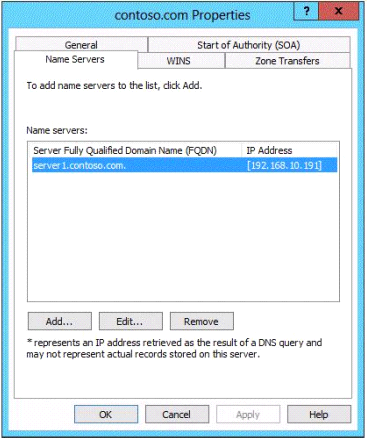
You need to assign a user named User1 permission to add and delete records from the contoso.com zone only.
What should you do first?
Answer : D
Question 4
You need to ensure that clients will check at least every 30 minutes as to whether a certificate has been revoked. Which of the following should you configure to accomplish this goal?
Answer : C
Question 5
There are 42 domains in the tailspintoys.com forest. Users in the Melbourne.victoria. australia.tailspintoys.com find the process of authenticating to resources in the Copenhagen. denmark.europe.tailspintoys.com domain to be much too slow.
Which of the following steps can you take to speed up authentication between these domains?
Answer : C
Question 6
Your network contains an Active Directory domain named contoso.com. The domain contains two sites named Site1 and Site2 and two domain controllers named DC1 and DC2. Both domain controllers are located in Site1.
You install an additional domain controller named DC3 in Site1 and you ship DC3 to Site2.
A technician connects DC3 to Site2.
You discover that users in Site2 are authenticated by all three domain controllers.
You need to ensure that the users in Site2 are authenticated by DC1 or DC2 only if DC3 is unavailable.
What should you do?
Answer : C
DC3 needs to be moved to Site2 in AD DS
Incorrect:
Not A. Modifying IP will not affect authentication
Not B. A query policy prevents specific Lightweight Directory Access Protocol (LDAP) operations from adversely impacting the performance of the domain controller and also makes the domain controller more resilient to denial-of-service attacks.
http://technet.microsoft.com/en-us/library/cc759326(v=ws.10).aspx
Question 7
Your company recently deployed a new Active Directory forest named contoso.com. The forest contains two Active Directory sites named Site1 and Site2. The first domain controller in the forest runs Windows Server 2012 R2.
You need to force the replication of the SYSVOL folder from Site1 to Site2.
Which tool should you use?
Answer : D
In Windows Server 2012 R2, Windows Server 2008 R2, or Windows Server 2008, you can force replication immediately by using DFS Management, as described in Edit Replication Schedules. You can also force replication by using the Dfsrdiag SyncNow command. You can force polling by using the Dfsrdiag PollAD command.
http://technet.microsoft.com/en-us/library/cc773238(v=ws.10).aspx#BKMK_072
 All Official Question Types