Page: 1
/ 14
Total 125 questions
Microsoft Azure AI Fundamentals (Updated Version) AI-901 Exam Questions
Question 1
You are building an AI system.
Which task should you include to help the service meet the Microsoft transparency principle for responsible AI?
Answer : A
Question 2
Which feature of the Azure Language in Foundry Tools service should you use to automate the masking of names and phone numbers in text data?
Answer : B
To automate masking of names and phone numbers in text data, use Personally Identifiable Information (PII) detection in Azure Language.
PII detection identifies sensitive personal information such as names, phone numbers, email addresses, addresses, and other personal identifiers. It can be used to detect and redact or mask that information from text.
The other options are incorrect:
Question 3
You are developing a simple application that uses the Microsoft Foundry SDK to send chat prompts to a model.
Which three elements should you provide in the code to run the application? Each correct answer presents part of the solution.
NOTE: Each correct selection is worth one point.
Answer : A, B, C
Question 4
You have the following REST API request.
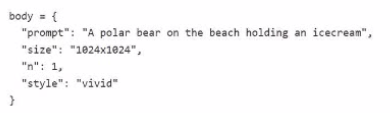
Which Azure OpenAI model should you use to process the request?
Answer : A
The REST API request contains an image-generation style payload:
{
'prompt': 'A polar bear on the beach holding an icecream',
'size': '1024x1024',
'n': 1,
'style': 'vivid'
}
This request asks the model to generate an image from a text prompt. In Azure OpenAI, DALL-E models are used for image generation from natural language prompts.
Why the other options are incorrect:
Question 5
You use natural language processing to process text from a Microsoft news story. You receive the output shown in the following table.
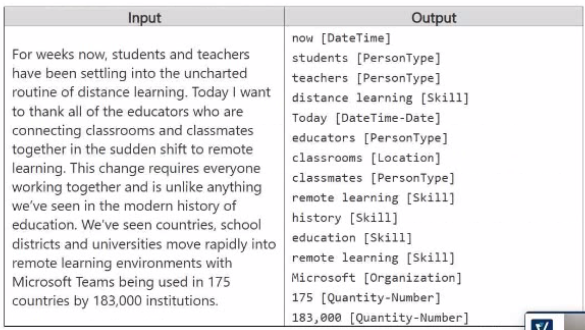
Which type of natural language processing was performed?
Answer : A
The output identifies text values and labels them with entity categories, such as:
now [DateTime] students [PersonType] Microsoft [Organization] 175 [Quantity-Number] Today [DateTime-Date]
This is entity recognition, also known as Named Entity Recognition (NER). NER identifies and categorizes entities in unstructured text, such as people, organizations, locations, dates, quantities, numbers, and other named or structured values.
Why the other options are incorrect:
Question 6
Which natural language processing feature can be used to identify the main talking points in customer feedback surveys?
Answer : C
Question 7
Your company wants to build a recycling machine for bottles. The recycling machine must use cameras to automatically identify bottles of the correct shape and reject all other items.
Which type of Al workload should the company use?
Answer : D
A recycling machine that uses cameras to identify bottles of the correct shape and reject other items requires analysis of visual input. This is a computer vision workload.
Computer vision is used for image and video analysis tasks such as object detection, classification, shape recognition, and visual inspection.
The other options are incorrect:
 All Official Question Types