Page: 1
/ 14
Total 281 questions
Microsoft Configuring Windows Server Hybrid Advanced Services AZ-801 Exam Questions
Question 1
You have a server named Served that runs Windows Server 2022 and is part of a three-node failover cluster. You need to upgrade Server1 to Windows Server 2025. The solution must minimize downtime for the cluster. What should you do first?
Answer : C
Question 2
Your network contains an Active Directory Domain Services (AD DS) domain that has a Windows Server 2012 R2 forest and domain functional level. The domain contains the domain controllers shown in the following table.
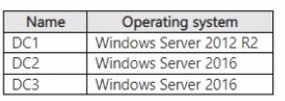
You need to ensure that you can deploy a new domain controller that runs Windows Server 2025. The solution must minimize administrative effort.
Which two actions should you perform? Each correct answer presents part of the solution.
NOTE: Each correct selection is worth one point.
Answer : C, E
Question 3
You have 200 Azure virtual machines.
You create a recovery plan in Azure Site Recovery to fail over all the virtual machines to an Azure region. The plan has three manual actions.
You need to replace one of the manual actions with an automated process.
What should you use?
Question 4
You have an Azure subscription that contains the Azure key vaults shown in the following table.
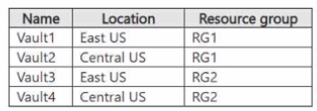
You create a virtual machine that has the following configurations
* Name:VM1
* Resource group: RG1
* Azure region: East US
* Operating system: Windows Server
You need to enable Azure Disk Encryption for VM1. Which key vault can you use to store the encryption key for VM1?
Answer : A
Question 5
You have an on premises Hyper-V host named Server 1. Server! contains a virtual machine named VM1. You have a non-domain joined Hyper-V server named Server2 that is hosted in a remote location. You plan to replicate VM1 to Server2 by using Hyper-V Replica. You need to configure replication on Server1. Which authentication method can you use?
Answer : D
Question 6
Your network contains an Active Directory Domain Services (AD DS) forest that has a Windows Server 2008 R2 forest functional level. The forest contains the domains shown in the following table.
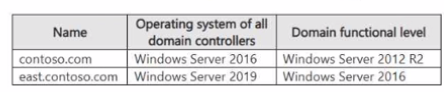
You need to perform an in-place upgrade of the domain controllers in east.contoso.com to Windows Server 2025. The solution must minimize administrative effort.
What should you do first?
Answer : C
Question 7
You have two on-premises servers named Server1 and Server2 that run Windows Server. Server2 contains a Hyper-V virtual machine named VM1.
You have an Azure subscription that contains a Recovery Services vault.
You need to configure Azure Site Recovery to replicate workloads from the on-premises environment to Azure.
What should you do first?
Answer : D
 All Official Question Types