Page: 1
/ 14
Total 351 questions
Microsoft Dynamics 365: Finance and Operations Apps Developer MB-500 Exam Questions
Question 1
You need to select an integration strategy to meet the new freight processing requirement. Which two integration strategies can you use? Each correct answer presents a complete solution. NOTE: Each correct selection is worth one point.
Answer : B, D
Question 2
You create an extension of ProjTable.
You need to configure the extension.
Which three table properties can you modify in the extension? Each correct answer presents a complete solution.
NOTE; Each correct selection is worth one point.
Answer : B, C, D
Question 3
You add a new field in an extension to the SalesTable table in Dynamics 365 Finance.
You must test the field in the SalesTable form to ensure that you can enter data from the UI. When you open the form in the browser, you receive a SQL error.
You need to resolve the issue.
What should you do?
Answer : D
Question 4
A company uses Dynamics 365 Finance.
The company requires you to develop a new batch processing feature. You need to implement the code by using the SysOperation framework.
Which three methods are already implemented by using this framework? Each correct answer presents part of the solution. Choose three.
NOTE: Each correct selection is worth one point.
Answer : A, B, E
Question 5
A company implements Dynamics 365 Finance and Dynamics 365 Supply Chain Management The company plans to perform a sales history analysis on existing customers, including their sales history and purchases.
You are creating an extension to create a sales history table that will run after the close of each period. The historical information must include customer information, date of purchase, and items that are purchased including product descriptions.
You need to ensure that the process for retrieving historical information minimizes database calls.
Which method should you use?
Answer : C
Question 6
A company is using a Dynamics 365 finance and operations app.
The accounting department requests two custom fields named CusStatus and CusDiscount for the header of the sales invoice SSRS report The custom fields are in the SatesTable table.
You create a duplicate of the report design and add the two new fields to a temporary table by using the following extension:
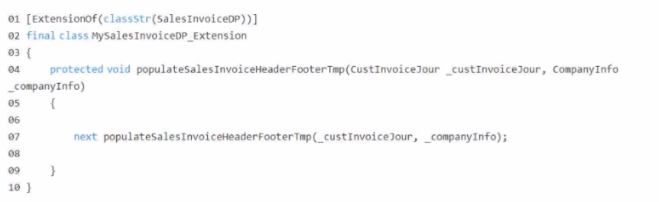
You need to populate the new fields by using Chain of Command (CoQ
Solution: Declare the SalesTable table on line 06 and insert a new line after line 06 to declare the SaleslnvoiceHeaderFooterTmp table ^Populate the new fields by using the custlnvoiceJour parameter with a reference to SalesTable
Does the solution meet the goal?
Answer : A
Question 7
You need to configure security for the Vendor Exclusion List report.
What are two possible ways to achieve this goal? Each correct answer presents a complete solution.
NOTE: Each correct selection is worth one point.
Answer : A, D
Scenario: Develop necessary security permissions to view and maintain the new Vendor exclusion list functionality and reporting. Users with maintain rights will be able create, update, and delete the exclusion list. Permissions must be assigned to security roles to match company security model.
The privileges are simply a way to grant permissions to an entry point, which can be services, to a duty, role, or even directly to a user. Typically, we only add entry points to a privilege, such as menu items.
D: You can extend a Security Role or a Security Duty to add new duties/privileges to these elements.
https://www.oreilly.com/library/view/extending-microsoft-dynamics/9781786467133/40a348f3-0f4c-4d47-a566-59f3a2e6afa0.xhtml
https://docs.microsoft.com/en-us/dynamics365/fin-ops-core/dev-itpro/extensibility/customization-overlayering-extensions#security-role-and-duty-extensions
 All Official Question Types