Page: 1
/ 14
Total 377 questions
Microsoft Windows Client MD-100 Exam Questions
Question 1
Note: This question is part of a series of questions that present the same scenario. Each question in the series contains a unique solution that might meet the stated goals. Some question sets might have more than one correct solution, while others might not have a correct solution.
After you answer a question in this section, you will NOT be able to return to it. As a result, these questions will not appear in the review screen.
You have two computers named Computer1 and Computer2 that run Windows 10.
You have an Azure Active Directory (Azure AD) user account named admin@contoso.com that is in the local Administrators group on each computer.
You sign in to Computer1 by using admin@contoso.com.
You need to ensure that you can use Event Viewer on Computer1 to connect to the event logs on Computer2.
Solution: On Computer2, you enable the Remote Event Log Management inbound rule from Windows Defender Firewall.
Does this meet the goal?
Answer : A
https://docs.microsoft.com/en-us/previous-versions/windows/it-pro/windows-server-2008-R2-and-2008/cc766438(v=ws.11)?redirectedfrom=MSDN
Question 2
You need to meet the technical requirement for User6.
What should you do?
Answer : B
Question 3
A user has a computer that runs Windows 10.
When the user connects the computer to the corporate network, the user cannot access the internal corporate servers. The user can access servers on the Internet.
You run the ipconfig command and receive the following output.
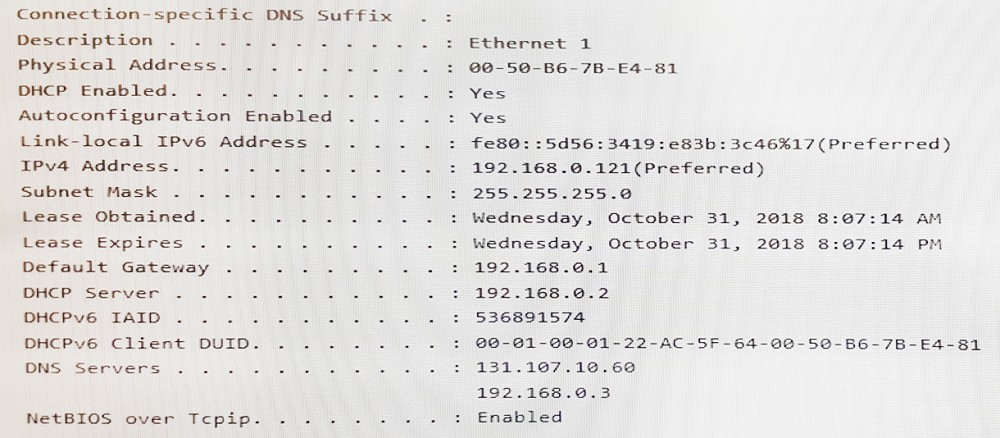
You send a ping request and successfully ping the default gateway, the DNS servers, and the DHCP server.
Which configuration on the computer causes the issue?
Answer : A
Question 4
You need to ensure that User10 can activate Computer10.
What should you do?
Answer : D
https://docs.microsoft.com/en-us/windows/deployment/windows-autopilot/windows-autopilot-requirements-licensing
Question 5
You have a workgroup computer named Computer1 that runs Windows 10. Computer1 contains five local user accounts. You need to ensure that all users who sign in to Computer1 see a picture named image1 jpg as the desktop background.
What should you do?
Answer : B
Question 6
You are a network administrator at your company.
The company uses an application that checks for network connectivity to a server by sending a ping request to the IPv6 address of the server replies, the application loads.
A user cannot open the application.
You manually send the ping request from the computer of the user and the server does not reply. You send the ping request from your computer and the server replies.
You need to ensure that the ping request works from the user's computer.
Which Windows Defender firewall rule is a possible cause of the issue?
Answer : B
Question 7
You have a Microsoft 365 tenant that contains 70 remote users.
The remote users work from various locations.
Recently, each remote user purchased a personal computer that runs Windows 10 Home.
You need to configure the VPN settings on the computers automatically by using the least amount of administrative effort.
What should you use?
Answer : D
https://docs.microsoft.com/en-us/windows/configuration/provisioning-packages/provisioning-packages
 All Official Question Types