Page: 1
/ 14
Total 145 questions
Nokia NRS II Composite Exam: IS-IS version 4A0-C03 Exam Questions
Question 1
A customer asks for its Layer 2 Ethernet service to be configured to forward frames up to 1514 bytes. The provider uses MPLS encapsulation and RSVP-TE fast reroute with facility bypass across its redundant IP/MPLS network. What is the minimum MTU configuration for the network ports?
Answer : D
The network-port Maximum Transmission Unit (MTU) must accommodate the complete encapsulated service frame, including the additional headers and MPLS labels imposed by the provider network.
A conventional distributed Layer 2 Ethernet service uses two MPLS labels: a service label identifying the pseudowire and a transport label identifying the backbone LSP.
When RSVP-TE facility fast reroute is activated, the Point of Local Repair can impose an additional bypass-tunnel label to forward traffic around the failed network resource.
Each MPLS label-stack entry occupies four bytes.
1540 bytes --- Minimum network-port MTU under the stated encapsulation assumptions
Component
Size
Customer Ethernet frame
1514 bytes
Outer Ethernet header
14 bytes
MPLS service label
4 bytes
MPLS transport label
4 bytes
FRR bypass label
4 bytes
Total MTU
1540 bytes
The required MTU is calculated as follows:
1514 + 14 + (3 4) = 1540
Without the additional facility bypass label, the minimum MTU would be 1536 bytes. However, this would not accommodate the worst-case label stack during FRR operation.
The calculation assumes an untagged network Ethernet header, no pseudowire control word, and no additional encapsulation or entropy labels.
Therefore, 1540 bytes is the correct minimum network-port MTU for the specified architecture.
Question 2
Which option most accurately describes a VPLS?
Answer : C
Virtual Private LAN Service (VPLS) is a Layer 2 VPN technology that provides multipoint Ethernet connectivity between geographically distributed customer sites over a shared service provider network.
A Nokia 7750 SR participating in a VPLS service performs Ethernet bridging functions, allowing customer devices connected to different provider routers to communicate as though they were attached to a common Ethernet LAN.
CE1 --- PE1; CE2 --- PE2; CE3 --- PE3. PE1, PE2 and PE3 form a multipoint L2 VPN across the IP/MPLS backbone.
The service can contain multiple SAPs and pseudowire bindings. MAC-address learning associates customer devices with their corresponding service endpoints.
Known unicast traffic is forwarded using the MAC Forwarding Database, while unknown unicast, broadcast, and applicable multicast traffic is flooded according to the service's forwarding and split-horizon rules.
An Epipe differs from VPLS because it provides point-to-point Layer 2 connectivity.
A VPRN provides Layer 3 VPN connectivity through separate routing and forwarding instances, while an IES provides routed access to the provider's IP infrastructure.
Therefore, VPLS is correctly characterized as a Layer 2 multipoint-to-multipoint service.
Question 3
Which statement about the function of the Route Target (RT) is TRUE?
Answer : A
A Route Target is a BGP extended community used to control the distribution and import of VPN routing information between participating Provider Edge routers.
In a traditional Nokia VPRN service, the exporting PE associates eligible customer routes with the appropriate Route Target communities.
Receiving PE routers evaluate these communities against their configured VRF import policies to determine which VPN instances are eligible to import the received route.
A Route Distinguisher (RD) performs a different function. It is combined with the customer IP prefix to construct a unique VPN-IPv4 or VPN-IPv6 route representation.
Control-plane components: Route Distinguisher + Customer IP prefix Unique VPN prefix. Route Target controls which VPNs import the advertised route.
Data-plane components: Transport label + Service label + Customer packet.
Route Targets are control-plane attributes, not MPLS packet encapsulation fields.
Neither the Route Target nor the Route Distinguisher serves as an MPLS forwarding label.
Customer traffic is transported using the appropriate VPN service label and backbone transport label.
Therefore, option A correctly identifies the purpose of the Route Target in MP-BGP VPN route advertisements.
Technical clarification: Route Targets are carried in applicable VPN route advertisements, not necessarily in every MP-BGP UPDATE across all supported address families.
Question 4
In the IS-IS network shown, the subnetworks 20.20.1.0/24 and 20.20.2.0/24 must be summarized as 20.20.0.0/16. On which router must the summary-address command be configured to accomplish this summarization?
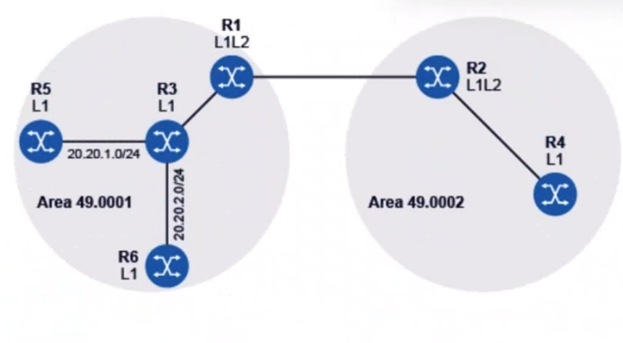
Answer : B
Question 5
Which of these statements about BGP is FALSE?
Answer : A
Border Gateway Protocol is a path-vector routing protocol originally designed to exchange reachability information between autonomous systems.
Unlike link-state routing protocols such as IS-IS and OSPF, conventional BGP does not use periodic Hello messages to discover neighboring routers automatically.
BGP peers are ordinarily identified through administrative configuration or supported dynamic-neighbor mechanisms. A TCP connection is subsequently established using port 179.
Once the TCP connection becomes operational, the routers exchange BGP OPEN messages containing information required to establish the BGP relationship.
The fundamental BGP message types include:
Message type
Function
OPEN
Establishes BGP peering and exchanges capabilities
UPDATE
Advertises and withdraws routing information
KEEPALIVE
Maintains BGP session liveness
NOTIFICATION
Reports protocol errors and terminates sessions
ROUTE-REFRESH
Requests route readvertisement
BGP KEEPALIVE messages are exchanged after the initial TCP and BGP establishment procedures. They are not neighbor-discovery Hello messages.
Although modern Nokia SR OS supports dynamic BGP neighbor configurations, the base BGP protocol does not implement an IS-IS-style or OSPF-style Hello discovery mechanism.
Therefore, option A is false.
Question 6
Which three IS-IS PDU types are used to synchronize databases?
Answer : D
IS-IS uses several Protocol Data Unit (PDU) types to establish routing relationships, distribute topology information, and maintain synchronized link-state databases.
Three types of PDUs directly participate in database synchronization: Link State PDUs (LSPs), Complete Sequence Number PDUs (CSNPs), and Partial Sequence Number PDUs (PSNPs).
PDU type
Function
LSP
Carries topology and network reachability information
CSNP
Provides a summary of the complete link-state database
PSNP
Requests missing LSPs or acknowledges received LSPs
IIH
Discovers neighbors and establishes or maintains adjacencies
When neighboring routers synchronize their databases, CSNP information allows them to compare stored LSP identifiers, sequence numbers, and checksums.
If an LSP is missing or outdated, the appropriate database synchronization procedures request or transmit the required information.
The actual topology information is then transferred using LSPs.
On point-to-point circuits, PSNPs also provide explicit acknowledgment of received LSP information. On broadcast networks, periodic CSNP transmission by the Designated Intermediate System assists database consistency.
IS-IS Hello messages establish the routing relationship but do not directly carry the database synchronization information considered in this question.
Therefore, option D is correct.
Question 7
In the diagram below, a data packet is transmitted from CE1 to a distant CE2 through a VPRN service spanning multiple regions. Which of the following statements about the tunnel labels is FALSE?
Answer : B
A VPRN service spanning multiple routing domains can use BGP Labeled Unicast to establish end-to-end MPLS transport connectivity while maintaining separate regional transport infrastructures.
Depending on the network architecture, forwarded packets can carry a three-level MPLS label stack.
Conceptual multi-region MPLS label stack
Function
Outer regional transport label
RSVP-TE, LDP or segment routing
Middle BGP-LU label
Inter-region labeled reachability
Inner VPN service label
Customer VPRN forwarding context
Customer IP packet
Payload
The innermost label identifies the customer VPN forwarding context and is imposed by the ingress PE router.
The middle label represents BGP-labeled reachability toward the remote PE or the relevant next-hop router. The outermost label provides forwarding through the applicable regional MPLS transport tunnel.
At a regional boundary, the existing transport label may be removed, exposing the BGP-LU label. A regional border router performing BGP next-hop-self operations can replace that BGP label with the appropriate downstream label through a label-swap operation.
This differs from independently pushing an additional BGP label onto an existing label stack.
Accordingly, option B is false if RBR1 performs a BGP label swap rather than a new label-push operation.
The outer label is subsequently removed at the applicable tunnel termination point or penultimate router, depending on the configured MPLS forwarding behavior.
Technical clarification: This question cannot be conclusively verified without its original diagram, which is absent from the uploaded document. Options A and D also depend on the exact tunnel endpoints and label-popping configuration. B remains a provisional answer consistent with the accompanying source explanation.
 All Official Question Types