Page: 1
/ 14
Total 56 questions
Nokia SR Linux EVPN and Data Center Interconnect 4A0-D03 Exam Questions
Question 1
Which of the following statements about PE-CE routing is FALSE?
Answer : D
Comprehensive and Detailed 150 to 250 words of Explanation From [SR Linux EVPN and Data Center Interconnect/Course Guide/topics]:
PE-CE routing is the mechanism used to exchange customer prefix reachability between a provider edge or data center leaf and the attached customer edge router. It can be implemented statically or dynamically. Static routing is operationally simple but does not scale well when many prefixes or frequent changes are involved. BGP is preferred for larger deployments because it supports policy, route filtering, attributes, and automated advertisement of changing reachability. In most EVPN PE-CE designs, eBGP is preferred because it creates a clean routing boundary between the PE and CE, with each device operating in a different autonomous system. Option D is false because the CE does not advertise BGP EVPN route type 5 updates to the PE. The CE advertises ordinary IPv4 or IPv6 unicast prefixes over the PE-CE routing session. The PE then imports those customer prefixes into the IP-VRF and advertises them into the EVPN overlay as route type 5 IP Prefix routes toward other PEs. This distinction matters: EVPN signaling is a PE-to-PE overlay function, not a CE-originated EVPN control-plane role. Reference: PE-CE routing, eBGP, EVPN RT-5 prefix advertisement.
Question 2
Which of the following statements about configuring and using an integrated routing and bridging (IRB) interface is TRUE?
Answer : C
Comprehensive and Detailed 150 to 250 words of Explanation From [SR Linux EVPN and Data Center Interconnect/Course Guide/topics]:
An IRB interface is the logical connection point between a Layer 2 MAC-VRF and a Layer 3 IP-VRF. It provides the routed gateway function for hosts in the bridge domain while allowing traffic to move into the routed VRF for inter-subnet forwarding. The correct statement is that when an IRB sub-interface has multiple IP addresses, one can be designated as the primary. This is important because the primary address is used for normal gateway or subnet behavior when more than one address is present on the same routed interface context. Option A is inaccurate because the question is about an IRB sub-interface, not a generic subinterface selection between bridge or routed access modes. Option B is not the defining multi-homing model; EVPN multi-homing is implemented through Ethernet Segment association and MAC-VRF attachment behavior, not by adding multiple IRB subinterfaces for multi-homing. Option D is also wrong because the IRB is the shared logical link between the MAC-VRF and IP-VRF; the design does not require separate IRB subinterfaces on each side as independent constructs. Reference: SR Linux IRB configuration, MAC-VRF to IP-VRF interconnection, primary IP addressing.
Question 3
Which EVPN route-type (RT) is used in multi-homing scenarios to support aliasing and fast convergence?
Answer : A
Comprehensive and Detailed 150 to 250 words of Explanation From [SR Linux EVPN and Data Center Interconnect/Course Guide/topics]:
The EVPN route type used for aliasing and fast convergence in multi-homing is RT-1, the Ethernet Auto-Discovery route. RT-1 has two important forms: Ethernet A-D per Ethernet Segment and Ethernet A-D per EVI. These routes advertise reachability to a multi-homed Ethernet Segment and to a specific EVPN instance on that segment. Remote PEs use this information for aliasing, meaning they can forward traffic toward any eligible PE attached to the same Ethernet Segment, even when a specific MAC was advertised by only one PE. RT-1 also supports fast convergence because withdrawal of Ethernet A-D routes quickly informs remote PEs that an attachment path or PE is no longer valid, avoiding slow MAC aging as the primary failure-detection mechanism. RT-4 Ethernet Segment routes are related to multi-homing, but their main function is Ethernet Segment discovery and Designated Forwarder election. RT-2 advertises host MAC/IP reachability, and RT-3 builds multicast/BUM replication lists. Therefore, RT-1 is the precise answer for aliasing and fast convergence. Reference: EVPN multi-homing route types, Ethernet Auto-Discovery, aliasing and convergence behavior.
Question 4
Consider the exhibit.
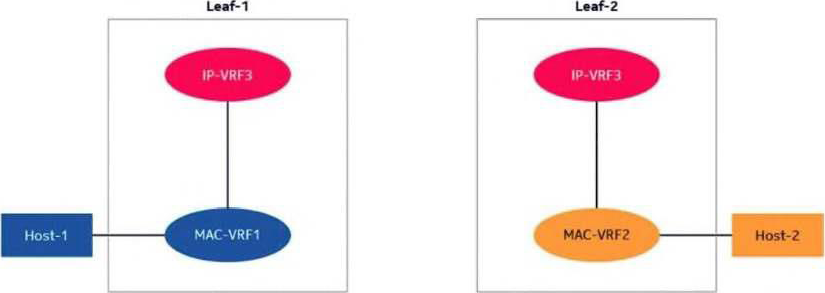
The two MAC-VRFs are inter-connected using IP-VRF3 which is to be deployed using asymmetric routing.
Which of the following statements is FALSE?
Answer : B
Comprehensive and Detailed 150 to 250 words of Explanation From [SR Linux EVPN and Data Center Interconnect/Course Guide/topics]:
In asymmetric L3 EVPN routing, each participating PE must have the MAC-VRFs needed to forward traffic in the destination bridge domain. However, the specific exhibit describes two MAC-VRFs interconnected through IP-VRF3, with Leaf-1 hosting MAC-VRF1 and Leaf-2 hosting MAC-VRF2. The false statement is that Leaf-1 and Leaf-2 must both have instances of MAC-VRF1 and MAC-VRF2. That requirement is not true for this described deployment. Each local MAC-VRF connects to IP-VRF3 using an IRB interface, and host MAC/IP information is advertised using EVPN route type 2 so remote PEs can learn endpoint reachability. The question's answer also implies that IP prefix advertisement using route type 5 is part of the control-plane exchange between the leaves for the routed service context. What matters is that the fabric can resolve host and prefix reachability through EVPN without forcing every PE to instantiate every MAC-VRF in this topology. Option B overstates the MAC-VRF placement requirement and is therefore false. Reference: asymmetric L3 EVPN routing, RT-2 host advertisements, RT-5 IP prefix routes, IRB attachment.
Question 5
Which of the following four symmetric routing options does NOT require the use of an EVPN route-type 2?
Answer : C
Comprehensive and Detailed 150 to 250 words of Explanation From [SR Linux EVPN and Data Center Interconnect/Course Guide/topics]:
EVPN route type 2 carries MAC/IP advertisement information. It is central to host-based routing and to designs where the fabric must distribute host MAC-to-IP bindings for integrated routing and bridging. In host routing, RT-2 is required because individual host reachability is signaled through MAC/IP advertisements. In interface-less prefix routing, RT-2 is still needed because the system relies on host or gateway MAC/IP information associated with the IRB and distributed gateway behavior. Interface-ful unnumbered designs may also require RT-2-style information to resolve next-hop or adjacency behavior because the routed interface does not use a conventional numbered next-hop model. Prefix routing with interface-ful numbered operation is different. In that model, the routed interface has explicit IP addressing and prefix reachability can be carried with L3 prefix routes without requiring EVPN RT-2 host MAC/IP advertisement as a dependency. Therefore, the symmetric routing option that does not require EVPN route type 2 is prefix routing interface-ful numbered. Reference: symmetric L3 EVPN routing models, RT-2 MAC/IP advertisements, prefix routing behavior.
Question 6
Consider the exhibit.
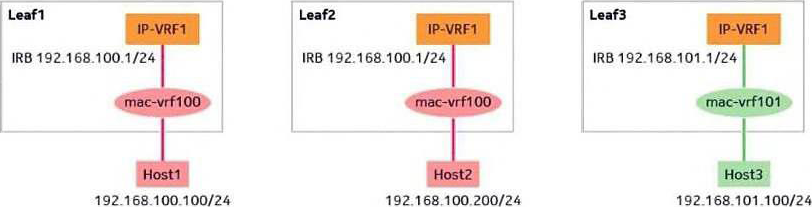
The network is configured for interface-less symmetric routing with an ECMP of 4 enabled on all leaf routers.
Which of the following statements is FALSE?
Answer : A
Comprehensive and Detailed 150 to 250 words of Explanation From [SR Linux EVPN and Data Center Interconnect/Course Guide/topics]:
In interface-less symmetric L3 EVPN routing, hosts in a subnet may be attached to different leaf routers, while inter-subnet forwarding is performed through the IP-VRF using VXLAN routed interfaces. The ingress and egress PEs both participate in L3 forwarding, and the routed VXLAN interface provides the per-IP-VRF overlay data-plane construct needed for symmetric routing. The IRB interfaces on the local MAC-VRFs must advertise learned local host routes so that remote PEs have the necessary host reachability information. The MAC-VRFs also need the appropriate EVPN control-plane configuration so host MAC/IP information can be exchanged, while the IP-VRF participates in L3 VPN-style route exchange for routed reachability. Option A is false because anycast gateway is not optional in this design for Leaf1 and Leaf2. Anycast gateway allows the same default-gateway IP and virtual MAC behavior to exist consistently on multiple leaves serving the same subnet. Without it, host default-gateway behavior would be inconsistent and traffic mobility across the fabric would break expected distributed gateway operation. Reference: interface-less symmetric routing, IRB, anycast gateway, routed VXLAN interface.
Question 7
When configuring the EVPN MP-BGP route reflector sessions between the leaf and spine routers, which of the following statements is TRUE?
Answer : A
Comprehensive and Detailed 150 to 250 words of Explanation From [SR Linux EVPN and Data Center Interconnect/Course Guide/topics]:
In SR Linux BGP configuration, parameters defined at a more specific hierarchy level can override broader protocol-level settings. Therefore, if a `local-as` value is configured within the BGP group used for EVPN MP-BGP route-reflector sessions, that value overrides the AS number configured directly under the BGP protocol for that group's sessions. Option A is correct. Option B is false because the cluster ID is configured on the route reflector, not on every participating client. The cluster ID identifies the RR cluster and helps prevent route-reflection loops. Option C is false because redundant route reflectors normally operate in parallel rather than as strict primary/backup devices; clients can peer with both for resilience. Option D is misleading because EVPN route reflectors are used to avoid a full mesh of overlay MP-BGP EVPN sessions between leaves, not to replace ordinary underlay eBGP leaf-spine routing sessions. In a clean fabric design, the underlay provides IP reachability, while the EVPN overlay uses MP-BGP sessions, often via route reflectors, to distribute tenant reachability. Reference: SR Linux BGP hierarchy, EVPN route reflector sessions, local-AS override, cluster ID behavior.
 All Official Question Types