Page: 1
/ 14
Total 187 questions
PMI Project Management Professional (PMBOK 7th Version) PMP Exam Questions
Question 1
A project team is working across different time zones and all team members are unable to attend the daily coordination meetings at the same time. The tasks are split
across teams working independently in different regions; however, there are task dependencies between the two teams.
What should the team lead do?
Answer : B
The correct answer is B because the scenario requires disciplined team and resource management rather than an immediate, informal, or purely administrative reaction. The selected response --- B. Ensure each team creates and accesses relevant project artifacts to manage dependent tasks. --- directly addresses the condition described in the question and keeps the project aligned with authorized objectives. PMBOK-aligned practice requires the project manager to support capability, clarify responsibilities, and remove blockers while preserving accountability and sustainable performance. This is especially important when project constraints, stakeholder expectations, quality expectations, delivery cadence, or business value may be affected. The competing options are weaker because they either bypass the accountable role, defer action without analysis, escalate before the project manager has prepared decision-quality information, or solve a symptom without correcting the underlying process issue. The selected answer also preserves transparency, ownership, and traceability, which are essential for sound project governance and effective delivery. PMBOK Guide Eighth Edition topics: people, team and resource management, stakeholder communication, impact analysis, governance, value delivery, and continuous improvement.
Question 2
A project to upgrade high-voltage transmission lines, towers, and substations in a remote mountainous area is 50% complete at the end of April.
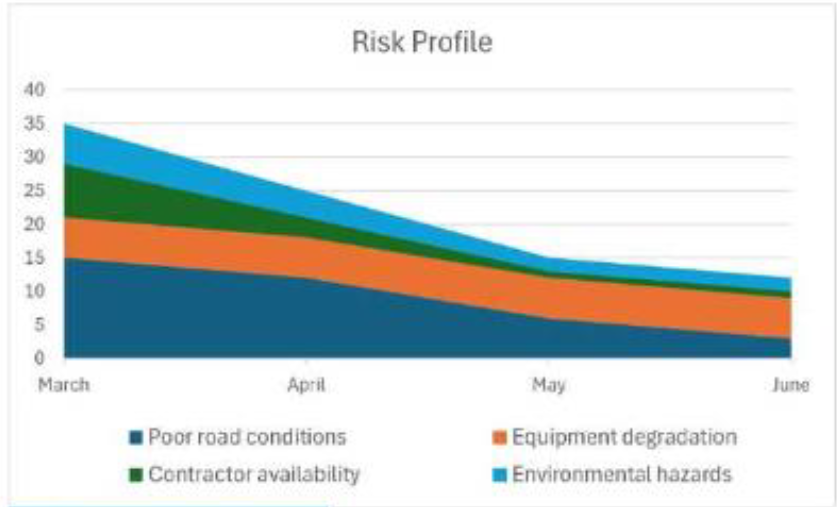
The risk manager has implemented risk responses and is projecting the probability and impact for the remainder of the project. At a monthly risk meeting, the risk manager presents the chart shown above.
What two conclusions can be determined from this chart? (Choose 2)
Answer : C, D
The correct answer is C, D because the scenario requires disciplined risk management rather than an immediate, informal, or purely administrative reaction. The selected response --- C. Some risks decrease over time as the likelihood of occurrence diminishes.; D. The overall risk is trending down due to the reduction in uncertainty. --- directly addresses the condition described in the question and keeps the project aligned with authorized objectives. PMBOK-aligned practice requires the project manager to identify the event or uncertainty, assess probability and impact, document ownership, and select a response that protects project objectives. This is especially important when project constraints, stakeholder expectations, quality expectations, delivery cadence, or business value may be affected. The competing options are weaker because they either bypass the accountable role, defer action without analysis, escalate before the project manager has prepared decision-quality information, or solve a symptom without correcting the underlying process issue. The selected answer also preserves transparency, ownership, and traceability, which are essential for sound project governance and effective delivery. PMBOK Guide Eighth Edition topics: process, risk management, stakeholder communication, impact analysis, governance, value delivery, and continuous improvement.
Question 3
A project manager needs to unexpectedly leave a critical project for valid reasons. How should the project manager prepare the knowledge transfer with the self-
managed team to help ensure the project continues?
Answer : B
The correct answer is B because the scenario requires disciplined team and resource management rather than an immediate, informal, or purely administrative reaction. The selected response --- B. Organize project management workshops with the team to collectively review and document project status, tasks, and responsibilities. --- directly addresses the condition described in the question and keeps the project aligned with authorized objectives. PMBOK-aligned practice requires the project manager to support capability, clarify responsibilities, and remove blockers while preserving accountability and sustainable performance. This is especially important when project constraints, stakeholder expectations, quality expectations, delivery cadence, or business value may be affected. The competing options are weaker because they either bypass the accountable role, defer action without analysis, escalate before the project manager has prepared decision-quality information, or solve a symptom without correcting the underlying process issue. The selected answer also preserves transparency, ownership, and traceability, which are essential for sound project governance and effective delivery. PMBOK Guide Eighth Edition topics: people, team and resource management, stakeholder communication, impact analysis, governance, value delivery, and continuous improvement.
Question 4
A project is delivering a new e-commerce platform. During execution, external market trends show shifting customer preferences toward mobile-first experiences.
There is uncertainty about whether the current feature set will meet user expectations.
What should the project manager do?
Answer : D
The correct answer is D because the scenario requires disciplined stakeholder engagement rather than an immediate, informal, or purely administrative reaction. The selected response --- D. Conduct a survey to gauge customer interest in the existing feature set. --- directly addresses the condition described in the question and keeps the project aligned with authorized objectives. PMBOK-aligned practice requires the project manager to clarify expectations, preserve transparency, and use the appropriate decision or communication channel. This is especially important when project constraints, stakeholder expectations, quality expectations, delivery cadence, or business value may be affected. The competing options are weaker because they either bypass the accountable role, defer action without analysis, escalate before the project manager has prepared decision-quality information, or solve a symptom without correcting the underlying process issue. The selected answer also preserves transparency, ownership, and traceability, which are essential for sound project governance and effective delivery. PMBOK Guide Eighth Edition topics: business environment, stakeholder engagement, stakeholder communication, impact analysis, governance, value delivery, and continuous improvement.
Question 5
A project manager is leading a predictive project. The main stakeholders involved in the project complain that the weekly status report sent over email, is very
confusing and so they expect a weekly meeting to be arranged to understand the project status and to ask questions wherever needed.
Which two steps should the project manager take? (Choose 2)
Answer : B, D
The correct answer is B, D because the scenario requires disciplined stakeholder engagement rather than an immediate, informal, or purely administrative reaction. The selected response --- B. Schedule a periodic meeting with stakeholders for sharing the information.; D. Prepare a clear template along with the stakeholders as how they want to visualize the information. --- directly addresses the condition described in the question and keeps the project aligned with authorized objectives. PMBOK-aligned practice requires the project manager to clarify expectations, preserve transparency, and use the appropriate decision or communication channel. This is especially important when project constraints, stakeholder expectations, quality expectations, delivery cadence, or business value may be affected. The competing options are weaker because they either bypass the accountable role, defer action without analysis, escalate before the project manager has prepared decision-quality information, or solve a symptom without correcting the underlying process issue. The selected answer also preserves transparency, ownership, and traceability, which are essential for sound project governance and effective delivery. PMBOK Guide Eighth Edition topics: process, stakeholder engagement, stakeholder communication, impact analysis, governance, value delivery, and continuous improvement.
Question 6
A project team released the first phase of a newly developed IT system to their operations team a month ago. The project team is currently working on new tasks for
the next phase but is continually contacted by operations key users with their new findings.
What should the project manager do to avoid this situation in the future?
Answer : A
The correct answer is A because the scenario requires disciplined stakeholder engagement rather than an immediate, informal, or purely administrative reaction. The selected response --- A. Work with the product owner to review the operations handover process and the checklist. --- directly addresses the condition described in the question and keeps the project aligned with authorized objectives. PMBOK-aligned practice requires the project manager to clarify expectations, preserve transparency, and use the appropriate decision or communication channel. This is especially important when project constraints, stakeholder expectations, quality expectations, delivery cadence, or business value may be affected. The competing options are weaker because they either bypass the accountable role, defer action without analysis, escalate before the project manager has prepared decision-quality information, or solve a symptom without correcting the underlying process issue. The selected answer also preserves transparency, ownership, and traceability, which are essential for sound project governance and effective delivery. PMBOK Guide Eighth Edition topics: process, stakeholder engagement, stakeholder communication, impact analysis, governance, value delivery, and continuous improvement.
Question 7
During the planning phase of a project, the local project team presents a task to the project manager. This task will require several months to complete, and the
duration will affect the expected timeline.
What should the project manager do first?
Answer : C
The correct answer is C because the scenario requires disciplined team and resource management rather than an immediate, informal, or purely administrative reaction. The selected response --- C. Meet with the project team to assess the task and any possible improvement to reduce its duration. --- directly addresses the condition described in the question and keeps the project aligned with authorized objectives. PMBOK-aligned practice requires the project manager to support capability, clarify responsibilities, and remove blockers while preserving accountability and sustainable performance. This is especially important when project constraints, stakeholder expectations, quality expectations, delivery cadence, or business value may be affected. The competing options are weaker because they either bypass the accountable role, defer action without analysis, escalate before the project manager has prepared decision-quality information, or solve a symptom without correcting the underlying process issue. The selected answer also preserves transparency, ownership, and traceability, which are essential for sound project governance and effective delivery. PMBOK Guide Eighth Edition topics: process, team and resource management, stakeholder communication, impact analysis, governance, value delivery, and continuous improvement.
 All Official Question Types