Page: 1
/ 14
Total 50 questions
QlikView 12 Business Analyst Certification QV12BA Exam Questions
Question 1
Refer to the exhibit.
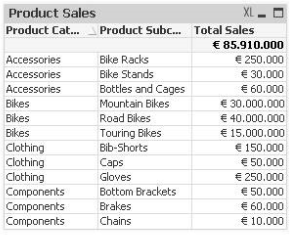
The Product Sales table shown represents the entire data set. A business analyst adds an expression in a document.

Next, the analyst selects Product Category = 'Bikes' and Product Subcategory = 'Road Bikes' What is the result of the expression with these selections'?
Answer : B
Question 2
A data architect needs to develop a dashboard to represent the previous year's sales performance in a simple KPI object Which expression should be used to calculate this value?
Answer : A
Question 3
A business analyst wants to display several dimensions and key performance indicators (KPI) in one object Aggregations must be done in this object. The user must be able to change the sorting of the dimensions and KPIs quickly and easily.
Which object meets these requirements?
Answer : A
Question 4
A business analyst needs to analyze average sales by product number and country by year. Which measure(s) should the business analyst use?
Answer : D
Question 5
Refer to the exhibits
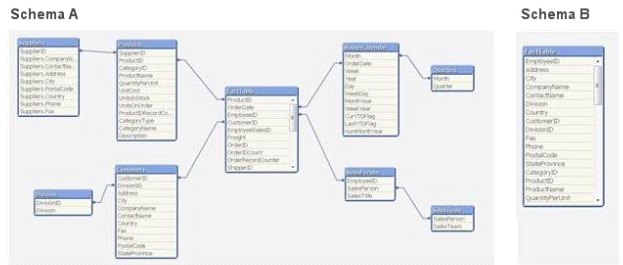
Schema A displayed in the exhibit has been transformed into Schema B
How can the before and after schemas be described?
Answer : C
Question 6
Refer to the exhibit.
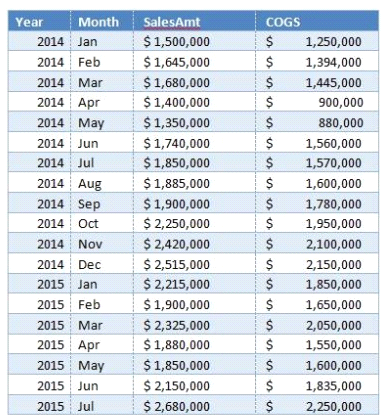
The dataset shown has been loaded into a QhkView application The user has selected the year 7015' to analyze
This expression is used to calculate a value:
Num((Sum({!<[Month] = {'May'} >> SalesAmt-COGS)/Sum({1<[Month] = {'May*} >} SalesAmt)), #,##0.0**)
What is the result?
What is the result?
Answer : D
Question 7
Refer to the exhibit.
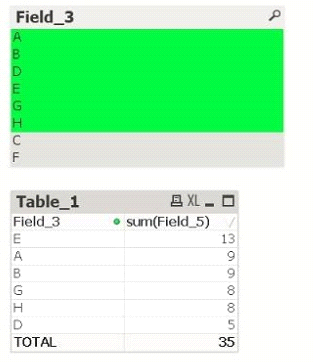
The TOTAL in Table_1 equals 35 instead of 52
What will this indicate about a data model?
Answer : A
 All Official Question Types