Page: 1
/ 14
Total 201 questions
Salesforce Build Applications Programmatically on the Salesforce Platform DEX-450 Exam Questions
Question 1
When importing and exporting data into Salesforce, which two statements are true?
Choose 2 answers
Answer : B, D
Question 2
A developer needs to create a baseline set of data (Accounts, Contacts, Products, Assets) for an entire suite of Apex tests allowing
them to test isolated requirements for various types of Salesforce cases.
Which approach can efficiently generate the required data for each unit test?
Answer : B
Question 3
A developer created a custom order management app that uses an Apex class. The order is represented by an Order object and an
OrderlItem object that has a master-detail relationship to Order. During order processing, an order may be split into multiple orders.
What should a developer do to allow their code to move some existing OrderItem records to a new Order record?
Answer : D
Allow Reparenting in Master-Detail Relationships:
In a master-detail relationship, the child record (in this case, OrderItem) is tightly bound to the parent record (Order).
By default, child records cannot be reassigned to a different parent record in master-detail relationships. However, enabling the 'Allow Reparenting' option on the master-detail field allows the child record (OrderItem) to be reparented to a different master record (Order).
This is the correct solution as it ensures that OrderItem records can be reassigned to a new Order without changing the structure of the relationship.
Why not the other options?
A . Add without sharing to the Apex class declaration:
Adding without sharing modifies sharing rules but does not affect the ability to reparent child records. This is unrelated to the issue described.
B . Change the master-detail relationship to an external lookup relationship:
Changing the relationship type is not necessary. Additionally, doing so could introduce unintended side effects, as master-detail relationships have features like roll-up summaries that are lost with a lookup relationship.
C . Create a junction object between OrderItem and Order:
Introducing a junction object is not required. This adds unnecessary complexity and deviates from the intended use of master-detail relationships.
Master-Detail Relationship Documentation
Allow Reparenting Option
Question 4
Which statement describes the execution order when triggers are associated to the same object and event?
Answer : B
Question 5
A developer has a Visualforce page and custom controller to save Account records. The developer wants to display any validation rule violations to the user.
How can the developer make sure that validation rule violations are displayed?
Answer : C
Question 6
Refer to the following Apex code:
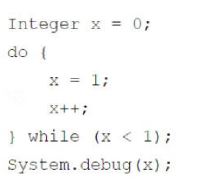
What is the value of when it is written to the debug log?
Answer : C
Question 7
Given the following Apex statement:
Account myAccount = [SELECT Id, Name FROM Account);
What occurs when more than one Account is returned by the SOQL query?
Answer : B
 All Official Question Types