Page: 1
/ 14
Total 60 questions
Salesforce Certified MuleSoft Developer II (Mule-Dev-301) Exam Questions
Question 1
Mule application A is deployed to CloudHub and is using Object Store v2. Mute application B is also deployed to CloudHub.
Which approach can Mule application B use to remove values from Mule application A'S Object Store?
Answer : A
To remove values from Mule application A's Object Store v2, Mule application B can use Object Store v2 REST API. This API allows performing operations on Object Store v2 resources using HTTP methods, such as GET, POST, PUT, and DELETE. Mule application B can use the DELETE method to remove values from Mule application A's Object Store v2 by specifying the object store ID and the key of the value to delete. Reference: https://docs.mulesoft.com/object-store/osv2-apis
Question 2
A scatter-gather router is configured with four routes:Route A, B, C and D.
Route C false.
Answer : A
The result of accessing route C failure is Error,errorMessage,payload.failures['2']. This is because a scatter-gather router returns an aggregated message that contains an array of results from each route and an array of failures from each route. The failures array contains error objects with information about each failed route execution. To access route C failure, which is the third route (index 2), the developer needs to use Error.errorMessage.payload.failures['2'] expression. Reference: https://docs.mulesoft.com/mule-runtime/4.3/scatter-gather-reference#scatter-gather-output
Question 3
A developer deploys an API to CloudHub and applies an OAuth policy on API Manager. During testing, the API response is slow, so the developer reconfigures the API so that the out-of-the-box HTTP Caching policy is applied first, and the OAuth API policy is applied second.
What will happen when an HTTP request is received?
Answer : B
When an HTTP request is received and the HTTP Caching policy is applied first, it checks if there is a cached response for that request in Object Store. If there is a cache hit, meaning that a valid cached response exists, then only the HTTP Caching policy is evaluated and the cached response is returned to the caller without invoking the OAuth policy or the API implementation. If there is a cache miss, meaning that no valid cached response exists, then both the HTTP Caching policy and the OAuth policy are evaluated before invoking the API implementation. Reference: https://docs.mulesoft.com/api-manager/2.x/http-caching-policy#policy-ordering
Question 4
When implementing a synchronous API where the event source is an HTTP Listener, a developer needs to return the same correlation ID back to the caller in the HTTP response header.
How can this be achieved?
Answer : D
When implementing a synchronous API where the event source is an HTTP Listener, Mule automatically propagates some message attributes between flows via outbound and inbound properties. One of these attributes is correlation ID, which is returned to the caller in the response header by default as MULE_CORRELATION_ID. Reference: https://docs.mulesoft.com/mule-runtime/4.3/about-mule-message#message-attributes
Question 5
A Flight Management System publishes gate change notification events whenever a flight's arrival gate changes. Other systems, including Baggage Handler System. Inflight Catering System and Passenger Notifications System, must each asynchronously receive the same gate change notification to process the event according.
Which configuration is required in Anypoint MQ to achieve this publish/subscribe model?
Answer : D
To achieve a publish/subscribe model using Anypoint MQ, where each system receives the same gate change notification event, the developer should publish the gate change notification to an Anypoint MQ exchange, create different Anypoint MQ queues meant for each of the other subscribing systems, and bind the exchange with each of the queues. An exchange is a message routing agent that can send messages to different queues based on predefined criteria. By binding an exchange with multiple queues, each queue receives a copy of every message sent to that exchange. Therefore, each system can subscribe to its own queue and receive every gate change notification event. Reference: https://docs.mulesoft.com/anypoint-mq/3.x/anypoint-mq-exchanges
Question 6
Refer to the exhibit.
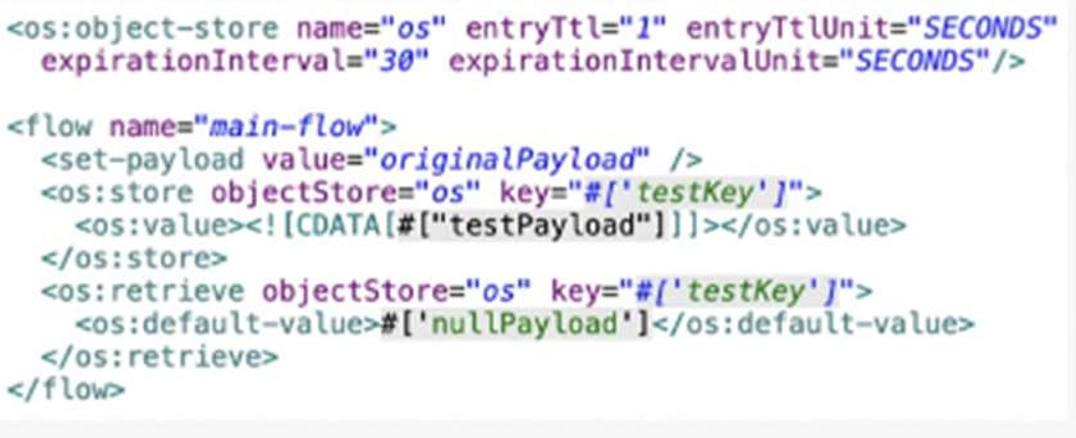
A Mute Object Store is configured with an entry TTL of one second and an expiration interval of 30 seconds.
What is the result of the flow if processing between os'store and os:retrieve takes 10 seconds?
Answer : A
The result of the flow is nullPayload if processing between os:store and os:retrieve takes 10 seconds. This is because the entry TTL of the object store is one second, which means that any stored value expires after one second and is removed from the object store. The expiration interval of 30 seconds only determines how often the object store checks for expired values, but it does not affect the TTL. Therefore, when os:retrieve tries to get the value after 10 seconds, it returns nullPayload because the value has already expired and been removed. Reference: https://docs.mulesoft.com/object-store/osv2-faq#how-does-the-time-to-live-work
Question 7
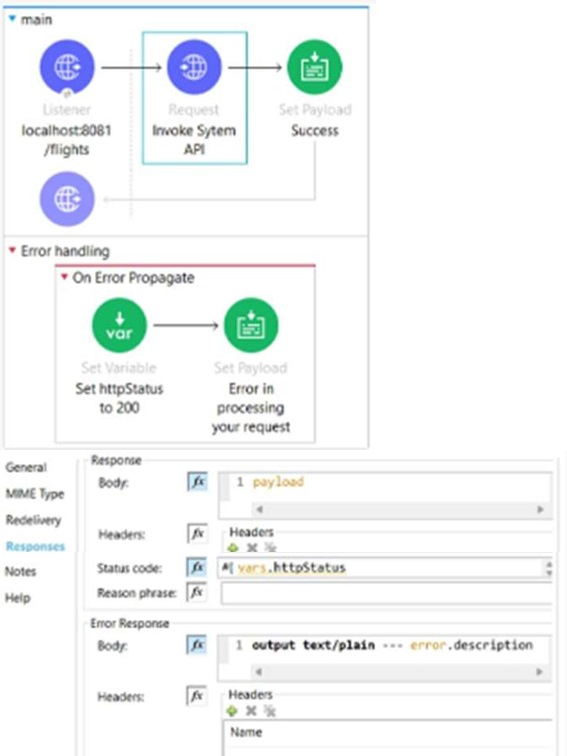
The HTTP Request operation raises an HTTP CONNECTIVITY error.
Which HTTP status code and body are returned to the web client?
Answer : C
When the HTTP Request operation raises an HTTP CONNECTIVITY error, it triggers an on-error-continue handler that sets a payload with 'Error in processing your request'. Since no status code is explicitly set in this handler, it defaults to 500 (INTERNAL SERVER ERROR). Therefore, the web client receives an HTTP response with status code 500 and body 'Error in processing your request'. Reference: https://docs.mulesoft.com/mule-runtime/4.3/error-handling#on-error-continue
 All Official Question Types