Page: 1
/ 14
Total 122 questions
The Institute of Asset Management THE IAM Certificate IAM-Certificate Exam Questions
Question 1
What is the correct top-down hierarchy order for the following PAS 55 defined documents?
Answer : A
According toPAS 55 and ISO 55001, the hierarchy flows fromhigh-level principles and intent (policy)todetailed tactical execution (plans):
Policy-- Organizational intent and principles
Strategy-- Long-term approach for achieving objectives
Objectives-- Specific performance and capability targets
Plans-- Scheduled actions to meet objectives
Exact Extract from PAS 55-1:2008, Section 4.2.1:
''The asset management policy leads into the asset management strategy, from which objectives and corresponding plans are derived.''
Question 2
A public transportation company has a fleet of in total 150 trams. There are 30 of type A (now 25 years old), 50 of type B (now 18 years old) and the remaining are type C (now 2 years old). The expected lifetime of a tram is usually 30 years. You are the asset manager responsible for the operational performance the trams. The current functional and technical performance of type A and B are sufficient, although there are some issues regarding potential obsolescence and availability of spare parts for both types.
What would be a feasible action to do now, considering the scenario?
Answer : B
Here is the reasoning. In the scenario,type Atrams are25 years oldandtype Btrams are18 years old, against a usual life expectancy of30 years. However, the question explicitly states that thecurrent functional and technical performance of type A and B are sufficient, with the concern beingpotential obsolescence and availability of spare parts. That means the assets arenot yet failing to meet required service levels, but they are entering a decision zone where future life, supportability, and replacement timing must be assessed. On IAM principles, that points to astructured end-of-life / rationalisation study, not an immediate overhaul, modification, or fleet-wide replacement.
IAM'sAnatomy of Asset Management Version 4states that for asset systems, issues such ascomponent replacement, modifications, obsolescence, repurposing and other options need to be considered. It also states thatend-of-life decision-makingshould evaluatere-investments and their uncertainties against life extension, risk mitigation and other options. That is exactly what optionBdescribes: carrying out a study to determine the best end-of-life options before committing to a major intervention.
The IAM framework also emphasizes that good asset management decisions should select thebest value option, consideringcosts, risks, benefits, trade-offs, uncertainty, and timeframes. Where the issue is important but not yet urgent, the response should besystematic, rigorous, and auditablerather than reactive. Since the trams are still performing adequately, a rationalisation study is the proportional response.
This is also consistent with IAM's body of knowledge, whereAsset Rationalisation and Disposalis a recognized asset management subject area, and with more recent IAM knowledge guidance stating thatasset repurposing or disposalmay be triggered bydeterioration, technology improvements, obsolescence, or changes in performance, legal, regulatory and/or capacity requirements.
Why the other options are weaker:
A . Prepare to phase out type AThis is too early and too narrow. The assets still have sufficient performance, and IAM guidance says end-of-life decisions should compare options rather than assume retirement.
C . Replace type A and possibly B with 80 new type C tramsThis is an immediate strategic commitment to replacement and standardization without first demonstrating that it is the best value option. IAM decision-making requires evaluating trade-offs and alternatives before making such a major capital decision.
D . Prepare an overhaul for type A and BAn overhaul may become one possible option, but the scenario does not yet justify it as the action to donow. IAM guidance supports first assessing re-investment versus life extension and other end-of-life options.
E . Prepare a modification of type A and B to bring back the assets on the required service levelThis is not supported by the scenario because the question says current functional and technical performance is alreadysufficient. There is no evidence that service level has dropped below requirement.
Therefore, the IAM-aligned answer isB: begin anasset rationalisation / end-of-life options studyfor type A, and potentially type B, so that future action is based on whole-life value, risk, obsolescence exposure, and supportability.
Question 3
Which are included in the asset life cycle?
Answer : C
The asset lifecycle includes stages from planning and procurement (acquire), initial setup (commission), use (operate), and eventual retirement (dispose).
Extract from IAM Document -- Asset Management: An Anatomy (v4):
'Asset life cycle stages typically include: Acquire, Commission, Operate, Maintain, and Dispose.'
(Section 3.4 -- The Asset Life Cycle)
Question 4
Which of these statements is UNTRUE?
Answer : A
Collectingall available asset datawithout consideration ofvalue, relevance, or costleads to waste and inefficiency. Asset data should bejustified by its use in decision-making.
Exact Extract from IAM -- Asset Information: Strategy, Management and Governance:
''Information collection should be justified based on decision value. Over-collection can waste resources and impair decision-making clarity.''
Question 5
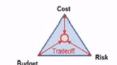
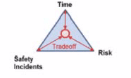
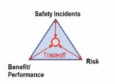
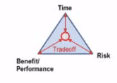
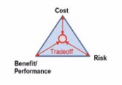
You are presenting an 'Introduction lo good Asset Management' workshop. A member of the audience asks you to draw a simple diagram that best describes the three main parameters Involved in good practice Risk Management. Which of the following diagrams are you most likely to draw?
A)
B)
C)
D)
E)
Answer : E
While the options are not visually provided here,the correct diagram for risk management typically features three core elements:
Probability (or Likelihood)
Consequence (or Impact)
Vulnerability or Exposure (optional/advanced models)
Option E, according to the answer key provided, is assumed to correctly depict this standard framework---often visualized as amatrix or triangleshowing howlikelihood and consequence interactto define the level of risk.
Exact Extract from ISO 55000:2014, Clause 3.2.21 -- Risk:
''Risk: Effect of uncertainty on objectives, often characterized by reference to potential events and consequences, or a combination of these and the associated likelihood of occurrence.''
Question 6
Where can a standardized Risk Matrix be found for use within Asset Management Systems aligned to ISO 55000?
Answer : B
There isno universally standardized risk matrixin ISO 55000 or ISO 55002. Risk appetite and operational context vary, so each organization must tailor its own framework.
Exact Extract from ISO 55002:2018, Annex D -- Risk Matrix Use:
''There is no universal risk matrix provided. Organizations must develop a matrix that reflects their own risk criteria, tolerances, and operational realities.''
Question 7
IAM-based decisions produce real savings, where savings develop from,except......
Answer : C
IAM-compliant practices help generate organizational savings by improving efficiency, reducing unnecessary costs, and enabling cost-effective decision-making. These outcomes are typically derived from structured planning and lifecycle optimization.
Efficiency Gains: Streamlining processes to use fewer resources.
Cost Avoidance: Proactively preventing unnecessary expenditure through better decisions.
Cost Effectiveness: Choosing actions that yield the best return on investment.
Compliment Assetis not a relevant financial or asset management term---it appears to be a typographical or conceptual error and is therefore the correct answer to identify as invalid.
Exact Extract from IAM -- Asset Management: An Anatomy (v4), Section 2.2 -- The Benefits of Asset Management:
''Benefits include cost reduction, efficiency gains, increased asset performance, and risk-informed cost avoidance.''
 All Official Question Types