Page: 1
/ 14
Total 70 questions
WGU Integrated Physical Sciences (C165, C908) Exam Questions
Question 1
An electron is transferred from one atom to another.
Which type of bond is formed?
Answer : C
When an electron is transferred from one atom to another, an ionic bond is formed. This type of bond occurs between a metal and a non-metal where one atom donates an electron to another, resulting in the formation of positive and negative ions that attract each other. In comparison:
Covalent bonds involve the sharing of electrons between atoms.
Elemental bonds is not a standard term in chemistry.
Metallic bonds involve the sharing of free electrons among a lattice of metal atoms.
Integrated Physical Sciences Learning Resources, Chapter on Chemical Bonds
Question 2
A chemist is studying the byproducts produced during the burning of gasoline. Gasoline bums by reacting with oxygen to produce water vapor and carbon dioxide. The chemist carefully measures the masses of all the substances involved in this reaction.
Which observation would lead the chemist to conclude that the law of conservation of matter is obeyed in this reaction?
Answer : D
The law of conservation of matter states that matter cannot be created or destroyed in a chemical reaction. This implies that the total mass of reactants before the reaction must be equal to the total mass of products after the reaction. When gasoline burns, it reacts with oxygen to produce water vapor and carbon dioxide. Therefore, for the law of conservation of matter to hold true, the combined mass of the gasoline and oxygen (the reactants) must be equal to the combined mass of the water vapor and carbon dioxide (the products).
Integrated Physical Sciences textbooks and resources on chemical reactions and the law of conservation of matter.
Standard chemistry principles regarding mass conservation in reactions.
Question 3
A scientist measures the change in temperature from a chemical reaction over a three-day period in a single experiment. When the scientist analyzes the data, the results are five degrees Celsius higher than reported by other scientists after studying the same reaction.
How can the scientist appropriately resolve this problem?
Answer : C
When a scientist's results differ significantly from those reported by others, the appropriate action is to perform the experiment again. Repeating the experiment helps to ensure that the results are accurate and reliable. It allows the scientist to verify their findings and check for any possible errors in the experimental process. Reference:
Integrated Physical Sciences, Chapter 2: Methods of Scientific Investigation
Question 4
In which scenario does gravity cause the change in the object's motion?
Answer : B
Gravity is the force that accelerates a skydiver towards the ground after they jump from a plane. In this scenario, gravity causes a significant change in the motion of the skydiver, pulling them downward and increasing their velocity until air resistance balances the force of gravity. Reference:
Integrated Physical Sciences, Chapter 3: Forces and Motion
Question 5
The rock layers shown in the illustration have not been disturbed or overturned
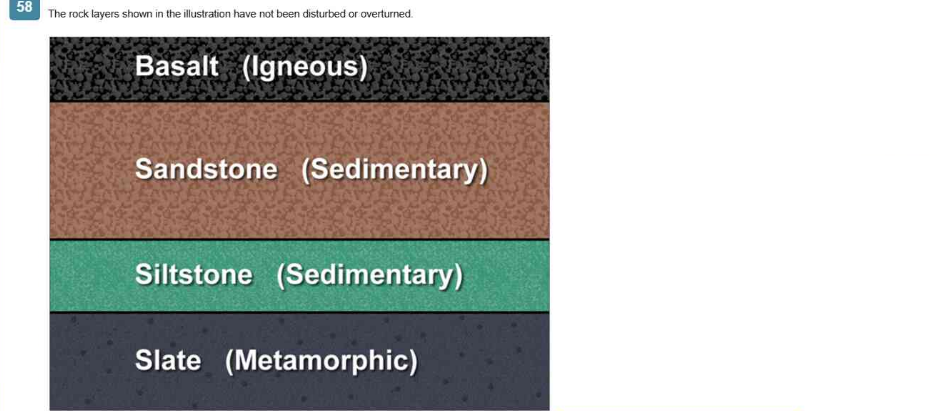
Basalt (Igneous)
Sandstone (Sedimentary)
Siltstone (Sedimentary)
Slate (Metamorphic)
What should a geologist conclude about the geologic history ot this area7
Answer : D
The given rock layers in the illustration show a sequence from bottom to top: slate (metamorphic), siltstone (sedimentary), sandstone (sedimentary), and basalt (igneous). This sequence indicates the following geologic history:
Metamorphic rock (slate) at the bottom suggests an initial period of high heat and pressure.
Sedimentary rocks (siltstone and sandstone) above the slate indicate subsequent periods of deposition under water.
Basalt (igneous) at the top suggests a volcanic eruption depositing lava that solidified into basalt.
Therefore, the correct conclusion about the geologic history of this area is that it experienced a volcanic eruption and then was located underwater.
Reference
Integrated Physical Sciences: Sedimentary, metamorphic, and igneous rock formation processes.
Geologic history interpretation based on rock layers.
Question 6
In which state of matter are particles closest together?
Answer : B
In the solid state of matter, particles are closest together. This is due to the fact that solids have a definite shape and volume, meaning the particles are tightly packed in a fixed, orderly arrangement. In comparison:
Liquids have particles that are close together but not in a fixed position, allowing them to flow.
Gases have particles that are far apart and move freely.
Plasma consists of ionized particles and is not typically considered in the context of ordinary matter states at standard conditions.
Integrated Physical Sciences Learning Resources, Chapter on States of Matter
Question 7
Which time of the year Is it In Fargo, North Dakota, when Earth is facing the sun as shown in the diagram?

Answer : C
The diagram shows the Earth with the northern hemisphere tilted towards the sun.
In this position, regions like Fargo, North Dakota receive the most direct sunlight, resulting in warmer temperatures.
This configuration occurs during the summer season in the northern hemisphere. Reference:
Integrated Physical Sciences resources on Earth's tilt and seasonal changes.
 All Official Question Types