Page: 1
/ 14
Total 40 questions
WGU Organizational Behavior (GTO1, C715) WGU Organizational Behavior Exam Questions
Question 1
Which dimension of the Fiedler contingency model is associated with the degree of influence a leader has over variables such as hiring, firing, discipline, promotions, and salary increases?
Answer : D
The Fiedler contingency model proposes that effective group performance depends on the proper match between the leader's style and the degree to which the situation gives control to the leader. Fiedler identified three contingency dimensions that define the situational favorableness: Leader-member relations, Task structure, and Position power.
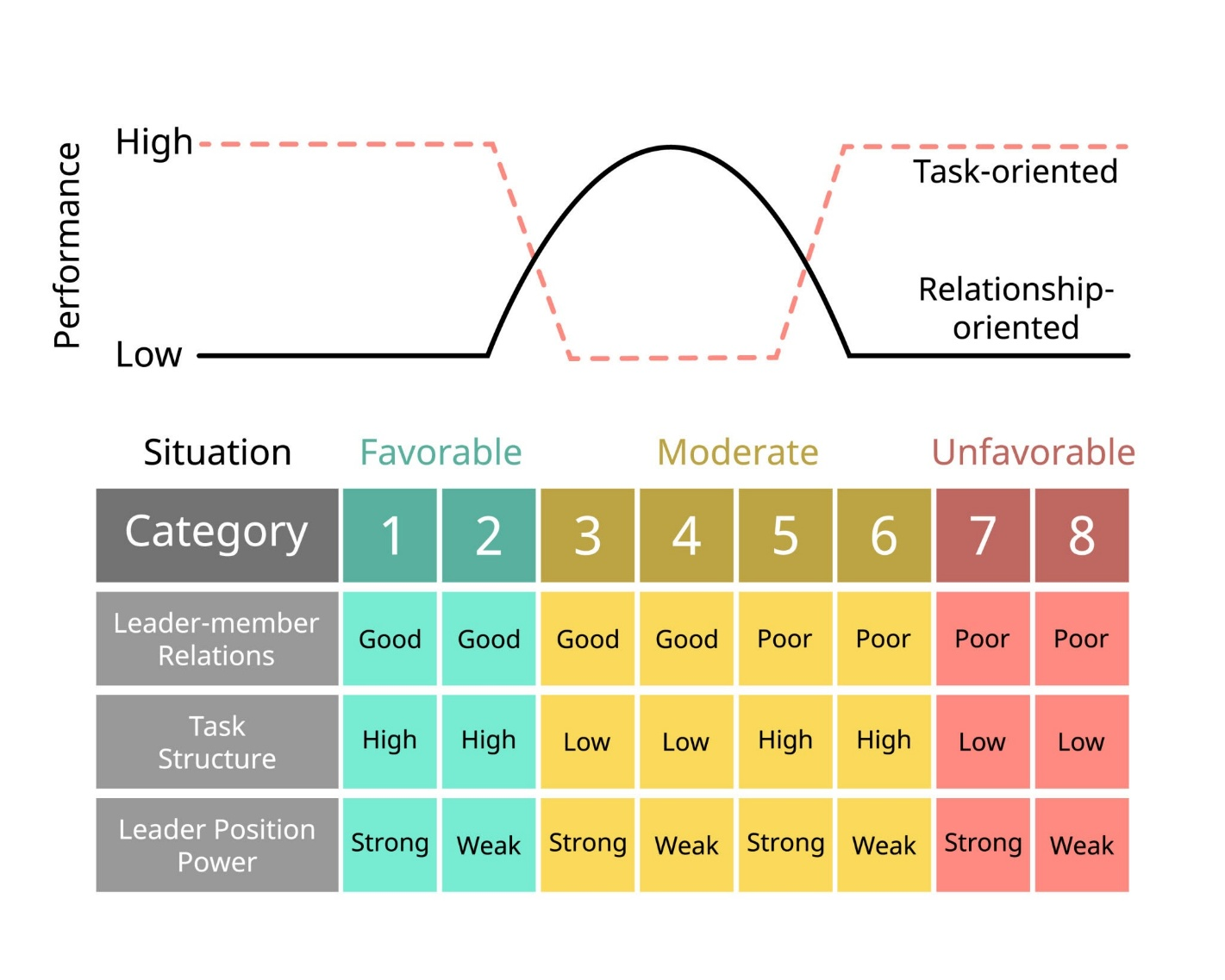
Position power is specifically defined as the degree of influence a leader has over power variables such as hiring, firing, discipline, promotions, and salary increases. A leader with high position power has significant structural authority, which makes it easier to influence the behavior of subordinates through formal rewards and sanctions. In contrast, a leader with low position power must rely more heavily on personal influence or rapport to achieve goals. Understanding these dimensions is crucial because Fiedler argued that a leader's style is essentially fixed; therefore, to improve effectiveness, one must either change the leader to fit the situation or change the situation (such as increasing or decreasing the leader's position power) to fit the leader.
Question 2
In organizing a team to develop a new product for entry into the electronics market, management wanted to assign team members having characteristics common to effective teams. Which list specifies common characteristics of effective teams?
Answer : A
The effectiveness of a team is generally categorized by its composition, context, and process. According to the Big Five Personality Model and team research, effective teams are typically composed of individuals who score high on emotional stability, agreeableness, and conscientiousness. These traits help maintain a positive working environment and reduce interpersonal friction. Furthermore, teams must ensure that they have people to fill various role demands---meaning that all necessary tasks and social-maintenance functions are being performed by someone within the group.
Crucially, effective teams do not necessarily have an 'absence of conflict' (which refutes option C). Instead, they maintain a manageable level of conflict. Specifically, 'task conflict'---disagreements over the content of the work---can actually stimulate discussion and lead to better decisions, provided that 'relationship conflict' (interpersonal animosity) remains low. Therefore, a team that is emotionally stable, fulfills its role requirements, and handles conflict constructively is much more likely to succeed in a high-pressure environment like the electronics market than one that simply tries to avoid all disagreement.
Question 3
After physiological desires such as hunger, thirst, and shelter are met, the next level of desires becomes the basis for motivation. This is an example of which theory?
Answer : D
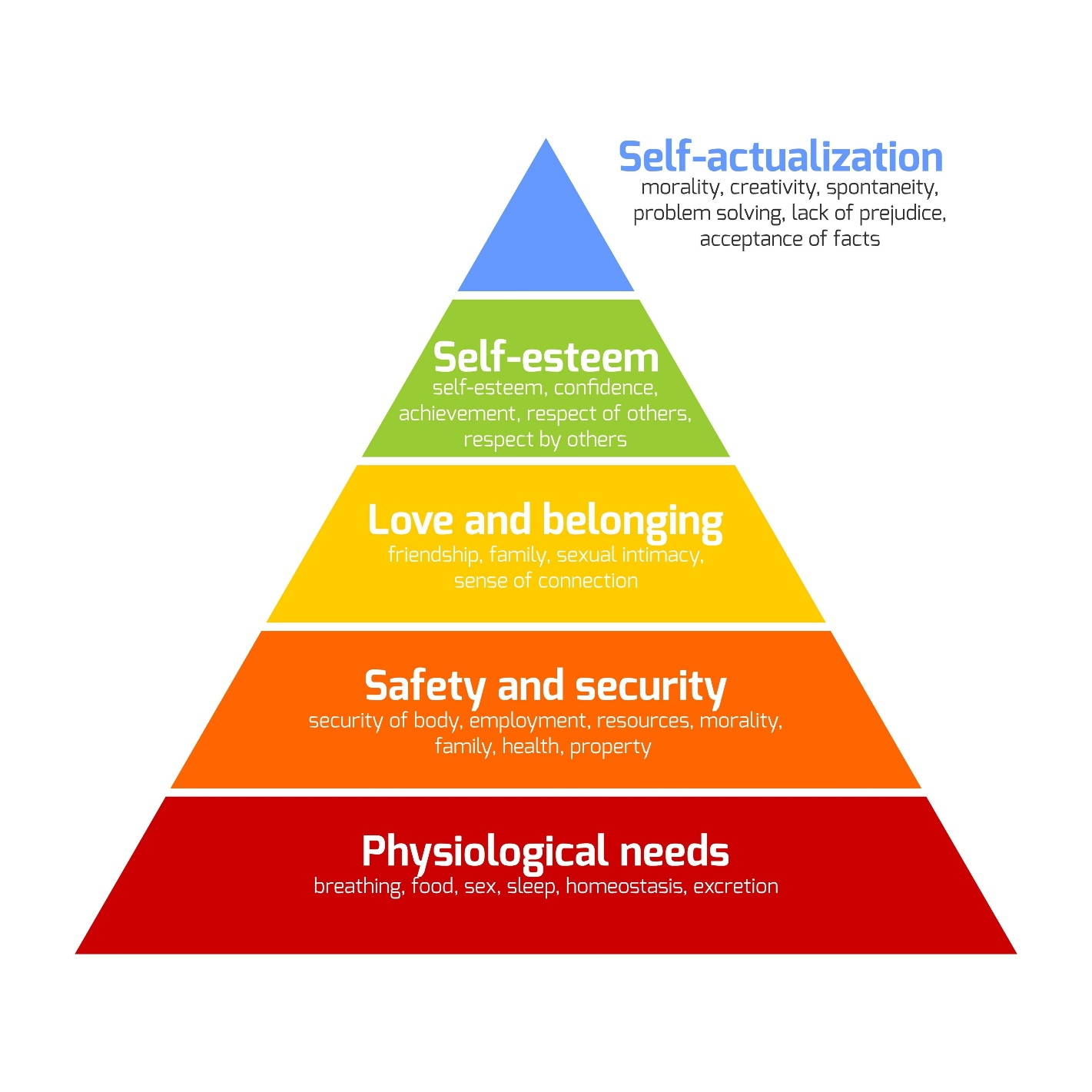
Abraham Maslow's Hierarchy of Needs is perhaps the best-known theory of motivation. Maslow hypothesized that within every human being, there exists a hierarchy of five needs: Physiological (hunger, thirst, shelter), Safety (security and protection), Social (affection, belongingness), Esteem (self-respect, autonomy), and Self-actualization (achieving one's potential).
Shutterstock
Explore
The core premise of this theory is the 'progression principle,' which states that as each of these needs becomes substantially satisfied, the next need in the hierarchy becomes dominant as a motivator. The question highlights that once physiological desires (the lowest level) are met, the individual moves to the next level. In Maslow's original model, the level immediately following physiological needs is Safety and Security. This level involves seeking a predictable environment free from physical and emotional harm. In an organizational context, this translates to job security, health benefits, and a safe working environment. According to Maslow, once an employee feels physically safe and secure, they will no longer be motivated by these factors and will instead seek to satisfy 'social' or 'belonging' needs. While contemporary research suggests that people don't always follow this rigid linear progression, Maslow's model remains a foundational tool for managers to understand that an employee's needs change as their circumstances improve.
Question 4
Which team type takes on many responsibilities of their former supervisors?
Answer : B
A Self-managed work team is a group of employees (typically 10 to 15) who perform highly related or interdependent jobs and take on many of the responsibilities of their former supervisors. In a traditional work structure, a supervisor would handle tasks such as planning and scheduling work, assigning tasks to members, making operating decisions, and taking action on problems. In a self-managed environment, the team collectively takes over these managerial duties.
These teams may even select their own members and evaluate each other's performance. The goal of organizing into self-managed teams is to increase employee involvement and empowerment, theoretically leading to higher job satisfaction and productivity through synergy and collective control. Unlike 'problem-solving teams,' which only make recommendations, self-managed teams have the authority to implement solutions and take full responsibility for outcomes. While this can be highly effective, the success of self-managed teams depends heavily on the organizational culture and the level of training provided to employees. If members are not prepared for the interpersonal demands of self-management---such as resolving internal conflicts or managing the pace of work---the team can struggle. However, when properly implemented, self-managed teams represent the highest level of team autonomy in organizational design.
Question 5
What is a personal view of how one is supposed to act in a given group situation?
Answer : C
In the context of group dynamics, 'roles' refer to a set of expected behavior patterns attributed to someone occupying a given position in a social unit. Within this framework, Role Perception is defined as an individual's own view of how he or she is supposed to act in a given situation. We get these perceptions from various stimuli around us---friends, books, movies, or observing how successful colleagues behave.
It is important to distinguish Role Perception from Role Expectations, which are how others believe a person should act in a given situation. For example, a manager might have a role expectation that a supervisor should be stern, but the supervisor's own role perception might be that they should be a supportive mentor. When role perception and role expectation do not align, it can lead to confusion or poor performance. Role Identity refers to the certain attitudes and behaviors consistent with a role, while Role Conflict occurs when an individual finds that compliance with one role requirement may make it difficult to comply with another. Because the question specifically asks for the personal view of behavior, 'Role Perception' is the correct technical term.
Question 6
Employee A noticed that Employee B was late for work, and A's perception of why B was late will determine what action A takes in this situation. Considering attribution theory, which factors will determine A's perception regarding whether B's behavior was internally or externally caused?
Answer : D
Attribution theory is a cornerstone of social perception in the workplace, explaining how we judge people differently depending on what meaning we attribute to a given behavior. When we observe an individual's behavior, we attempt to determine whether it was internally caused (under the person's control) or externally caused (forced by the situation). According to Harold Kelley's model, this determination depends on three specific factors: distinctiveness, consensus, and consistency.
Distinctiveness refers to whether an individual displays different behaviors in different situations. If Employee B is late for work but is generally reliable in all other tasks, the behavior has high distinctiveness, suggesting an external cause (like a traffic jam). Consensus occurs if everyone who faces a similar situation responds in the same way. If every employee who took the same route as Employee B was also late, consensus is high, pointing to an external cause. Consistency looks at whether the person responds the same way over time. If Employee B is late every single day, consistency is high, which usually leads the observer to attribute the behavior to internal causes (like a lack of discipline). By analyzing these three dimensions, Employee A forms a perception that dictates their reaction---whether that be empathy for a one-time external delay or disciplinary action for a recurring internal habit.
Question 7
What is true about the relationship between performance evaluation and motivation?
Answer : A
The link between performance evaluation and motivation is best explained through Expectancy Theory. According to this theory, an individual's motivation to exert effort depends on three relationships: Effort-Performance, Performance-Reward, and Rewards-Personal Goals. For an employee to be motivated, they must have confidence that the effort they exert will lead to a favorable performance evaluation (the Effort-Performance relationship).
If an employee believes that no matter how hard they work, the evaluation process is biased, based on luck, or uses unclear criteria (like personality traits rather than measurable behaviors), their motivation will suffer. Furthermore, the employee must believe that a good evaluation will lead to organizational rewards (such as a bonus or promotion) and that those rewards will satisfy their personal goals. If any of these links are weak---for instance, if the evaluation process is perceived as unfair---the entire motivational chain is broken. Therefore, the perceptual process is central to this relationship; it is not the objective reality of the evaluation that motivates, but the employee's perception of its fairness and accuracy.
 All Official Question Types