Page: 1
/ 14
Total 50 questions
Workday Pro Talent and Performance Workday-Pro-Talent-and-Performance Exam Questions
Question 1
Refer to the following scenario to answer the question below.
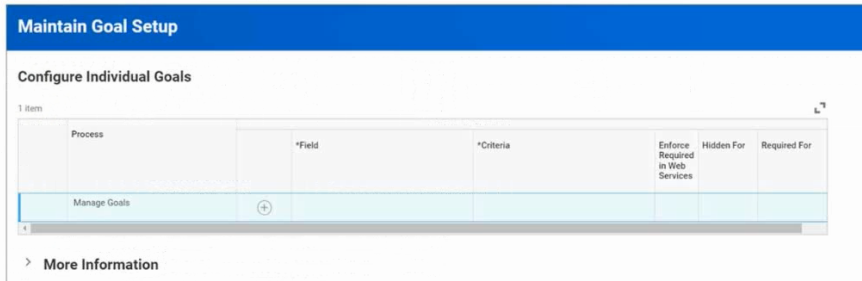
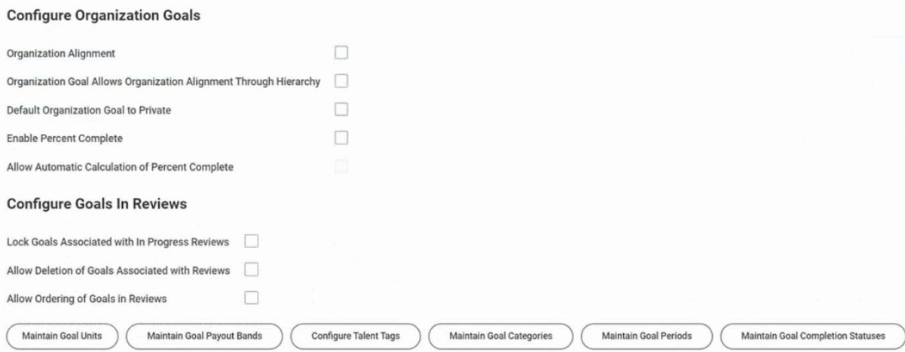
An enterprise creates organizational goals that include the following criteria:
The organizational goals span five years.
Workers can align their individual goals with the organizational goals.
Workers must provide a description for each individual goal.
Each individual goal must fall within one of three groupings.
When workers create their goals, they need to include a goal description.
Where do you make the goal description a required field?
Answer : D
To make specific goal fields mandatory (such as requiring a goal description), you must configure this in the Configure Individual Goals section of the Maintain Goal Setup task.
In this section, administrators define which fields are:
Required (must be completed by the worker),
Optional, or
Hidden (not shown to users).
The Maintain Goal Categories task only sets up categories such as Innovation, Financial, Productivity.
The Maintain Goal Units task configures measurement units (e.g., percentages, dollars).
The Configure Organization Goals section governs how enterprise-level organizational goals behave, but does not control whether an individual field like ''Description'' is required.
Therefore, to enforce that workers must always provide a goal description, you configure this requirement in the Configure Individual Goals section.
Workday Talent & Performance Admin Guide: ''Configure Individual Goals section allows fields such as description, due date, and measurement to be marked as required or optional.''
Workday Pro Talent & Performance study material confirms: ''Goal description requirements are set in Configure Individual Goals, not in organization goal setup or categories.''
Question 2
When a position has a succession plan, what talent attribute identifies the timeframe that you expect a specific worker to move into that position?
Answer : C
In succession planning, the Readiness talent attribute represents the timeframe in which a worker is expected to be ready to move into a position (e.g., ''Ready Now,'' ''1--2 Years,'' ''3--5 Years'').
Incorrect options:
A . Achievable Level indicates the highest role/level a worker may reach, not timeframe.
B . Retention risk of employee leaving, not succession readiness.
D . Potential overall growth capacity, not time-based readiness.
Workday Succession Planning documentation: ''Readiness specifies the timeframe for potential successors.''
Question 3
What task do you configure to use suggested skills?
Answer : C
Suggested skills functionality is enabled and configured using the Maintain Skills and Experience Setup task.
This controls whether Workday will suggest skills to workers based on their profiles and activity.
Incorrect options:
Edit Tenant Setup -- System and Edit Tenant Setup -- HCM global settings, not skill suggestions.
Configure Optional Fields defines visibility of fields but not skill suggestion functionality.
Workday Talent & Performance documentation: ''Suggested skills are configured in Maintain Skills and Experience Setup.''
Pro Talent certification material confirms this task.
Question 4
Your organization launches talent reviews for the entire organization on an annual basis. You created a new Talent Lead security group to initiate the talent review event.
What do you need to modify to enable this configuration?
Answer : A
This scenario involves enabling a new security group (Talent Lead) to initiate Talent Review events in Workday. To achieve this, you need to configure both the business process security and domain security that govern Talent Reviews.
Launch Talent Reviews business process security policy
This policy controls who has permission to initiate the Talent Review event.
Without updating this, the new Talent Lead group cannot start the review process.
Talent Review domain security policy
This policy governs access to Talent Review objects, such as templates, review events, grids, and attributes.
Without updating domain security, even if the group can launch the process, they will not be able to view or interact with the talent review itself.
Incorrect alternatives
Option B (Launch Talent Reviews only): This would allow the group to initiate the process, but they would lack access to view or work with the reviews.
Option C (Talent Review business process security policy): There is no generic ''Talent Review business process''; the correct one is ''Launch Talent Reviews.''
Option D (Talent Review business process + domain security): Misstated. The business process in question is ''Launch Talent Reviews,'' not a general Talent Review business process.
Therefore, the correct answer is to update both the Launch Talent Reviews business process security policy and the Talent Review domain security policy so that the Talent Lead group has both initiation rights and access permissions.
Reference
Workday Pro Talent & Performance Certification Guide -- Security in Talent Reviews: Explains that both business process security and domain security must be configured for security groups responsible for launching talent reviews.
ERP Cloud Training -- Talent Review Security: Notes that business process security grants initiation rights, while domain security controls access to objects and review content.
Workday Community Documentation -- Talent Review Setup: Confirms that both the Launch Talent Reviews business process policy and the Talent Review domain security policy must be modified when a new security group is added to initiate reviews.
Question 5
What field does Workday require when you create a competency?
Answer : C
When creating a Competency in Workday Talent & Performance, the system enforces certain required fields.
Name:
This is the mandatory field. Every competency must have a name so it can be identified in job profiles, performance reviews, and talent pools.
Without a name, Workday will not allow you to save or proceed.
Proficiency Rating Scale:
This is important for measuring competencies (e.g., Basic Intermediate Advanced Expert).
However, it is not required at the point of creation. If you don't assign one, the system can still save the competency, though you may not be able to rate employees effectively without linking a scale later.
Competency Description:
Highly recommended for clarity and reporting.
But this field is optional, not enforced by Workday.
Category:
Used to group competencies (e.g., Leadership, Technical, Communication).
Again, optional and for organizational purposes only.
Thus, while other fields add functionality and structure, the only required field to create a competency is the Name.
Reference
Talent & Performance Learning Material: Competencies are created with ''Name'' as required, while ''Description, Proficiency Scale, and Category'' are optional metadata used to support evaluation and reporting.
Workday Pro Talent & Performance study outlines: Under the Competencies section, it explicitly states: ''The only mandatory field is Name. Description, Proficiency Rating Scale, and Category are optional fields that can be configured for richer competency management.''web source Talent & Performance training + community notes
ERP Cloud Training -- Workday Talent & Performance course: Highlights that ''Name is required when creating a competency; all other fields are optional depending on business needs.''
Question 6
What option is available for managing your succession plans?
Answer : D
In Workday, when managing Succession Plans, you can directly add employees by searching for them in the Find Workers report.
Incorrect options:
A . Adding employees from a talent pool is possible for development, but not a delivered method for populating succession plans.
B . External candidates cannot be directly assigned to succession plans; succession focuses on internal talent.
C . Job profiles are the object succession plans are created for, not what you add via Find Workers.
Workday Succession Planning Guide: ''Use the Find Workers report to identify and add employees to succession plans.''
Pro Talent & Performance exam materials confirm this process.
Question 7
An employee had a manager from January through August. The employee then had a new manager from September through December.
In the Start Performance Review business process, for the Complete Manager Evaluation step, what security group would you use to route the step to the employee's manager that they had in January?
Answer : B
In a performance review event spanning multiple months, Workday determines which manager should receive the evaluation step.
The option Manager for Majority of Event ensures that the manager who supervised the employee for the longest portion of the review period (in this case, January--August) is the one who receives the task.
Incorrect options:
A . Manager routes to current manager by default, not historical.
C . Matrix Manager used for matrix org relationships, not standard review.
D . Primary Manager is the current primary manager at the time of launch.
Workday Business Process configuration rules for manager evaluation steps.
Workday Pro study content: ''Use Manager for Majority of Event when you need the prior manager to complete the evaluation.''
 All Official Question Types